


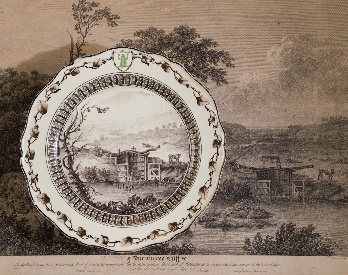
WILLIAMSBURG — A rare pair of related 18th-century objects were recently acquired by The Colonial Williamsburg Foundation (CWF).
The pieces are a creamware plate, made by Josiah Wedgwood as part of a service commissioned by Catherine the Great to be used at her castle and a fine copy of a print engraved by François Vivares after work by Thomas Smith, according to the foundation.
The print depicts Dunnington Cliff on the River Trent in England, which is the motif seen in the center of the plate. By adding the plate to its ceramics collection, the foundation said it becomes one of the few American institutions to own a surviving piece from this famous dinner service.
“Colonial Williamsburg’s collection of British-made ceramics is one of the finest in the United States,” said Ronald Hurst, the foundation’s senior vice president and chief mission officer. “The acquisition of this plate and its printed design source brings new prominence to the collection. We are deeply grateful to the Friends of Colonial Williamsburg Collections for funding both purchases.”
Royal patronage within England and abroad helped Josiah Wedgwood secure a well-respected reputation as a manufacturer of ceramics for all levels of society, according to CWF.
Catherine the Great of Russia was a patroness who commissioned two dinner services from his firm; the Frog Marsh service was the second. It encompassed an astounding 952 pieces, each of which was hand-painted in monochrome with distinct views of England and bore a splayed frog within a shield to signify the name of the palace for which it was made.
To this day, the service remains the most ambitious endeavor by a British ceramics manufacturer. According to the foundation, it was more than a mere dinner service; it was a symbol of British diplomacy and shared with the larger world all that England could offer from ancient architectural ruins to imposing country homes in bucolic landscapes to industrial achievements.
“This plate will be very much at home alongside other important Wedgwood-made holdings already in Colonial Williamsburg’s ceramic collection, including a prized Portland vase and a piece from the Husk service, the earlier service commissioned by Catherine the Great,” said Angelika R. Kuettner, Colonial Williamsburg’s curator of ceramics and glass. “This Green Frog service plate provides so many layers of interpretation for us. Other pieces from the service depicting grand houses are truly lovely, but this example allows us to talk about waterpower in the 18th century and ceramic production, not to mention Wedgwood’s industrial and entrepreneurial influence throughout the world.”
Of the pieces in the original dinner service, the majority remain in Russia today and have been there since their delivery in the 18th century, the foundation said.
To date, there are 26 extant pieces known that were not delivered to Catherine the Great because, as Wedgwood noted, they were either duplicates or considered by Wedgwood not up to his high standard of quality. Of those, 17 are in museum collections, only five of which are in American museums, it added.
This acquisition brings that number to six in museums in the United States; the remaining eight pieces are still privately owned.
The representation of Dunnington Cliff on the plate comes from a 1745 print, ‘View of Dunnington Cliff on the River Trentengraved’ by François Vivares after the painting on the subject by Thomas Smith.
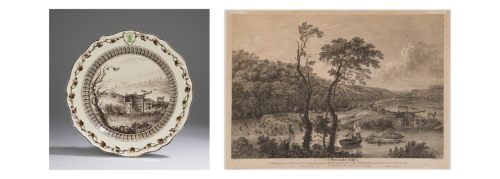
The opportunity for the foundation to acquire both the source print with the hand-painted ceramic plate from the Frog Marsh service is significant, it said.
“Together they tell an incredible story. Prints like this one were imported in the 18th century from England to decorate the walls of Virginia houses and also served as inspiration for an important dinner service used in a Russian Palace. Being able to show a printed design source alongside the ceramic plate helps us draw connections between mediums within the decorative arts,” said Katie McKinney, Margaret Beck Pritchard Curator of Maps & Prints.

