


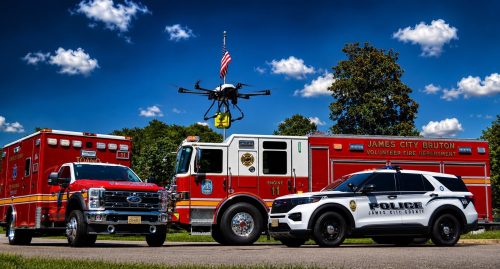
JAMES CITY COUNTY — James City County officials are testing whether drones can deliver automated external defibrillators to cardiac arrest scenes faster than traditional emergency responders after an initial trial showed an AED arrived more than five minutes before firefighters in one test.
The effort is part of the RESTORe-CARE clinical study, funded by the American Heart Association and led by researchers from Duke University and Virginia Commonwealth University. James City County is the first locality in Virginia and the second in the nation, alongside Forsyth County, North Carolina, to participate in real-world AED drone delivery trials.
The program is designed to determine whether drones carrying AEDs can improve cardiac arrest response times in rural communities by delivering AEDs to bystanders before emergency crews arrive.
According to the American Heart Association, every minute defibrillation is delayed decreases a person’s chance of survival by approximately 7% to 10%.
Initial tests have shown shorter delivery times in some scenarios, county officials said.
In one test, the James City County Police Department’s Air10 drone delivered an AED to a residence in 2 minutes and 30 seconds. By comparison, the James City County Fire Department’s average response time to the same location is 8 minutes and 6 seconds, meaning the drone arrived 5 minutes and 36 seconds sooner.
“These early results show what this technology might be able to do for our community,” Police Chief Mark Jamison said in a statement. “This is about using every tool we have to keep people safe. We’re excited to keep learning from these tests.”
Fire Chief Ryan Ashe said the trials could help determine how drones can support emergency responders during cardiac emergencies.
“In cardiac arrest, minutes matter,” Ashe said. “If we can get an AED to a bystander faster, that’s a win. These trials are helping us understand how drones can support our firefighters and medics in real emergencies.”
The project will enter a pilot phase Aug. 1 following the completion of three testing phases. James City County is currently in the final week of Phase 3 testing.
The American Heart Association is covering the cost of the equipment used in the study, county officials said.
During the pilot phase, drone dispatches will be limited to a five-mile radius around James City County Fire Station 1, located at 3135 Forge Road in Toano, and will occur during limited hours as officials evaluate performance, reliability and response times. As testing progresses, the county will explore longer distances, additional drones and potential expansion of the program.
Dispatchers at the Peninsula Regional Emergency Communications Center may deploy both first responders and an AED-equipped drone when receiving reports of suspected cardiac arrest during the pilot. The drone lowers the AED to the ground by tether while dispatchers provide instructions to bystanders, including those with no prior training.
The trials are being conducted through the James City County Police Department’s Drone as First Responder program, which launched in April 2025 after receiving waivers from the Federal Aviation Administration. County officials said the program provides real-time situational awareness during emergencies and does not involve proactive surveillance. Officials also plan to continue educating residents about AED use as the study continues.
Joseph Ornato, a professor in VCU School of Medicine’s Department of Emergency Medicine, said the earlier an AED is used, the better a person’s chance of survival.
“These tests show how drones could give rural communities a critical head start in saving lives,” Ornato said.

