


YORK COUNTY – On Tuesday, the York County Board of Supervisors approved a rezoning ordinance that will create new residential and commercial properties across from Water Country USA.
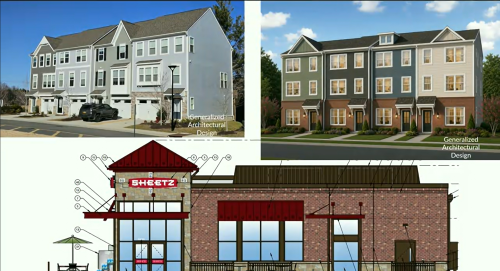
The 4-1 vote approved rezoning an approximately 22-acre parcel at 200 Water Country Parkway for Planned Development Mixed Use. The proposed project, called Marquis Crossing, is projected to have a maximum of 125 three-story townhouse units, a Sheetz gas station and convenience store – with the possibility of an accessory car wash – and an Arby’s.
According to a July 2026 fiscal impact analysis by Ted Figura Consulting, residential units are expected to be priced between $380,000 and $450,000.
In the prepared memorandum, Mark L. Bellamy, Jr., county administrator, noted that the proposed rezoning has several positive aspects, including the potential to bring additional residential development. However, he also expressed concern that the commercial development wasn’t guaranteed to be completed before the residential development. Both he and the county’s Planning Commission recommended the Board deny the application.
Public comment remained mixed: Planning Commission staff received five emails between their July 8 meeting and Tuesday’s Board of Supervisors meeting, with three expressing support and two stating opposition to the ordinance as well as requesting the parcel remained zoned as Economic Opportunity. The county also received two letters requesting the ordinance be denied, though G. Stephen Roane, Jr. from District 4 clarified that the number did not reflect the letters that board members received individually. Chairman and District 1 Supervisor Douglas R. Holroyd said he believed they had received 12 letters on Tuesday.
“The supporting emails cited the potential to increase affordable housing, commercial activity, expand the tax base, attract investment and make better use of existing infrastructure,” Jeanne Carner, senior planner of the county’s planning commission, said. “Other residents urged denial of the proposal, due to concerns about traffic safety, blind curves, litter, crime, overdevelopment, limited walkability and live-work-play amenities and the lack of need for another gas station, given nearby alternatives.”
Several board members took issue with the fiscal analysis commissioned by the county to compare figures submitted by developer Dan Hargett. Carner said that a review – conducted by the firm TischlerBise – of the analysis revealed it had insufficient documentation, understated school operating costs, largely omitted capital facility impact and called its conclusions about school capacity “questionable.” Holroyd noted that the corresponding presentation slide didn’t reflect the review’s updated numbers and pulled from the original fiscal impact analysis.
“It behooves us to do a better job of analyzing the independent reports that come in,” Holroyd said. “I think we have, as a board and as a county, the responsibility to ensure that the information is accurate.”
Another point of concern was the estimated 47 children Marquis Crossing will add to the York County School Division, which would mean an annual cost of $267,375 to public schools based on TischlerBise’s review. The fiscal impact analysis underestimated these costs at $145,000.
Vice Chairman Thomas G. Shepperd, Jr. noted that the addition of the Marquis Crossing children puts the county close to the threshold of needing to invest $30 to $40 million in schools, likely in the form of building a new school. While he didn’t blame Marquis Crossing, he referred to it as “the match to the dynamite.”
Board members also took particular issue with the proposal’s requirement that homebuilder Stanley Martin Homes only be allowed to finish a maximum of 80 townhomes before commercial developer Roka Partners could start working on Arby’s and Sheetz.
“We want to see those economic elements in place long before we get to 80 townhouses,” Holroyd said. “Why are you holding up two businesses?”
Hargett ultimately agreed to the board’s condition that the building sites for Sheetz and Arby’s be ready for construction before any houses go up.
The developer estimated that the project could generate more than $800,000 in annual revenue for the county, according to presented slides. This, along with cash proffered by the developer of $1,360 per residential unit – $850,000 over a five-year period – helped convince the supervisors of the project’s viability.
Roane was the only board member who remained unconvinced and voted against the ordinance.
“I believe there’s a solution here that will be beneficial to the county,” Roane said. “I don’t know if it’s here just yet.”

