


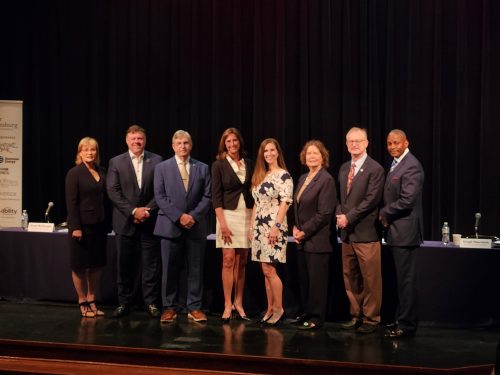
WILLIAMSBURG— The Greater Williamsburg Chamber of Commerce held a Post-Session Legislative Forum with five members of the state delegation regarding the outcomes of the 60-day General Assembly session and the impact on its 2026 Legislative Priorities.
The members of the state delegation present for the forum included Senator Ryan T. McDougle, Senator Danny Diggs, Delegate Jessica Anderson, Delegate Dr. Mark Downey, and Delegate Virgil Thornton, Sr. GWCC says that this program is made possible by its Presenting Sponsor, Angie Bezik and Principle Advantage Government Relations Group, whose commitment to civic engagement ensures GWCC members have a voice in the legislative process.
The forum started with each of the members of the delegation getting three minutes to highlight their reflections following the conclusion of the session. After questions were asked that were more issue-oriented, centered around some of the priorities of the chamber, and some questions that were submitted by attendees.
The 2026 Legislative priorities are:
- Strengthen Career and Technical Education Pathways
- Strengthen Workforce Pathways for Veterans and Displaced Workers
- Invest in a Safe, Reliable, Efficient Multimodal Transportation Network to Meet Workforce Needs
- Enhance Access to Capital and Support for Small Businesses
- Support Policies that Attract and Retain Young Professionals
- Expand Access to Affordable Housing for Virginia’s Workforce
- Maintain a Business-Friendly Climate
Three Minute Summary
McDougle started off the summary starting by noting that attendees would probably hear a very different view of this legislative session among the members of the table. He personally thinks it was a very challenging session.
“By that I mean you’re gonna pay more,” he said. “This was billed as a session that would improve your affordability. Make things cheaper for you. And I think it was one that will make business more expensive and make life more expensive for everybody.”
He continued to highlight the taxes on employees regardless of operation size, power, regardless of if its home or business, and mattresses in the future. He thinks the biggest challenge coming out of the session is the passage of collective bargaining. Because of this, he said all local government employees will be able to unionize and collectively bargain, adding it would be expensive for local and state governments. The cap on tuition from higher education was also removed, which is another issue he found to be impactful.
Diggs said when he began his three minutes, McDougle shared many of the same talking points that he had.
“Depending on your perspective, whether you’re a Republican or a Democrat, the session went well or it didn’t go well. For me personally, I think it went very well. I got a number of my bills out.”
He also expressed that he feels he made a conscious effort to try to vote in a way he felt that the constituents in his district wanted him to vote. For this reason, he feels it is very important that people communicate with their representative, no matter what the issue, as he doesn’t know everything about everything, nor does he have opinions on everything.
Anderson talked about how, as this was her first session, she got to do a lot of relationship building with stakeholders, local organizations, and her fellow constituents. She also echoed McDougle that people would likely hear very different perspectives on how the session went, not only for the party court but also for the House versus the Senate.
“I think what I’m really proud of about this session, there was a lot of legislation. There was kind of a spin to make it anti-business, that is not what it is. It is pro-people,” said Anderson about the first 60 days. “We were really looking at a middle-out economic driver, where we were putting more spending power in the hands of our constituents. At the end of the day, we do want to support and expand and promote our businesses. You cannot do that if the people that reside in their communities do not have access to money.”
Anderson also talked about collective bargaining for public sector workers. She pointed to Connecticut for an example of collective bargaining having been in place since 1963 and expanded to all public sector workers in 1975, which also have 99.4% of small businesses representing the state. With prices going up, Anderson worries that if people do not have increased spending power, then businesses will shut their doors.
Downey found it to be a good learning experience for himself as he learns by observing and does that with his practice. It is with that he feels it’ll make him even more effective going forward. He also points out that he got to know individuals not just from his party but also across party lines.
“I think there’s a lot of collegiality that doesn’t always show up in the headlines and that sort of thing. And most people are very open to having conversations about things,” said Downey. “There’s always flashpoints, but I think at the end of the day, most of the bills most likely to pass have bipartisan support. You only hear the hot topics that come up throughout the session.”
He feels that as a pediatrician and healthcare professional, his main focus was protecting insurance policies that people have for families and businesses. He expressed that if there isn’t a healthy environment or workforce, then no one is going to thrive, whether it is individuals or businesses. He also feels that the legislation passed strengthens the working middle class. He also weighed in on the collective bargaining trend in the three minutes, saying that a point not often discussed is how it usually results in less turnover at businesses.
Thornton said that for him, going up to the general assembly was about affordability and how to make it more affordable while also compromising.
“I went up there with an open mind. An open mind that I’m not going to get much sleep. An open mind that I need to absorb as much information as possible and as quickly as possible to represent my constituents,” said Thornton. “When I go up there, I’m going up there because my constituents sent me for a mandate. And that is a mandate on affordability; to do everything to compromise with whom I need to so that I can bring back affordability.”
He talked about how he introduced 11 bills and six made it across the finish line or are on their way across the finish line. One of the bills he noted was a bill on Veteran Suicide Prevention, and he found this important due to the high number of serving and veterans in the area. He also mentioned workforce development as another part he focused on during these first 60 days.
What did the session/legislation do to strengthen or weaken Virginia’s position as a place to do business?
Anderson opened siting a piece of legislation for a child care assistance pilot program, which has a delayed enactment. She said one of the biggest concerns she’s heard from her business community is that they cannot retain employees due to the cost of childcare. Anderson says this legislation uses both state and business funds to try to ensure people have the ability to keep working and believes it’s a strength.
McDougle says the state has always been ranked high by outside organizations that look at the business climate. He credits this to having a good bond rating policies that affect businesses in a favorable way. He says he thinks Virginia is going to slide with how they rank against other states due to policies passed. He once again brought up collective bargaining as a reason why he thinks it will hurt Virginia’s ability to compete with the surrounding states.
Downey says there are a few big items coming up in the fall, such as the constitutional amendments, that he thinks will make Virginia much more welcoming to a lot of people. A specific example he cited is protected reproductive rights, automatic restoration of voting rights, and marriage equality. He believes Virginia is demonstrating to the country that Virginia is a place where everyone is welcome and valued, and that it will encourage people and families to come here and stay here.
Thornton says some of the legislation passed will make housing more affordable and will expand the supply. The legislation, he said, was passed to work with some localities as far as ordinances to weaken zoning and get a larger supply of housing. He also believes this will impact workforce development as it will bring more talent to the state with more housing.
What came out of this session that will realistically increase housing supply for workers and families, and from a business perspective, what barriers still need to be addressed for economic growth in our region?
Thornton expanded on his previous response, that the zoning would allow housing to be built on some of the land that religious organizations would allow for more housing to be built, increase the supply to meet the demand, and help with affordability. More local to the area, he feels there are some laws that have been around for a while that need to be observed and reassessed to find a balance of what was needed in the past versus what is needed now.
Diggs said that while attempts were made to make housing affordable, he did not feel that anything was done to make any real impact. He says what happened was that all the zoning was taken in every locality and threw them out the window. He says if the governor signs the bill, every piece of commercial property in Williamsburg, York County, and James City County will, by right, have the ability to build multi-family housing. This was already optional, as he cited the Wells Fargo building from last year; however this legislation he says, takes away the choice.
Anderson said there had been a lot of conversation about the HB1279 bill that Thornton is a patron of. She says she personally had a lot of conversations about the bill and arranged for the localities to sit with Joshua G. Cole, the chief patron of the bill to discuss. She also said that in terms of trying to understand that not all localities are the same. She acknowledges there is still a lot of contention, and it is still not perfect, and recognizes that. She also says that the commonwealth is 300,000 houses short and wants to incentivize growth for people coming to the area.
McDougle says that the debate that happened during the session mirrored the points Diggs and Anderson made. He says in James City County, there are thousands of lots that have been approved but not yet built, and the county has made the decision every time that there is an area they want to develop and allow people to build on. He emphasizes that localities are in the best place to make the decision, as opposed to those in Richmond.
What meaningful progress did the general assembly make this year to strengthen talent pipelines, including CTE, Apprenticeships, and employer partnerships, and what additional steps are needed so businesses can fill positions?
Anderson said a few things that happened was Virginia Works announced funds for the Hired Program and the Commonwealth has committed funds for Internships VA. She says that while the budget is not yet agreed upon, in both versions, she asked for nine million dollars for the State Council of Higher Education for Virginia (SCHEV) to dedicate to the Fast Forward program to bolster certification programs and trades at community colleges. She says both the House and the Senate have given double that as it is recognized to be a priority.
Thornton brought up his bill HB772, which authorizes the Department of Workforce Development and Advancement to waive the 40 percent allocation requirement of certain funding under the federal Workforce Innovation and Opportunity Act of 2014 for a local workforce development board that submits a request for a waiver and demonstrates that the board is unable to meet the requirement due to a lack of available training providers in the local workforce development area, a lack of demand for training services among eligible participants or other extraordinary circumstances. The bill requires the Department to develop and publish a process for the application and approval of such waivers.
Diggs said he had a similar bill in the Senate that Anderson had and points out that not everything is political and things can be done together. He said the pieces couldn’t quite get together at the end, but expects to have a bill ready for prime time next session, and that it will do a lot for workforces and businesses.
Downey said he had the privilege of carrying a bill to streamline the Virginia Healthcare Workforce Development Authority, particularly nursing scholarships. Unfortunately, he says it wasn’t ready to be run efficiently, so instead, they are creating a new nursing developmental center to identify programs around the commonwealth to train more nurses, RNs, and advanced practice providers. He says it was money that was already there and not being utilized, and hopes to expand and reach out to more programs around the commonwealth as care shortages are felt across the state.
What are some positive actions to support businesses on the business side?
Anderson brings up HB61 (patroned by Thornton), which focuses on small women and minority owned businesses but sets aside funds to award to certified small businesses. She acknowledges start up capital can be difficult to come across and is excited to hopefully help small businesses expand and give opportunities to people who wanted to start a business but hesitated.
McDougle doesn’t feel like much was done to help small businesses. He thinks that what happened during the session would make life more challenging. He once more brought up the debate about Richmond setting the policy that everyone else has to work under. He thinks legislation that requires paid sick leave and paid medical leave to include small businesses could be impactful to businesses, particularly if the leave is for a long period. He also said that each employee in the business would have to pay a portion of the tax or fee for the policy. He also mentioned on the litigation side that lawsuits could be bundled together to bring class actions, which includes from employees. He says this could make business more expensive and harder to operate.
Anderson jumped back in about the paid FMLA, that if the business has 10 or fewer employees, they do not pay into the system but do benefit from it. She says they are cognisant that incredibly small businesses cannot take on that financial burden, and this was a consideration in the policy. The policy will also not go into effect until December of 2028, with the goal of building up the revenue over the years leading up to it, and is designed to combat employee retention problems.
Downey also added in the session had to address impending cuts to healthcare across the commonwealth. He said if people don’t have healthcare, they won’t be able to come to work and do the job they need, and says family leave is crucial due to the fact that, recalling his own wife having to return to work after six weeks post partum, after not being able to sleep during that time.
Thornton reminded attendees of the height of the COVID-19 Pandemic. He brought up that people tend to go to work sick with COVID or otherwise due to not having time off and choosing between getting better and going to work sick and possibly contaminating others because they can’t afford to take the time off. He says bill HB 5 helps with that.
What progress was made in the session about long-term transportation funding and public transit?
Anderson brought up a joint committee created to talk about the Williamsburg Area Transit Authority (WATA) and how it connects to the Hampton Roads Transit and how to bolster the ability to access services in Newport News and Hampton. Another one extending the transit ridership incentive program to make sure there are more funds, budget pending, for individuals who use the service.
How can state and local partners better align to accelerate trail and outdoor infrastructure projects like the Capital Trail extension?
Anderson thinks the Historic Triangle overall has been a priority in the General Assembly. She notes that she personally loves the trails and prioritizing them in the budget now and in the future is huge, and having the partners that are with Capital Trail, Colonial Williamsburg, and the localities being in the room and saying where the state needs to show up to fill in gaps would be huge.
McDougle pointed out that the budget is not yet completed, and because of that, there is no guarantee how things will go. He said there are efforts he and others have put in to accelerate VDOT fashion funds for the Capital Trail expansion, and these are things they continue to fight for. He mentioned the conversation about the state park system, and some argue that the system should be upgraded and maintained before adding new parts, particularly in Northern Virginia. He said there has been some success with obtaining money for Jametowne Island for maintenance.
What are thoughts on how the state can partner with this region to support visitation and economic growth from a tourism standpoint?
Downey said that with the 250th, there will be an opportunity for a lot of eyes to be on the area. He believes the commission has been working to prepare for that. He mentioned there will be a special session in October in Williamsburg to promote and amplify that. He also mentioned the Sports Complex and the opportunities it brings for sports tourism.
McDougle says the special session in Williamsburg will be a highlight of the 250th celebration, but also mentions there are a lot of events in the region due to how crucial the region was to the founding of the country. He says a lot of funds are raised from the private sector and not just tax dollars, and so he expressed excitement not just for the dates in Williamsburg but also, hopefully, driving Americans to visit Virginia.
What are your thoughts on how localities can plan for the associated costs of collective bargaining, and what the potential implications may be on local budgets and taxpayers?
Anderson says there is a delayed inactment due to the implied initial costs. She also likes to remind people that a lot of people, as she feels most people jump to the dollar associated, that most people just want to have a seat at the table and have conversations about the working conditions and programs beyond the paycheck. She mentioned legislation was also passed that would put more revenue into the pockets of James City County and York County, specifically through admissions.
Diggs says some think Collective Bargaining is a great thing, but recalls his time as a sheriff interacting with other sheriffs who said it was the worst thing that ever happened to them. He said he did not get one email from any locality that supported collective bargaining and the committee hearings that every locality that spoke about it spoke against it, including Fairfax, which had voted to have collective bargaining. He also noted that WJCC schools voted down collective bargaining for their employees. He mentioned concerns not only costs but also as unions become stronger, they start dictating the work day, making the employer essentially a figurehead who had to rubber-stamp what the union demands were.
Anderson commented that she invites Diggs to add state employees and professors in the next general assembly round, as she agreed with a point he made during his conversation that there were people left out of the conversation, which she was also disappointed about. She reminded again that there is a two-year inception date.
McDougle continued off his earlier points and said he feels the reason it was put off until 2028 was that that is when the next election occurs, and no one wants to say, ” Hey, we raised our taxes by $.25.”
Thornton said collective bargaining is nothing more than coming together and having a conversation on pay, work conditions, and benefits. He says they don’t know what that impact is going to be because a conversation is happening to find a compromise. As funding goes, he said they talked about drawing companies to the region, and if companies come to the region, then tax revenue increases. He also brought up workforce development, which means that if more people are working, there are more tax dollars. He added they also needed to be creative with gaming, bringing in venues as well as data centers. He asked what other creative ways they can make to offset costs if they come up, but first, a conversation needs to happen.
Downey said the collective bargaining argument is that collective bargaining is just going to pit the workers against the owners. He thinks to support Thornton’s point that everyone who works for a company wants that company to be successful, but if they don’t have a voice in how the company is run, they’re not going to stay with the company if they don’t enjoy their work. He feels we’re all in this together and we can’t just have one side, and often times its cooperations that have the biggest voice and power, and just want to give the folk that are trying to make headway in their lives a seat at the table. He said its about community, not about us vs them, just making sure everyone is successful, not just one part of the equation.
What is the practical takeaway for business leaders on this referendum on redistricting in terms of timing, process, and potential downstream impact?
Downey said that in his mind they’re trying to do their part to make sure everyone in Virginia has a say in the commonwealth and across the company. He noted that leadership in Washington changes the game and that there is redistricting every ten years, and if people agree with gerrymandering or not, every 10 years it happens. He said one administration decided to change the rules halfway in and Virginia has to respond and if they don’t, they’re going to get cut out of the conversation. He said the measure is temporary and can be discussed again in 2030.
Diggs said temporarily suspending the Constitution should tell people something is wrong. But there are still parts of the constitution that exist, say in the Virginia constitution, that districts will be compact and continuous. He does not believe the proposed districts are all compact in any way. He said, in addition to the biased wording of the referendum, which is against the law, it is wrong in so many ways to temporarily suspend the constitution because we don’t like who the president is. He said other states that may have done this did so because their laws allowed them to do that, but we cannot violate the Virginia State Constitution because we don’t like what other states have done.
Anderson says Texas, North Carolina, and Ohio have made the choice to obey the president and change their current maps to add roughly ten seats that she believes are not true representations of their states. She said while people say it’s just about Virginia, she argues it isn’t. She says Virginia has 11 members of 435, which is 2.5% of the members making federal legislation. She says if they do not respond and give an opportunity to put a level playing field regarding representation with this temporarily, the state will be a mess fiscally. She brings up HR 1 as the primary example, saying it is a constant conversation in budget decisions when it comes to funding Medicaid, SNAP, and housing.
Downey noted the war in Iran and the rising gas prices, on top of tariffs, that if there are two more years of unchecked power in Washington, the costs are going to go up, and the businesses in Virginia are going to get hurt even more.
Thornton said nothing has happened yet. That there is just going to be a vote to put the power in the hands of the people, for them to decide if it is something they want. Not the state, the people. He said the vote is, can they put it on the ballot, nothing else. He brought up DOGE and said that the affordability they are working with now is a result DOGE. He said if they want to have a voice on what happens on the national level that impacts the local level, then that opportunity happens by voting. He also said after the vote, nothing will happen until it gets on the ballot, and then the state decides.
McDougle says being a person who has filed suit in this, he said they let the people decide, but in a way that is illegal to get there and has a vote time frame that is against the Constitution. He says things were done procedurally wrong and lists that Massachusetts, Connecticut, Maine, New Mexico, New Hampture, Rhode Island, and Hawaii, despite some having up to 48% of the population that votes Republican. He says what people should think about what Diggs said, and if you live in western James City County, your representative could come from Alexandria.
Conclusion
“Our Legislative Affairs Committee worked tirelessly to survey our membership and establish clear priorities for the 2026 session. From addressing the housing affordability crisis to strengthening our workforce talent pipeline,” said Terry Banez, CEO, Greater Williamsburg Chamber of Commerce. “The questions raised today reflect the real-world challenges our employers face. We are grateful to our delegation for their transparency regarding the session’s outcomes and for their commitment to keeping Virginia a competitive environment for businesses to grow and succeed.”
The General Assembly will reconvene on April 22 to consider the Governor’s actions on bills and budget items.
For more information about the chamber or the candidates, visit the official website.

