


Kyle White makes art for his work—but not the kind done on paper or canvas, nor with pencils or paint.
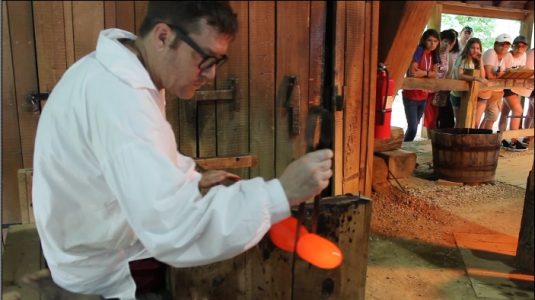
Instead, White makes the kind of art that uses a boiling-hot furnace, some 2,000-degree-Fahrenheit glass, a few tools, and the breath in his lungs — glassblowing.
White had dreamed of having an art-based career since he was a child.
He thought he could be an art educator, a newspaper cartoonist, or even a police sketch artist — all the kinds of careers a “little art kid dreams of doing,” he said.
While today one does not find White sketching criminals or cartoons for his career, he can still be found making art—in the form of glass.
“Any way that I can be creative and expressive…I generally love,” White said.
When White began his four-year apprenticeship at the Jamestown Glasshouse, he considered himself a blank slate. He had no previous glassblowing experience. He had never even seen it done. Now, White has been blowing glass for 17 years.
But the Hampton native who dreamed of an artistic career did not follow a straight line to the Jamestown Glasshouse.
After high school, White joined the National Guard of the U.S. Army, serving from 1996 to 2000.
During his time in the army, White worked in artillery as a cannon crew member. He spoke positively of the experience, and said he knew “pretty much immediately” that he would not make a career out of military service.
“There’s no room for creativity in the military, and that was something that I really required,” White said.
White began studying at Christopher Newport University in 1997. He decided to major in political science and considered becoming a human rights advocate.
Yet after two years of political science classes, White turned the tables.
“I decided that it wasn’t going to be fulfilling,” White said. “And I asked myself: what’s the one thing you’ve always truly loved? And it was art.”
White decided to change course from political science and transferred to Thomas Nelson Community College to study Fine Arts with a concentration in painting.
He was inspired by surrealist works, like those of Frida Kahlo and Salvador Dalí, attracted to their idea that art stems from the subconscious.
Despite having no experience with glassblowing whatsoever, White responded to an ad in the newspaper calling for glassblowing apprentices.
“I didn’t even know what glass was made of when I applied,” White said. “I just thought it would be a fun medium to work in, something creative, something [where] I get to use my hands, and as an added bonus, I get paid for it.”
White said his earliest, “terribly crooked and lopsided” glass pieces are still preserved in his mother’s cabinet, despite his offer to replace them with some of his nicer pieces.
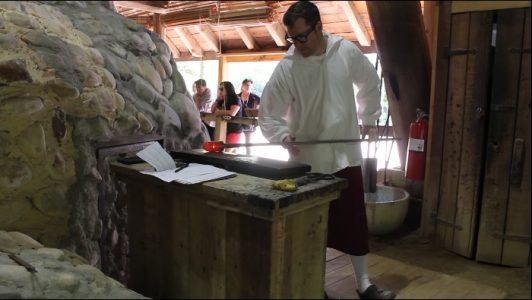
In addition to the art of glass, White learned the history of the Jamestown Glasshouse. White said history was a subject that “always…came easily” to him. During his younger years, his father had taken him to multiple Civil War battlefields and monuments, he said.
Now, White finds himself in a place where his interest in history melds with his art.
“I would say that this is a perfect marriage of the two things that I was most interested in: art and history,” White said. “And it all comes together right here.”
Yet White did not even know, until his interview for the position, that the glasshouse was a site of colonial demonstration.
“I was taken aback at first, but my desire to actually learn this craft kind of outweighed it,” White said. “Now I sort of relish the fact that I’m a glassblower and a historian.”
White is not only a glassblower and historian, but a volunteer and a father, too. White has contributed to the Human Rights Campaign and Hampton Roads Pride organization, including blowing glass at the latter’s annual festival for the past three years.
Outside of his glass work and volunteering, he continues to practice other art forms, like painting and sculpting. However, White often finds himself working with crayon given that he has a set of four-year-old twins—one boy and one girl.
Many kids and adults pass through the Jamestown Glasshouse site, which traces its roots back to 1608. White enjoys seeing visitors’ reactions to the glassblowers’ work.
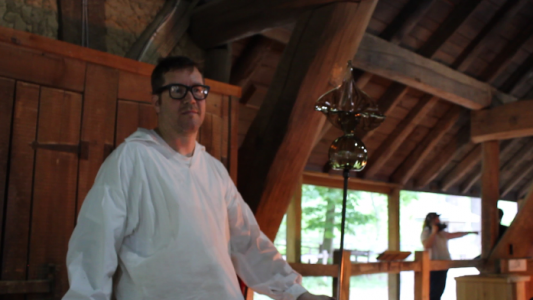
“My favorite part of the job, what I find most rewarding, is definitely seeing the faces of the visitors when they’re actually in awe of something that we do, how mystified that people seem to be when they see us work with the molten glass,” White said.
Working in the 17th-century setting has provided the 21st-century artist not just a creative outlet but also a sense of pride in the legacy he takes part in.
“I’m actually very proud to be part of such a legacy—the very first place in North America that glass was made and I work just a few feet from it…it’s actually an honor to be part of such a legacy,” White said.

