


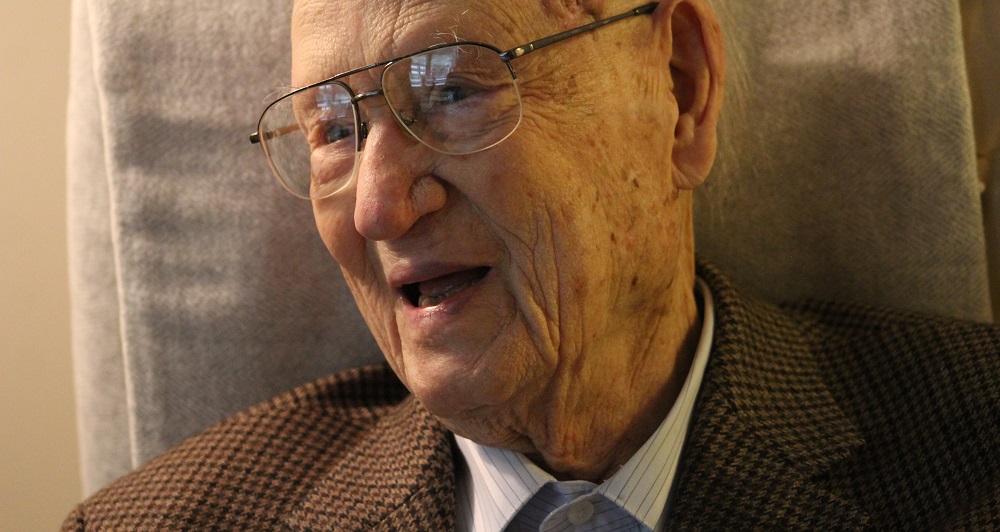
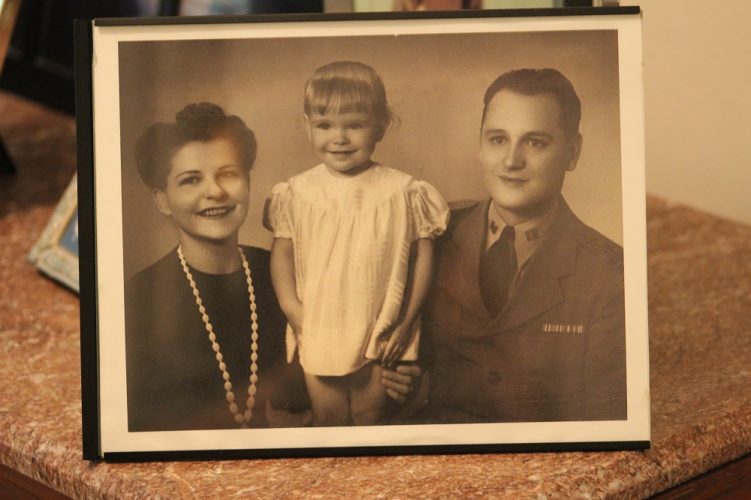
Carl Accola was 27 on July 13, 1942 when he reported to serve in World War II for the U.S. Navy. His wife Geraldine had just gone into labor with the couple’s first and only child.
On July 14, 1942, Accola awoke in Boston, Massachusetts, hundreds of miles away from his expecting wife. He recalled waking up to the words: “Lieutenant Accola, your wife’s just given birth to a six-pound daughter.”
“That’s the first notice I had a child,” Accola said.
One world war and about 70 years later, Accola is now 102. On a recent morning, he sat with his daughter, Kathy Coomer, in his room at Williamsburg Landing. Together they recalled stories of many years ago — of his time in Africa, his ship at Normandy and the occupation of Japan.
A skilled pool player even at age 100, Accola was dubbed “Mr. Impossible” by his friends for his ability to sink improbable shots. It’s a skill not unique to the pool table, Accola has a history of making improbable shots.
Having faced the shores of Normandy, France all the way to Sasebo, Japan, Accola is one of a dwindling number of World War II veterans alive today. After years of worldwide experiences, Accola still remembers his upbringing in the rural town of Canton, Missouri.
Growing up in the 1920s, Accola played sports, went to school, and helped out at his father’s harness-making shop. He later studied law at the University of Missouri in St. Louis and befriended a senator who would one day preside over the war Accola fought in: Harry S. Truman.
“Would you believe that Harry Truman, the president, was at perfect ease to visit with me and bring me along as a kid and took an interest in me that lasted until he died?” Accola said. “Things were different then.”
After graduating in 1938, Accola hitched a ride on a cattle truck to St. Louis, slept out in the yards on a bale of hay and the next morning went to the Standard Oil office to get himself a job.
The company was where he met his future wife, who worked at the switchboard there. The couple married on Sept. 19, 1941, just a few months before a major tragedy struck the U.S.: the Japanese bombing of Pearl Harbor, Hawaii. President Franklin Roosevelt called the day of the attack, in which over 2,000 people died, a “date which will live in infamy.”
The next day, the U.S. Congress declared war on Japan. Accola knew that despite his age and marital status, he would be in the war.
“I didn’t wait to be drafted,” Accola said. “The minute the bomb was dropped, I knew I was gone.”
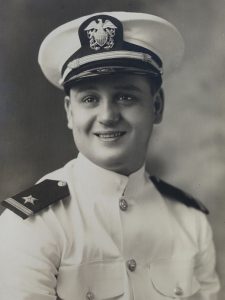
Believing he would be drafted, Accola enrolled as a commissioned officer in the Navy. Accola’s service took him around South America and Africa, where he helped deliver and collect resources for the war effort. Back in Missouri, his wife wrote him letters, updating him about his young daughter.
“It was a lonely situation, having a family someplace else,” he said.
The tides of war turned in June, 1944.
The Allied Powers coordinated a plan, code-named Operation Overlord, to invade German-occupied France. On the first day of the invasion — a day often referred to as D-Day — soldiers spilled out of barges and stormed the beaches of Normandy, France against throngs of German machine gun fire. While the invasion proved successful, it resulted in thousands of casualties.
During the invasion, Accola was a commanding officer in the Naval Armed Guard. He coordinated the approach to Omaha Beach on an old ship, the S.S. Potter. It was lined with explosives, Accola said. The craft was to be deliberately sunk into the water.
Accola’s ship, along with about 10 other ships, were blown up in a line, bow to stern, he said. According to Accola, the sunken ships were meant to create a breakwater in the ocean and calm down the landing area for the smaller incoming crafts.
German gunfire went over their heads, Accola said. He recalled squatting in the ship when the explosion went off. He said the jolt proved greater than what he was told to expect.
“Oh man, I tell you, it threw me…blew me sure up against the wall and the boat had–I thought we’d been hit,” Accola said. “There was dust and dirt going all over the place. But we got it done.”

Over a year after the operation, President Harry Truman allowed U.S. forces to drop two atomic bombs that killed thousands in Hiroshima and Nagasaki, Japan. The bombs acted as an alternative to a potentially deadly invasion, one Accola was set to participate in. Japan surrendered and the Second World War ended with an Allied victory.
Accola described his reaction to the war’s official end with a simple: “Hallelujah.”
“It had been a long time,” he said.
With the war over and a 3-year-old daughter waiting at home, Accola finally had the opportunity to get his sea legs with parenthood.
Nearly 60 years after her father’s service, Coomer returned to Normandy with him. This time around, though, Accola was not helping to create a breakwater with a sunken ship. Instead he was sharing a moment of memory with his daughter alongside him.
“It was pretty amazing…it was a very emotional experience because of knowing what happened there,” Coomer said.
The trip, in celebration of Accola’s 90th birthday, marked the first time Accola visited Normandy since the invasion in 1944.
“It felt like one trip was enough,” Accola quipped.
Today, the Navy veteran–a father of one, grandfather of two, and great-grandfather of four–says family is what he is most proud of in life.
While the centenarian’s balance may no longer be quite as good as it once was, “Mr. Impossible” still appears in good spirits.
After over a century of life, his words of wisdom are simple.
“Enjoy,” he said. “Enjoy.”
Read more profiles of local residents in WYDaily’s section In Our Hometown.

