


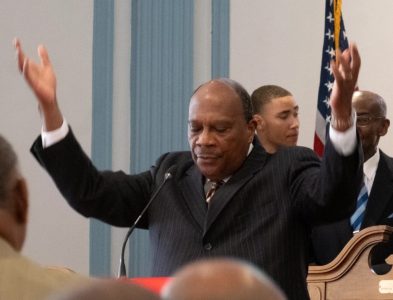
For more than two decades, Rev. Reginald Davis has led First Baptist Church of Williamsburg while preaching a message rooted in faith, justice and the long history of one of the city’s oldest Black congregations.
“I want my legacy to say that Pastor Davis tried to push America to become a more perfect union,” Davis said. “And he tried to push the church, particularly the Black church, more toward the kingdom of God and to be that institution that Christ created when he was here on Earth.”
First Baptist Church of Williamsburg is a state and national landmark and a central institution in the city’s Black community. The church is nearing its 250th anniversary in 2026. It was organized by free and enslaved Black people in October 1776, with roots reaching even earlier, when members met in secret at a time when such gatherings were prohibited without white supervision.
Forgetting that history is something Davis, the church’s 21st pastor, said he is committed to preventing. Through the centuries, First Baptist and its congregation have endured disasters, discrimination and displacement.
“We are still here,” Davis said. “We’re in the soil, we’re in the fabric. You cannot erase us. And we’re going to continue to tell our story, because history half-told is untold. We want to tell the whole story. America has done a great job in hiding a lot of our history, even from us.”
Davis’ story begins in Memphis, Tennessee, where he was raised as the son of a pastor, James C. Davis. He grew up during the Civil Rights Movement, an era that, along with the work of Martin Luther King Jr., had a lasting influence on his faith and vocation.
“I wanted to study more about why a people who have been in this nation for so many years are still marching just to get our citizenship rights,” Davis said. “That should come at birth.”
He began college at a small parochial school in Texas before attending Colgate Rochester Divinity School in New York, where he studied under Kenneth Smith, one of King’s former professors, who taught ethics.
“Since he was still alive, I wanted to make sure that I received that kind of teaching that Dr. King received,” Davis said.
Davis later earned a doctorate at Florida State University, where he met his wife, Myrlene, at Jerusalem Baptist Church. A Haitian woman fluent in French, she helped tutor him while he worked to fulfill language requirements for his doctoral program.
“I said, ‘Oh Lord, I’m struggling with English, much less talking about French,’” Davis said with a laugh. “But because she became my tutor, I was able to pass.”
In 1999, Davis became dean of students at a seminary in Illinois. He joined First Baptist Church of Williamsburg five years later. When he arrived, he learned that his former field director at Colgate Rochester Divinity School, Rev. Leandrew Johnson, had once pastored there.
“He and I would always talk when I was at Colgate and he talked about bringing integrity back to the pulpit,” Davis said. “So when I saw he had been here, I just knew this was the place for me.”
Davis has since become a prolific author and speaker, publishing more than a dozen self-published books focused on the Black church, liberation theology, Christianity’s engagement with power and racial unity.
From the pulpit, Davis often speaks about racism and oppression, arguing that people of faith have a responsibility to confront injustice. He frequently cites Swiss theologian Karl Barth, who encouraged preaching “with the Bible in one hand and the newspaper in the other.”
“Some of the things that the Bible pointed out that would be happening, the newspaper is printing in real time,” Davis said. “A pastor’s job is to warn the people, prepare the people, encourage the people and help them live lives of faith.”
Davis said that responsibility feels even more urgent amid ongoing national debates over voting rights and efforts to remove or limit certain historical narratives from public education and federal sites.
But he said the responsibility to speak out should not fall only on Black churches.
“Until the white church gets out of bed with the power structure, with the elites, and comes over and really joins Jesus Christ, I think that we’ll see a difference,” Davis said.
Seeing little engagement from many predominantly white congregations, Davis said he and other Williamsburg-area pastors began exchanging pulpits about five years ago in an effort to foster understanding and connection between congregations.
“The kingdom of God is not going to be just one color,” he said. “It’s going to be a multitude of people — all nationalities, all tongues. We have to start demonstrating it here.”
For Davis, that work reflects a broader philosophy of leadership rooted in example.
“Now, would that permeate throughout the nation? We hope so,” he said. “The only thing we can do is be the example that we wish to see in other people.”

