


The school bus has shown up late every day so far this school year for eighth-grader Emily Radosta.
School starts at 8 a.m., but by 8:10 a.m. Emily is still waiting for her bus to arrive and take her to Berkeley Middle School.
Emily is one of many students throughout the Williamsburg-James City County School Division who have been affected by a shortage of school bus drivers.
But Emily’s not your average student, she has autism, which means she needs a little extra time and routine to do well in school. Getting there on time is just the beginning.
Emily’s problem of trying to get to school isn’t hers alone. She is one of many students throughout the Williamsburg-James City County School Division who have felt the pain of a lack of school bus drivers.
The shortage of bus drivers isn’t confined to Williamsburg, or even Hampton Roads — it’s a problem affecting families throughout the country.
Demand for bus drivers up, wages not so much
Nationwide, there has been an increase in demand for bus drivers of all kinds, according to the Bureau of Labor Statistics.
“Job opportunities for bus drivers should be favorable, especially for school bus drivers, as many drivers are expected to leave the occupation,” reads a report on bus drivers from the Bureau of Labor Statistics. “Those willing to work part-time or irregular shifts should have the best prospects.”
In 2017, growing demand for bus drivers can be found in elder care communities, as well as places with private and charter schools, and localities with transportation companies. Such a rise in demand could lead to scarcity in the market, according to James Madison University Professor of economics Bruce Brunton.
Brunton said it was “common sense” the shortage of bus drivers would continue “unless the wage rate goes up.”
“They’re going to go where they can make more money,” Brunton said.
Nationwide, there is an increasing number of job openings for school bus drivers. Over the next seven years, nearly 20,000 of the positions will be added to the country’s economy, according to the Bureau of Labor Statistics.
The graph above shows the number of projected school bus driver jobs nationwide in 2024 compared to the number of school bus driver jobs nationwide in 2014.
Only 72 of the 20,000 positions added will be in Hampton Roads, according to a report from the Virginia Labor Market Information database.
Throughout the Historic Triangle, the shortage of bus drivers reflects a national trend: lower wages and training requirements can keep wanna-be bus drivers off the road, according to the Bureau of Labor Statistics and Professor Brunton.
The bus driver shortage is causing some buses to pick students up later than normal, according to Williamsburg-James City County School Division spokeswoman Betsy Overkamp-Smith.
“As drivers and students get into routines, we expect the delays to diminish in number,” Overkamp-Smith said in an email.
Still, bus driver shortages aren’t new to the Historic Triangle
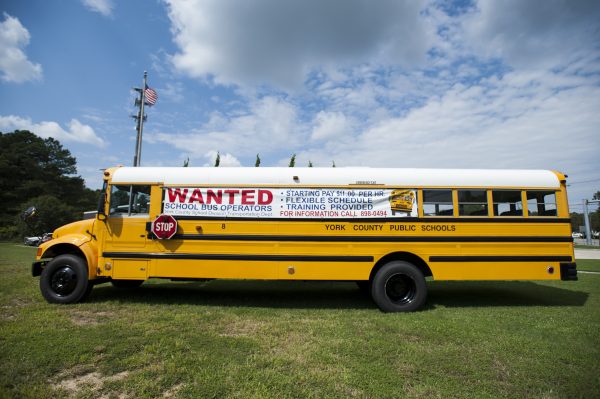
Last year in York County, there was a shortage of bus drivers after the flu season had a higher than normal number of drivers calling out sick, according to York County School Division spokeswoman Katherine Goff.
Parents in York County were outraged, but so far this school year the division has made progress on its shortage of bus drivers, Goff said.
“The division has taken steps to help improve reduce driver shortages for daily routes, such as restructuring our bus routes to reduce the number of runs made each day and working with schools to reduce the impact of special event needs during daily bus route times,” Goff said in an email.
The division currently has 137 bus drivers for 125 routes, Goff said. The division is still looking to hire at least nine more bus drivers.
So far this year in Williamsburg and James City County schools, parents have been publicly speaking out about buses not arriving on time — or worse, not arriving at all.
One parent, Whitney Tait, said her son Kellan’s bus to Stonehouse Elementary School never came on Thursday morning.
“There’s no communication from Transportation when buses run late,” Tait said of the division’s busing department. “There’s no communication, until it’s too late, from the school that the student isn’t there. It’s all very frustrating.”
Kellan’s bus has arrived nearly 30 minutes late every day so far this school year, Tait said.
“This is three weeks in, and there is absolutely no excuse,” Tait wrote in an email.
Money talks
In both divisions, hiring and retaining bus drivers can be a hard task.
The York County School Division still has long-term openings for bus drivers, and the number of bus drivers can vary month to month and year to year, according to Goff.
The Williamsburg-James City County School Division has 111 bus drivers for 131 routes, according to Overkamp-Smith. The division is still looking to hire at least nine more bus drivers.
Wages for bus drivers are significantly lower than the national and area averages in both the Williamsburg-James CIty County and York County school divisions.
In York, a full-time school bus driver makes between $8,918 and $17,836 in a starting position before taxes. In Williamsburg and James City County, a full-time school bus driver earns $11,179 and $14,148 in a starting position before taxes.
The graph above uses data acquired from area school division’s websites and spokespeople as well as data from the Bureau of Labor Statistics. The data shows the starting wage for school bus drivers.
The national average for a bus driver is about $31,750, and the average pay for a bus driver in the “Norfolk Area” is about $30,000, according to online salary website Glassdoor.
Given the regional and national wage disparities, bus drivers are going to work where they can make the most money within certain circumstances, Brunton said.
Lower wages can lead to employment shortages such as the shortage of bus drivers in both school divisions, according to Brunton.
Missing out on an education
Meanwhile in James City County, Emily Radosta sits and waits. It’s become part of her routine each morning as she waits for her late bus. She frets about missing her first-block English class.
“She was actually crying today because they have testing that shows where they are in terms of the subject,” Emily’s mother Susan Radosta said. “She was scared she was going to miss it because of her bus.”
Last year, Emily was late to her Standards of Learning tests because of a late bus, Susan Radosta said.
The late buses are affecting Emily’s education, but they’re also affecting her entire English class as the teacher has to hold off on course instruction until Emily arrives, Susan Radosta said.
The division says it is working toward hiring more bus drivers so students such as Emily Radosta and Kellan Tait can get to school on time.
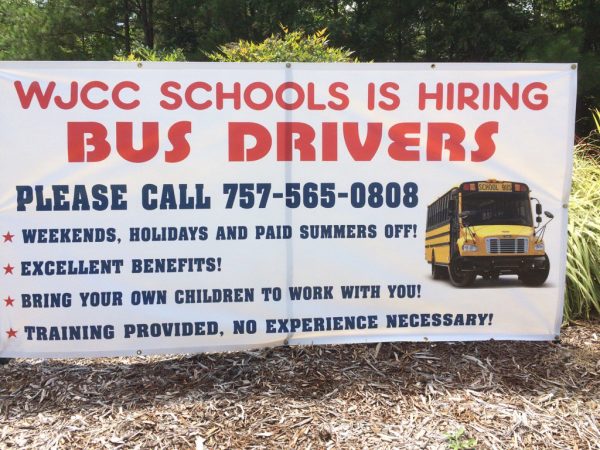
Overkamp-Smith said the division is advertising the openings for the bus driver positions in area news outlets as well as online job posting sites.
On Sept. 5 the division hired three new drivers, Overkamp-Smith said.
That’s a small comfort to Emily who found out three weeks into school that she had been assigned homework at the start of class — a start she had missed each day, her mother said.
“We are at the busses’ mercy,” Susan Rodosta said.
Correction: This article previously used a mathematical calculation which inflated the wages of bus drivers. The annual wage ranges of school bus drivers are, in fact, lower than previously reported. This article currently uses the following mathematical equation: hourly wage x number of hours worked daily x number of state mandated school days per year.

