


The United States will be preparing for sun this weekend, but it has nothing to do with the beach. Americans will be rushing to buy specialized glasses, make travel plans and scout out viewing spots for this year’s solar eclipse.
While solar eclipses can be seen from Earth every few years, Monday’s eclipse is particularly special for the U.S. – it is the first total solar eclipse to pass over America in nearly a century.
Scientists, William & Mary astronomy enthusiasts, and everyday citizens are gathering together to view the eclipse – some traveling thousands of miles to places like Nebraska and South Carolina – others are planning to view events right here in Williamsburg.
The solar eclipse’s 60-mile-wide path will arc from Oregon to South Carolina – meaning only a select few Americans will get to view the eclipse in its totality.
In Williamsburg, however, the sun will still be 85-percent covered during the eclipse. William & Mary art and art history lecturer Michael Gaynes has helped organize viewing events on campus.
For those in other areas, the York River State Park, James City County Library, and Tabb Library are also hosting viewing parties. A limited number of solar viewing glasses will be given out at each event.
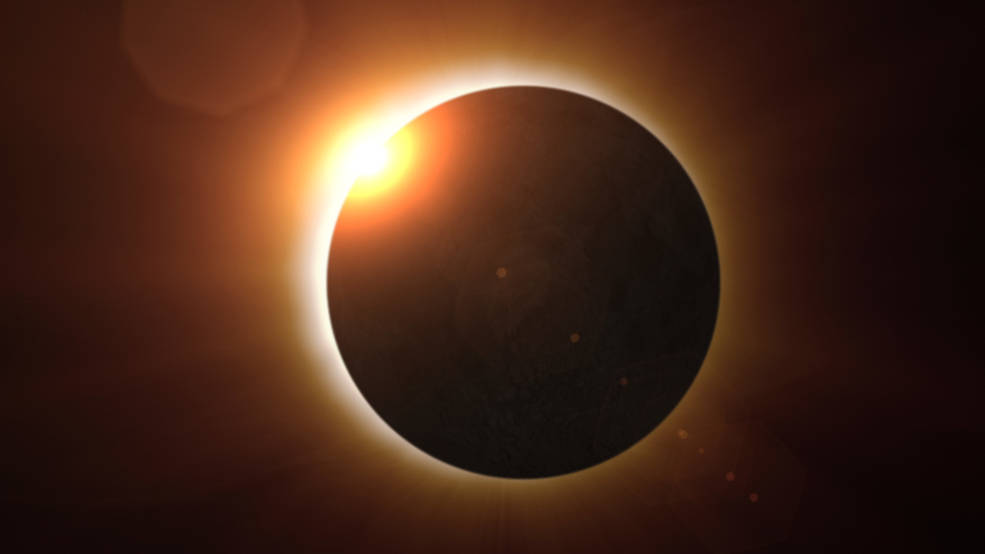
The total eclipse — when the sun is completely covered — is estimated to last about two and a half minutes in Williamsburg, although eclipse will total about three hours long from start to finish.
“With only two and a half minutes… it always feels like seconds,” said Chris Benner, a retired William & Mary physics professor.
Solar excitement in Williamsburg
About a year ago, William & Mary physics professor Joshua Erlich started a working group to prepare for the eclipse. Students and faculty were both welcome to join, but very few students got involved. After a few meetings, the group came to a halt.
Now, the Solar Eclipse Working Group is back, headed by Gaynes. Erlich is also involved with the group but is not leading it.
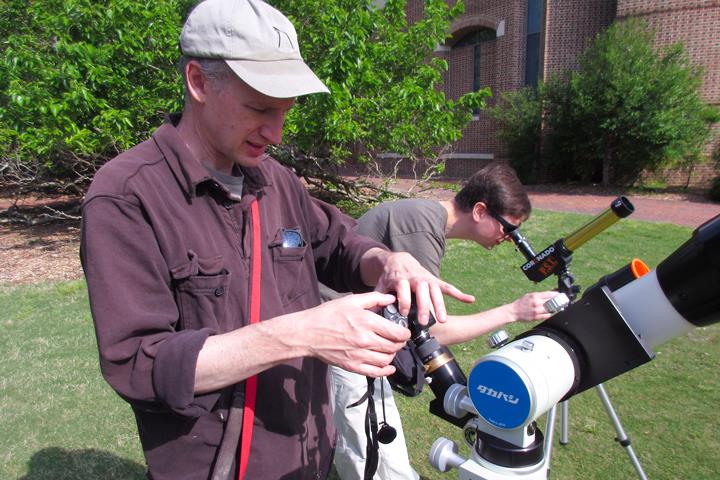
Gaynes said he has volunteered to set up his two properly filtered telescopes for viewing. In Williamsburg, the eclipse starts at 1:19 p.m., reaches the maximum coverage at 2:45 p.m., and ends at 4:05 p.m., Gaynes said.
“We are expecting a fairly low-key affair since we won’t be experiencing totality, but interest is very high,” Gaynes said. “We’ve chosen to set up in front of SWEM library, appropriately, at the sundial. Because there will be new faculty orientation at that time, we hope to draw them in throughout the eclipse.”
The group will set up in front of SWEM Library at the sundial, which is located behind Phi Beta Kappa Hall.
For those unaware of the solar event, it may just appear as if the sun went behind a cloud, Erlich said.
The public is also invited to attend the viewing at William & Mary, although finding parking on campus can be difficult, Gaynes said. Visitor parking will be available on level 3 of the Parking Deck at 201 Ukrop Way, according to a William & Mary news release.
There will also be a few eclipse-related activities, the release said. Gaynes said he might set up some pinhole viewers as well.
From all corners of the U.S.
While Williamsburg residents are enjoying the solar eclipse, some folks are traveling to areas where they can see the eclipse in its totality.
Other William & Mary faculty are traveling for the eclipse. Erlich and Benner are traveling to opposite sides of the country. Erlich will be in Charleston, S.C., and Benner will be in western Nebraska.
Erlich’s research is not focused on astronomy, but he enjoys it as a hobby. Benner’s research, on the other hand, focused specifically on astronomy, including on “molecular spectroscopy in support of studies of the atmospheres of planets,” Benner said.
Benner is traveling with a DSLR camera with a telephoto lens, a tripod, a couple pairs of binoculars and a filter for the camera lens.
Erlich said he doesn’t recommend traveling at the last minute to see the eclipse, as others are also likely to be traveling as well.
Benner, who reached eastern Nebraska Tuesday night, said the hotel he stayed in was booked to capacity. Many other hotels in the path of the eclipse, he heard, were also booked. Some hotels even raised their room prices for the eclipse weekend, he said.
Don’t get blinded with science
Another major concern, beyond traffic, is the potential damage to eclipse viewers’ eyes.
“Some people damage their eyes if they’re not careful,” Erlich said. “Staring at the sun, even if it looks dimmed, there’s still UV and infrared light that can damage the eyes.”
Erlich warned that not all eclipse-viewing glasses are authentic and safe eclipse glasses. Solar eclipse glasses should be labeled as “ISO 12312-2” compliant, which will keep viewers’ eyes from being damaged.
Erlich recommends Celestron or Rainbow Symphony brand glasses. Even with the proper glasses, however, viewers should not stare at the sun for minutes at a time, Benner said.
“I’d like to emphasize people should not look at the sun directly,” Benner said. “I made the mistake, when I got the eclipse glasses, of taking them off before looking away from the sun… Make sure you look away first.”
Benner has several alternatives to looking at the sun directly through viewing glasses. One option is a pinhole projector, another is a binocular projector.
With the large lenses of binoculars facing the sky, binoculars can project an image of the sun onto the ground. When focused correctly, the binoculars can project a very detailed image of the sun.
Similar to early versions of cameras, viewers can poke a pinpoint hole in a piece of thin cardboard and use it to project an image of the sky on the ground.
Eclipse enthusiasts must be cautious when using binoculars for an eclipse.
Using binoculars incorrectly is also another, lesser-known, issue with solar eclipses. Erlich does not recommend looking through binoculars at all, but if a viewer wants to, they must put solar filters on the large front lenses of the binoculars.
Without solar filters on the front, binoculars can magnify the sun’s light more than staring at it directly, he said.
Studying the sun
Solar eclipses are a prime time to study the sun’s corona or outside layer, but are also valuable for other areas of scientific research, Benner said.
During an eclipse, the sun’s corona becomes far more visible than it is when the central, hotter part of the sun is not covered.
The corona, the ray-like aura around the sun, is about one million times dimmer than the sun’s surface, and difficult to see without a solar eclipse.
In 1915, Einstein developed his Theory of General Relativity, which predicted that light passing through gravitational fields will bend, Benner said.
Experiments during a solar eclipse in 1918 revealed Einstein’s theory was true, he said.
“There has been a lot we have learned over the years from eclipses,” Benner said. “A lot of questions have been asked.”

