


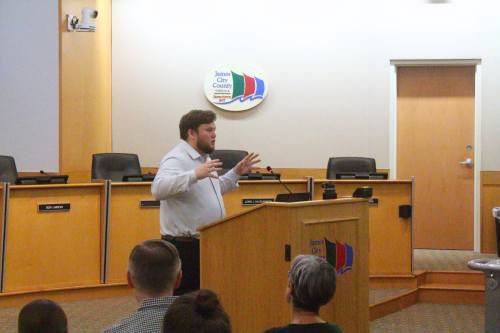
JAMES CITY COUNTY—On Monday night, James City County presented the first of many plans to improve water quality in the city’s watershed, starting with College Creek. Residents and environmental groups pressed county officials on how much they can accomplish without help from upstream neighbors.
The Oct. 26 meeting was the first public session for the College Creek Watershed Management Plan, which the county is developing with consultant agency Stantec. Environmental consultant Brendan Player of Stantec said the goal is to find where stormwater controls can be repaired or upgraded within the watershed, where precipitation, snowmelt and rain drain and often become areas of recreational use.
“Ultimately what we’re trying to do is look for opportunities to retrofit and stabilize stream systems and BMP’s [Best Management Practices]…that are going to help to improve upon the water quality within the watershed.”
Player said the team has mapped the watershed and modeled nutrients and sediment, using the growth projected in the county’s 2045 comprehensive plan. Crews last week assessed stormwater facilities and residential and commercial sites across the area, including 19 stormwater facilities in College Creek.
Early findings suggest older neighborhoods often lack modern controls, while newer ones can still be hotspots because of fertilizer and runoff. The plan is due in 2027, with a draft open for public comment and a second public meeting this spring.
In response to whether this venture it would restrict development near the creek, Player said it is meant to adjust for planned growth, not steer it. Director stormwater division Toni Small added that it does not override floodplain, Resource Protection Area or other existing rules.
When asked whether hotspot locations would be public. Player said the draft plan will be released, but he wasn’t sure how much site-level detail it would include. Tidal waters such as the James River are outside the plan’s scope, he said.
Residents also asked whether it’s worth investing in this project if runoff keeps flowing in from Williamsburg and the College of William & Mary, outside of the James City County jurisdiction.
“All of our modeling, everything is focused on the watershed as a whole,” said Player. “The management plan itself, and in terms of our recommendations, are focused on James [City] County.”
Small said the county can act only within its boundaries but can share data and work regionally on common goals.
Amanda Guthrie, assistant director of coastal restoration for the James River Association, closed the discussion by asking how stormwater improvements would address sewage entering College Creek from an unidentified source.
She said separate testing by JRA and the Hampton Roads Sanitation District found evidence of contamination that they suspect may originate from a leaking sewer within Williamsburg’s jurisdiction. The association’s monitoring this summer found College Landing met bacteria standards just 6% of the time.
Player said the plan focuses on runoff, not single-source problems, but asked her to share the data so it can be considered.
In an interview with WYDaily, James Riverkeeper Tom Dunlap said he has prioritized outreach to Williamsburg because the evidence collected so far points more toward the city, though investigators have not identified the specific source of contamination.
He said he contacted city parks and recreation staff about unusually high bacteria readings shortly before Memorial Day weekend, then reached out to public works staff, who referred him to department leadership.
Williamsburg parks and recreation director Robbi Hutton said she was unaware of any contact between her department and JRA.
The county is seeking public input as it develops the plan. Residents can share concerns and observations about flooding, erosion and water quality through the College Creek watershed planning website. A draft plan will be available for public comment, with a second public meeting planned for the spring.

