


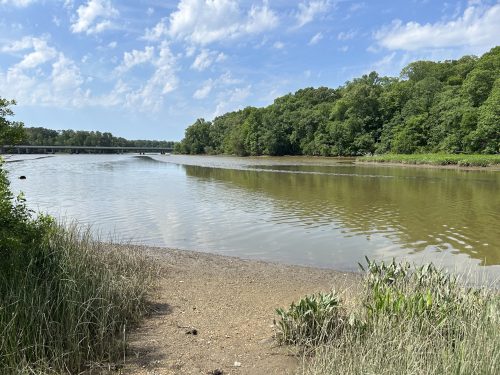
WILLIAMSBURG—Two Williamsburg-area waterways have recorded persistently elevated bacteria levels, raising questions about possible contamination sources as the James River Association calls for further investigation.
According to the James River Association’s 2026 James River Watch recap that came out Sept. 15. samples from five Williamsburg-area sites met recreational bacteria standards 61% of the time, compared with approximately 87% across the watershed. The local results were driven largely by poor readings at Powhatan Creek and College Landing. The other three area sites had a combined passing rate of 94%.
Michael Gillert, James River Association’s geographic information systems and water quality program manager, said the two local sites show problems extending beyond a single summer.
“Powhatan Creek is consistently having elevated levels of bacteria, [but] not nearly at the level that College Landing is seeing at times,” Gillert said.
Monitoring at College Landing began in 2021, and the site has shown poor results throughout that period, he said. Powhatan Creek monitoring began in 2015, with passing rates declining sharply beginning in 2019.
“For College Landing and Powhatan Creek to be at 6% and 19% is clearly indicative of some sort of persistent issue,” Gillert said.
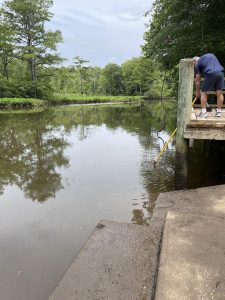
Gillert said the five Williamsburg-area JRA sites produce Tier III data, described as one of the highest levels of data collection accepted by Virginia for citizen monitoring programs.
For people planning to swim, paddle or fish, those differences underscore the importance of checking conditions at the specific place they intend to visit. Harmful or high levels of bacteria in recreational watersheds can be highly harmful to human health, especially those who are immunocompromised.
James Riverkeeper Tom Dunlap said the program measures bacteria as an indicator of waste contamination that could signal the presence of harmful pathogens.
The association compares bacteria levels with the Virginia Department of Health standards for recreational use. Exceeding those standards indicates increased potential risk, particularly for activities involving submersion and for children, older adults and people with weakened immune systems, Dunlap said.
“What we’ve got to do is think about our sampling as a snapshot, and think about this data in its totality,” Dunlap said.
James River Watch samples every Thursday between Memorial Day and Labor Day, regardless of whether it has rained.
A sample reflects conditions when it was collected, rather than guaranteeing conditions will remain the same throughout the weekend. Rain and other changes can affect bacteria levels, Dunlap said.
Randolph Chambers, a William & Mary biology professor and director of its Keck Environmental Field Laboratory, monitors the College Creek watershed. He said his team collects data from 24 locations during non-storm conditions, when bacteria levels typically are lower.
“As a result, we don’t see elevated fecal coliform levels at College Landing,” Chambers wrote in an email. “I don’t doubt the JRA data; we just happen to sample when the discharge of bacteria from the watershed is low.”
Chambers explained that rain flushes material from the surrounding watershed into streams. He said contamination can come from multiple areas—runoff from roads, parking lots, animal waste, and other leakage—making a specific source difficult to locate.
Dunlap said source-tracking work with Hampton Roads Sanitation District detected a human-waste component in samples from the College Landing area coming downstream. The specific origin remains unidentified.
Possible explanations include leaking sewer infrastructure or failing septic systems, he said, but those possibilities have not been established as the cause. Beyond informing the public, JRA hopes the findings will lead to an investigation and corrective action.
“I’m afraid unless we track down the source of what’s going on, we’re going to continue to get high readings here,” he said.
Dunlap said he has prioritized outreach to Williamsburg because the evidence collected so far points to a possible contamination source within the city. He said he contacted city parks staff about unusually high bacteria readings shortly before Memorial Day weekend.
Williamsburg Parks and Recreation Director Robbi Hutton said she was unaware of any contact between her department and JRA. City communications director Nicole Trifone also said she was unaware of such contact.
James City County has been more responsive, Dunlap said. Amanda Guthrie, the association’s assistant director of coastal restoration, attended the Oct. 26 public meeting on James City County’s College Creek Watershed Management Plan, which the county is developing with consultant Stantec.
Guthrie told officials that independent testing by the JRA and HRSD had found evidence of human waste in the creek. She asked how stormwater improvements in James City County would help if sewage was entering from an unidentified source upstream, most likely in the Williamsburg portion of the watershed.
HRSD environmental scientist Kyle Curtis said the agency recognizes the burden source-tracking efforts can place on local governments. “I recognize that we’re putting a little bit of a burden on the locality by doing this … so to try to fix that, we’ve created this reimbursement program,” he said. Through the program, HRSD will reimburse localities for 100% of repair costs once a contamination source is identified
Brendan Player of Stantec said their plan focuses on runoff-related pollution such as fertilizer, pet waste and drainage changes, rather than single-source problems like a leak. He asked Guthrie to provide her data so it could be considered in the planning.
Stormwater division director Toni Small said the county’s recommendations can apply only within James City County, but the county can share data and work with neighboring localities on common goals. The plan’s final recommendations are expected in 2027.
Dunlap pointed to Richmond’s Chapel Island as an example of what cooperation could accomplish. After JRA reported poor readings, Richmond’s Department of Public Utilities identified a sewer line improperly connected to stormwater infrastructure and addressed it, Dunlap said.
The site’s passing rate rose from 29% in 2025 to 69% this year, according to the recap.
“That evidences what a successful partnership could look like,” Dunlap said.

