


Before Williamsburg was a city, it was a plantation. Middle Plantation to be precise. In 1698, after a fire destroyed the Jamestown Statehouse, the first representative government in English-speaking North America decided to move the colony’s seat to Middle Plantation, soon to be renamed Williamsburg.
On May 18, 1699, the colonists resolved to build the first American structure to which the word “Capitol” was given. It was constructed around two giant H-shaped frames, each one 75 feet by 25 feet in size.
Two buildings, connected by an arcade, housed the General Court, the colony’s secretary, the Council Chamber, the House of Burgesses and its clerk. The entire structure, each classically corniced room, was financed and constructed by slave labor.
When construction of the Capitol began in 1699, a tax was placed on imported African slaves to pay for the building. Its foundations were dug by slaves. Bricks were molded, fired and laid by slaves. The walls where the seeds of democracy would be planted were constructed by slaves.
It’s a fact the nation’s largest living museum, Colonial Williamsburg, has increasingly tried to address over the past 38 years.
While other Virginia museums such as Mount Vernon and Monticello have moved to offer tours dedicated to the history of slavery, Colonial Williamsburg has taken a different approach to addressing slavery in the colonial context.
One of the people on the front line of bringing the reality of slavery to the masses is Ted Maris-Wolf, Colonial Williamsburg’s vice president of education, research, and historical interpretation.
“The history of slavery in Williamsburg is inseparable from the development of the Capitol of Virginia from 1699 until its move to Richmond in 1780,” Maris-Wolf said.
The problem for Colonial Williamsburg may be that they are telling visitors truths they don’t always want to hear. For example, in 1776, half of all Williamsburg residents were enslaved.
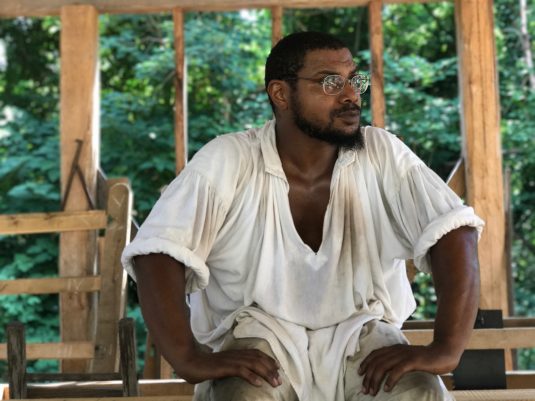
Ayinde Martin, 37 of Hampton, has worked as a journeyman carpenter in Colonial Williamsburg for nearly a decade. Over the years, Martin has prepared an answer for the question he says he never gets: “Who would be doing this work?”
He’s ready to tell the story behind the construction of Williamsburg — an area that could not have been built or grown as fast without many enslaved hands cutting wood, laying foundations, or mixing mortar.
“They built the country,” Martin said. “They built the colony. They built this town.”
It’s a reality of the town’s history that guests tend not to address, he said.
“There’s not a whole lot of people that want to talk about slavery,” Martin said. “That’s something I wish people would ask more about, instead of ‘Gee, do you wish you had a circular saw?’”
Few industries in Williamsburg had as many slaves as the carpentry business, according to Colonial Williamsburg’s master carpenter Thomas “Garland” Wood.
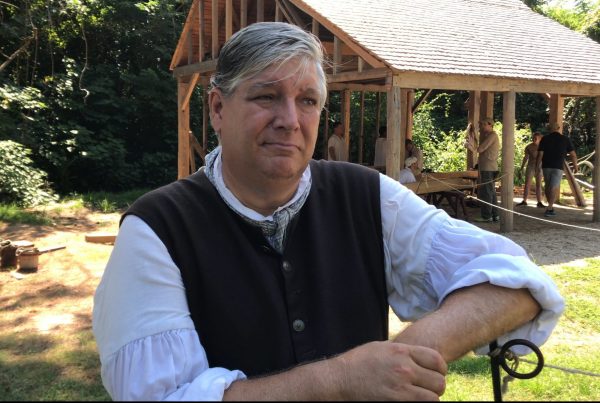
At age 57, Wood has spent three and a half decades working with lumber in the Historic Area. In the intervening years, he has devoted his life not only to his craft, but the history of woodworking in Williamsburg.
According to Wood, enslaved African Americans represented a majority of trade workers in Williamsburg, from lumbermen, carpenters, joiners — skilled workers who joined pieces of wood without the use of a traditional fastener — and sawyers.
As part of their work, the Foundation’s historical interpreters all receive training on “the Williamsburg story,” according to Maris-Wolf. They are trained to answer questions about the history and legacy of slavery.
“That story includes African American history, the history of English colonization, and the continuing story of America,” Maris-Wolf said.
However, in the past Colonial Williamsburg has inspired simultaneous outrage and interest at its various historical interpretations of slavery. The Foundation has been caught in a perpetual catch-22: address the horrors of enslavement in an accurate way or sanitize them for the public.
Twenty-three years ago, the Foundation sponsored a mock slave auction which drew ire from groups across Virginia and the nation.
“Our phones have been ringing off the hook,” Salim Khalfani of the Virginia branch of the National Association for the Advancement of Colored People told the New York Times. “The consensus is that people are outraged at what they’re doing in Williamsburg.”
Yet, Wood and other lumber-tradesmen at the carpentry yard say addressing slavery is part of their mission to keep history alive. The yard is designed with a saw pit at its heart: a typical sight in areas with large numbers of slaves, Wood said.
Unlike the lumber mills of New England, which utilized consistently flowing streams and rivers to power the saws, the saw pits of the Mid-Atlantic — including Tidewater Virginia — were powered with bare hands and muscle, Wood said.
“Just like today when you see a house being built, you don’t know the guy that cut the tree down or the men that drove the trucks to move the materials or the guys who operated the saw mills,” Wood said. “We don’t know the names of the laborers that dug the cellars or made the bricks or made the shingles. That’s another part of history that we’re trying to bring back to life.”
Roberts may be reached at [email protected].

