


The pieces are falling into place to widen Interstate 64 to Lightfoot, but the funding for the multibillion dollar project to add lanes between the Historic Triangle and Richmond suburbs remains elusive.
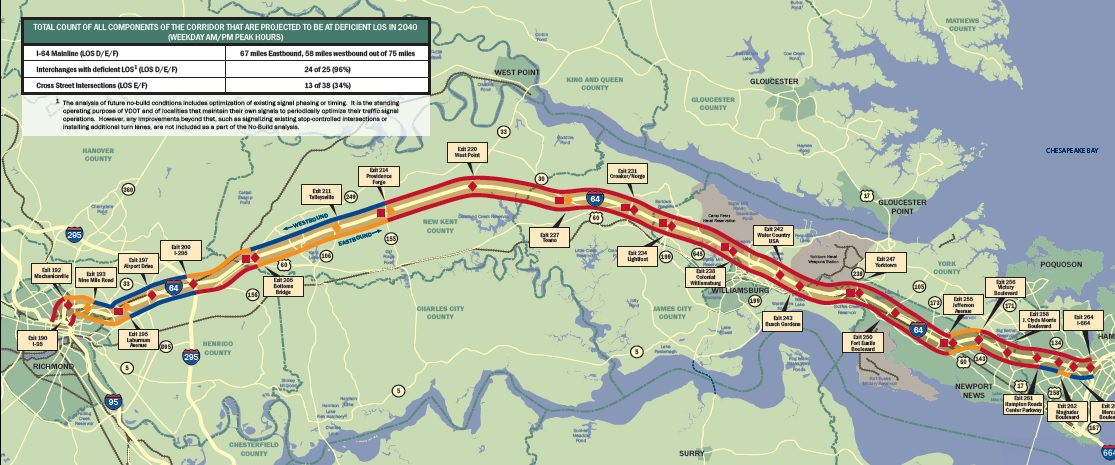
The stretch of I-64 from Lightfoot to Henrico County where the road again widens was designed more than 50 years ago to handle far less traffic than currently uses it, according to a 2013 study of the road and its needs. Current projections show almost all of I-64 from downtown Richmond to the Interstate 664 interchange in Hampton will not be able to accommodate future traffic levels.
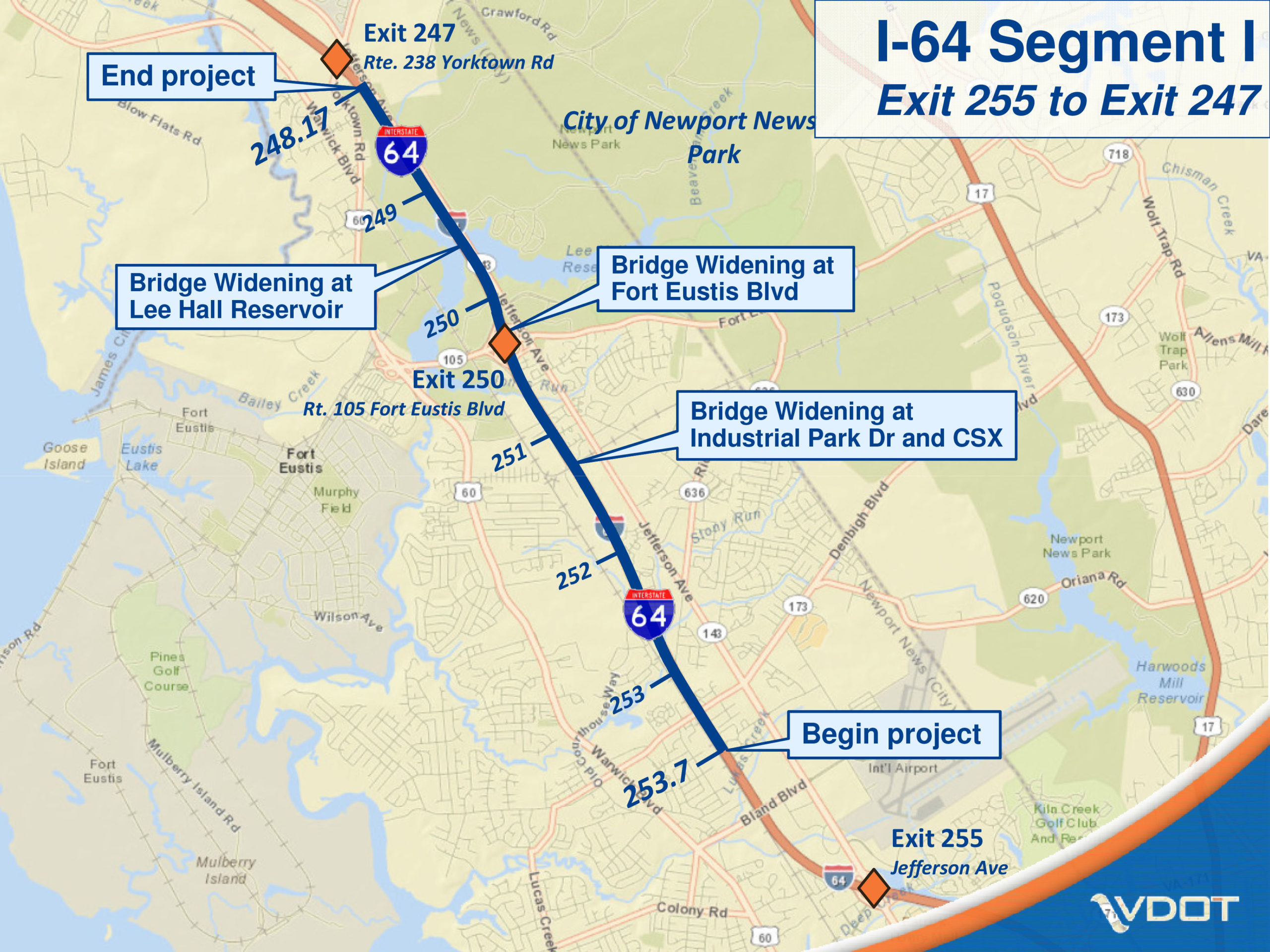
Help is on the way for the area from Newport News to Lightfoot, where the road will be widened to six lanes in the coming years. Funding is already in place to widen from Jefferson Avenue (Exit 255) to near Lee Hall (Exit 247), and traffic planners are confident the money will be available in the next few years to widen from there to Lightfoot (Exit 234).
A Local Demand
The money to pay for more lanes past Lightfoot has not been identified, and unlike the funds paying for the widening to Lightfoot, there is far less certainty whether that money will be available in the coming years. For the Historic Triangle, that’s a real problem, according to local elected officials and administrators familiar with the situation.
“A lot of the people who come here come by automobile, and if they’re coming from D.C. or west of Richmond, it’s pretty important that they can get here without traffic congestion,” Williamsburg Mayor Clyde Haulman said of tourists who use I-64 to access the Triangle.
The road is the major link for the Peninsula to Interstate 95, which connects the Triangle to valuable tourist markets like New York, Raleigh-Durham, Philadelphia, Baltimore and Washington, D.C. According to Greater Williamsburg Chamber & Tourism Alliance President and CEO Karen Riordan, 86 percent of the tourists who visit the Triangle get here by car.
“Congestion ruins the travel experience and leaves guests frazzled and unhappy by the time they arrive, affecting their experience,” Riordan said in an email. “We also know it is a barrier, dissuading visitors to come if they dread the traffic to get here.”
The link to I-95 is also an important conduit for industry, as more than half of all the freight in the region is shipped via truck, and the volume of freight passing through the region is expected to climb as the Port of Virginia expands.
“There’s a lot of stuff flowing in and out of this area,” York County Supervisor Thomas Shepperd said. “So financially that movement of goods in and out of Hampton Roads to get to the rest of the United States is very important.”
Shepperd said transportation problems posed by the chokepoints at the bridge tunnels and the capacity of I-64 are prohibitive to businesses looking to relocate to or expand in the Triangle and the rest of Hampton Roads.
“If you don’t widen these roads, we’re going to come to a standstill,” Shepperd said. “It will become a negative to the point where businesses will not come here.”
James City County Administrator Bryan Hill agrees with Shepperd’s assessment of the road potentially blocking future business expansion.
“The big comment about I-64 is traffic, so if we have an extra lane, we’ll have less traffic and we can bring in more businesses and larger businesses,” he said.
Shepperd also said a healthy transportation grid is important for national defense, as there are numerous military installations in the area that depend on the roads and waterways to connect them to the rest of the world.
Usage of I-64 Projected to Increase in Coming Years
The 2013 study of I-64 estimates about 125,000 people commute to those installations throughout Hampton Roads each weekday. They are among the approximately 60,000 drivers who use the four-lane stretch of I-64 from Henrico County to the western edge of Newport News each day.
The daily rate will climb to near 80,000 throughout New Kent County and 100,000 or more from the Triangle to Newport News by 2040, according to the study.
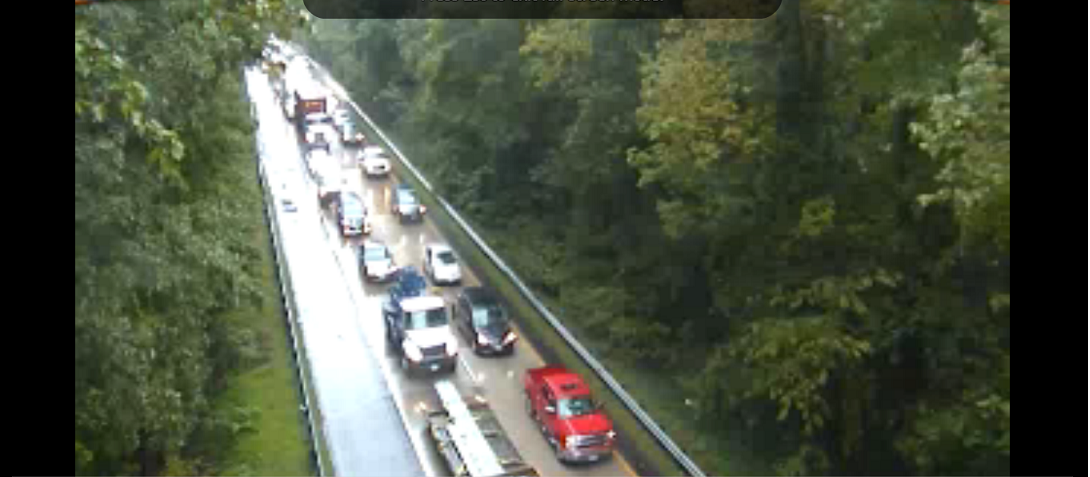
Almost all of the road from Lightfoot to Newport News already has an “F” level of service. That designation represents “the worst conditions with heavily congested flow and traffic demand exceeding capacity, characterized by stop-and-go waves, poor travel time, low comfort and convenience, and increased accident exposure,” according to the 2013 study.
The higher rates of car accidents are already present on much of the road between Lightfoot and Newport News, where accident numbers — not counting fender benders — range from between one and one-and-a-half to two times the statewide average. As usage of the rest of the road to Richmond increases by 20,000 to 40,000 cars per day, that inflated crash rate could creep west.
“If no improvements are made, it is anticipated that the number of crashes within the I-64 corridor would increase over time as traffic volumes increase and the I-64 corridor experiences slowed or stopped traffic for an increased number of hours in the day,” the study reads.
The study proposes widening the 75 miles of I-64 between I-664 and I-95. The rural segment between Henrico County and Newport News would go to six lanes, while the more developed portions of the road near Richmond and in Newport News would climb to between eight and 13 lanes.
An Expensive Proposition
The proposal for that 75-mile stretch is costly: The study estimates the cost would range from between $4.7 billion and $7.3 billion. A widening of the scale suggested by the proposal requires the acquisition of significant amounts of land adjacent to the interstate, the widening or replacement of dozens of bridges, stabilization of nearby lands, the construction of ponds to deal with increased runoff of precipitation and the effect of extra lanes on existing interchanges.
The funding for any work to widen the road is likely to come from a few places.
Federal law requires metropolitan areas like Hampton Roads and Richmond to each have what’s known as a transportation planning organization. TPOs consist of elected officials and administrators from each municipality in its borders, and they regularly gather to determine which transportation projects are the most important and how to pay for them. HRTPO recently added I-64 widening from Newport News to Lightfoot to its long-range transportation plan, a necessary move for the project to receive funding.
Many of HRTPO’s members are also part of the newly created Hampton Roads Transportation Accountability Commission, which is in charge of allocating the approximately $200 million per year expected to be generated by a sweeping reform of transportation laws in Virginia passed in 2013.
HRTAC has already moved to designate about $100 million for adding a lane in each direction from Jefferson Avenue to near Lee Hall, and it is projected to allocate another $400 million to add a lane from there to Lightfoot and to rebuild the Fort Eustis Boulevard interchange.
HRTAC cannot push funds toward widening the road outside of its jurisdiction even if that widening would benefit the region.
I-64 in New Kent and Henrico counties is under the jurisdiction of the Richmond Regional Transportation Planning Organization, which lacks the fiscal muscle of HRTAC. Unlike Hampton Roads, the Richmond area does not have the added fees and taxes from the 2013 reform, leaving the area with a fraction of the money available in Hampton Roads.
That leaves the Commonwealth Transportation Board as the lone body able to pay for widening the road in New Kent and Henrico counties. The CTB is appointed by the governor and is able to allocate the bulk of the highway funding in Virginia used to pay for new construction.
Each year the CTB updates its six-year improvement plan. Unless a project is in that plan, it will not receive funding from the board. The board is preparing to pass this year’s update, which does not include widening between Lightfoot and Richmond.
“[Widening into Richmond] is going to require the CTB to step up and say that’s a priority,” Shepperd said. “While we can sit here and wish and hope and all that, the powers that be will have to put the money against it.”
Haulman agrees.
“I think we just have to keep the pressure up and see if we can advance that in the state’s priority list [via the CTB],” he said.
Both Shepperd and Haulman serve on HRTPO, which is working on establishing its next set of priority projects. Among them is the widening to Richmond, which would enshrine the group’s support for the project.
Other local bodies are also working to tell the CTB — and the General Assembly, which sends money to the CTB — that the widening is a priority for the region. The Alliance is working with the Hampton Roads and the Virginia Peninsula Chamber of Commerce to determine how to approach next year’s General Assembly session about the project, which all three groups consider a major priority.
The Hampton Roads Partnership, a group of mayors and chairs of boards of supervisors, have identified the widening as a top regional priority. The widening is on the legislative agenda recently passed by the Williamsburg City Council, and it is in the draft list set to be considered by the James City County Board of Supervisors in December. That agenda sets the tone of the conversation between the municipalities and the General Assembly delegation representing them in Richmond.
Beyond leveraging regional groups like the partnership and making the widening a legislative priority, there is little that can be done at the local level to try to push the project.
“Our local delegation is certainly aware of it and see it as a priority,” Haulman said. “We’ve done everything we can to make them aware of the issues and the importance of it.”
James City County Board of Supervisors Chairwoman Mary Jones (Berkeley) said in an email the widening is a priority for the county both for tourism purposes and for public safety, noting the interstate serves as an evacuation route.
But the widening is absent from York County’s legislative agenda. The agenda previously contained a provision seeking a widening of the road to Lightfoot, but since that is already approved, the county’s board of supervisors wanted to shift the agenda’s focus to issues closer to home.
“We have a whole raft of other things we think are important, and the transportation process is already laid out,” Shepperd said. “So asking for legislative support, I don’t know that there’s much return on that.”
He cited a recently passed law that could prove to be an impediment to the project. The law requires VDOT to assign priority scores based off several factors — including congestion relief and economic development — to every major road project in the state by 2016.
The CTB will then have to look at the scores when determining which projects to fund, pitting the widening to Richmond against projects across the state.
Related Coverage:
- York Supervisors Remove I-64 Widening from Legislative Priority List
- Transportation Planners Prioritize I-64 Widening Near Williamsburg
- VDOT Hosts Public Hearing on I-64 Widening
- VDOT Schedules Public Hearing for I-64 Widening
- VDOT: I-64 Could Be Six Lanes from Jefferson to Lee Hall by Winter 2018
- HRTPO to Consider Widening I-64 to Near Lee Hall
- Proposed I-64 Widening Project Reaches Next Milestone
- VDOT: I-64 Widening Pre-Construction Work Moving at ‘Breakneck Speed’
- With HRTPO Vote, Interstate 64 Widening Could Stretch to Lightfoot
- VDOT: I-64 Widening Will Go From Jefferson Ave. To At Least Ft. Eustis Blvd.
- VDOT Crews Surveying on I-64 to Prepare for Widening Project
- Public-Private Partnership Could Speed Up I-64 Improvements
- I-64 Widening from Williamsburg to Newport News Gains Momentum
- Transportation Bill Signing Likely Clears Way for I-64 Widening
- I-64 Widening Potentially on the Horizon
- Local Officials Push I-64 Widening in Transportation Bill Discussions
- New Lanes on I64? Maybe, as VDOT Hosts First Meeting on Options
