


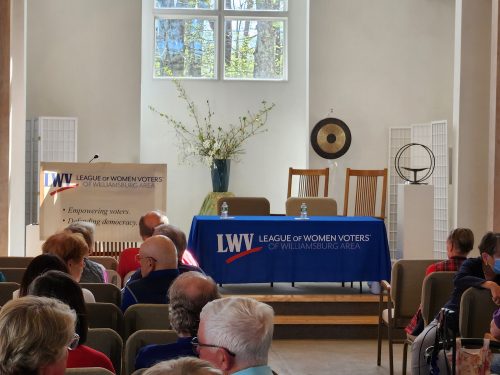
WILLIAMSBURG— The Williamsburg Chapter of the League of Women Voters held a panel discussion with Delegates Jessica Anderson and Dr. Mark Downey at Williamsburg Unitarian Universalists on March 31 to discuss the 2026 General Assembly.
The LWV disclaimed at the start of the panel that they are a non-partisan group and do not endorse candidates or parties. The league says that these particular candidates were on the panel as they wanted to meet as soon as possible when asked by the league to be part of a panel, whereas other local delegates wanted to meet later.
After introductions, each delegate was given 20 minutes to discuss their successes and challenges during the general assembly. After the 20 minutes, the floor was opened for audience member questions.
First 20 Minutes
Anderson described her first session as a whirlwind, but also felt it was productive not only for herself but for the General Assembly as a whole.
“You learn a lot about relationship building. Policy and policy-making is not a one-person fill-all kind of role. It is something that is very collective, it is a community,” Anderson said about the experience.
Currently, Anderson works in the education system as a part-time front office receptionist at a public elementary school in the 71st District. She is currently on the Education Committee, specifically K-12, and feels there needs to be representation that is citizen-led.
She also noted that 10 of her bills crossed the finish line and only two of them were changed, and two that were incorporated and combined with a senior member’s bill.
“One was around data centers, specifically for me, it was about transparency,” she said. “Another one was about portable solar units, especially those renting or in small homes that want to get additional solar without going on the grid. So this is completely separate from the likes of Appalachian or Dominion. This is something that you can independently put in place, that Virginia didn’t have legally in code. So that was something that was incorporated in one of the bills that did pass.”
Anderson also commented that roughly 85-90% of what is done is done bipartisan. She said personally every bill that she passed had one, if not all, Republicans supporting it. She feels this speaks to the legislation she puts out and the thought put into it, but also relationship building.
“I think it’s very important for us to recognize that this is very bipartisan by large. The few sticking points, we’re going to have our debates, we’re going to hammer it out, we’re gonna see really great wild stuff on the floor, because they gotta get those clips,” said Anderson. “But by in large, a lot of what we’re doing is working as a collective.”
Downey agreed with Anderson’s statement that it was a whirlwind. He also acknowledges that this is a similar role to his job as a pediatrician in terms of listening to anyone who comes through the door to talk about issues they have, as he believes no one has the ultimate claim on what’s right or wrong.
“I think so much of what you see on TV and on social media and online, it’s just so extreme. But to Jessica’s point, most of the time, conversations we’re having in the General Assembly are very respectful, very deep, and getting into the weeds. I like that as a physician. I like things with data and knowing how this is going to impact people,” said Downey.
During his time in this first session of the General Assembly, Downey notes that he had five bills pass out of the 11 he proposed. He was also appointed to the Health and Human Services Committee and two subcommittees on health and health services. One of the bills he said should be soon signed into law is a healthcare workforce development authority. He notes there is money appropriated every year, but they weren’t able to put out the funds to the people and students that need it.
“We’re hoping with this new nursing developmental center that we’ll be able to get the money to build our workforce in the nursing population,” he said, also noting that the shortage of nurses isn’t just in Virginia but is a national issue.
Another bill he said, made it so if someone goes to their primary care doctor and have a question of whether or not you need to go to a specialist, the primary care physician could now do a telehealth consult with a specialist to determine if it’s something that can be managed locally with your primary care doctor or if its something that needs a referral.
Another policy he helped carry forward was on safe storage for firearms. This policy requires households that have minors to have firearms locked and secure.
How dangerous are guns to have in our civil society?
The asker of this question acknowledged there are many aspects and arguments on this issue, but wanted to hear how it’s possible to educate a kindergarten child or a first grader, and then, as the child grows into the upper ranges of education, to learn and understand what the value of a gun really is and how dangerous they are.
Anderson noted the passage of HB201, which she says had a similar lesson. She says it requires school boards to revise safe storage, prescription drugs, and firearms in the household education for every family without public school divisions. She also disclaimed that it was something that had passed several sessions before this most recent session, but it is expected to be signed into law this time.
“It’s one of those things where some thought is, well, if we don’t talk about it, then people won’t know about it, and then won’t. But I think the problem is, they learn about guns from people who don’t have good intentions. So I think it’s similar to what we do on sexual education, and that’s where we have to provide good data, good facts, and really, I think it falls on all of us to try and deescalate and not normalize it,” said Downey in response.
Downey said he doesn’t think there is a single piece of legislation that will solve this problem, but believes that if guardrails are put in place, it sets expectations.
How do you interact with the Governor, and how influential is she on your decisions?
Anderson said Governor Abigail Spanberger hosted a number of events in her home for all members. She also said every event included the secretary of the development department heads, so they were all able to meet the individuals that they would be working closely with and receive their insight and input on some of the policies that were introduced. Overall, she said the relationship was fantastic.
Downey said he feels all the administration was very open, and if they had questions, they could reach out, but they also let them do their work. He thinks there is a good reason to have a separation of the government between the various branches.
Is there anything being done on the state level to offset the national hostility towards clean energy?
“I believe clean energy options is still very much a priority in the Commonwealth,” said Anderson. “The Wind Turbines that are going to be sustaining 600,000 homes in the Hampton Roads area are often running, and we are continuing to prioritize.”
Anderson also says the state rejoined RGGI, which she says there are a lot of mixed feelings about. The intent, she says, is to ensure that they are expanding and bringing the cost down, particularly for those who are the most vulnerable citizens and struggling to keep lights on. She believes there is going to be a stalemate with the current administration when it comes to this particular topic, and that they have to do what they can at the state level, with states’ rights being a top priority. She says the largest issue is finding funding, which has to be done at the state level.
“We are in essence being held hostage by oil companies and by remaining completely dependent on fossil fuels,” she said. “And no matter how you feel about clean energy, that is just a matter of fact.”
Downey said there is only so much that can be done at the state level that’ll override federal policy. However, he does also mention a solar balcony build and that there was a bill that allowed parking lots to build solar parking.
He says he has had solar panels on his house since 2023, hasn’t paid an electric bill in three years, and is actually a net producer. He says the more it is incentivized, the more secure the grid will be.
Data Centers
One of the attendees commented on data centers.
Anderson says that even with an executive order by President Trump, due to the language, data centers are not tied legally whatsoever to do as he says. She said what they have seen is that data centers are currently providing in the commonwealth, are tax incentives. She said there is no transparency regarding the information, which was one of the bills she introduced, but did not make it across the finish line.
She said that the stuff data centers are supposed to be adhering to in order to get those tax incentives isn’t publicly known because it isn’t disclosed. She acknowledged that rates go up because of data centers as they pull more on the grid than is able to be provided. She also said the data from five years ago of what they were projected to be using and what they were projected to be saving in taxes has more than quadrupled because of the acceleration and how friendly they have become to data centers.
“I stood on a stage with [my predecessor] last year where she said we were on the brink of the lights going out on a really cold Christmas or a really hot summer, because of the fact our grid is fragile, and we are adding more and more to it, without bringing in things,” she said.
Anderson also built on Downey’s comment about banking energy with his solar panels, and she said it is a common thread between many people who are currently using solar in homes. For that reason, she believes we need to be looking at expanding battery storage. She also believes we need to be looking at nuclear options as well as natural gas. She acknowledges the stigma as well as health risks, even if it is cleaner than coal.
It was commented by the LWV that part of the reason the commonwealth does not yet have a budget is that there is a battle going on, and part of that battle is related to the tax incentives for data centers.
Downey assures people that the commonwealth is fully funded until June 30, even if the budget has not yet passed. He has also said that what is currently being debated in the special session will be what starts on July 1.
“We felt like it was even more important to get this right than to do it fast,” he said.
He said currently it’s a balancing act of the promises made by Virginia to these data centers, but also facing the reality that when it was put in place, they had been discussing five data centers versus the over 400 currently in place. He also says the current legislation on data centers isn’t set to expire until 2035.
LWV says that Senator Ryan McDougle is the branding member of the finance committee, and if you have concerns to send an email or call his office to express those concerns if he is in charge of your representing senator.
For more information about the League of Women Voters, please visit the official website.

