


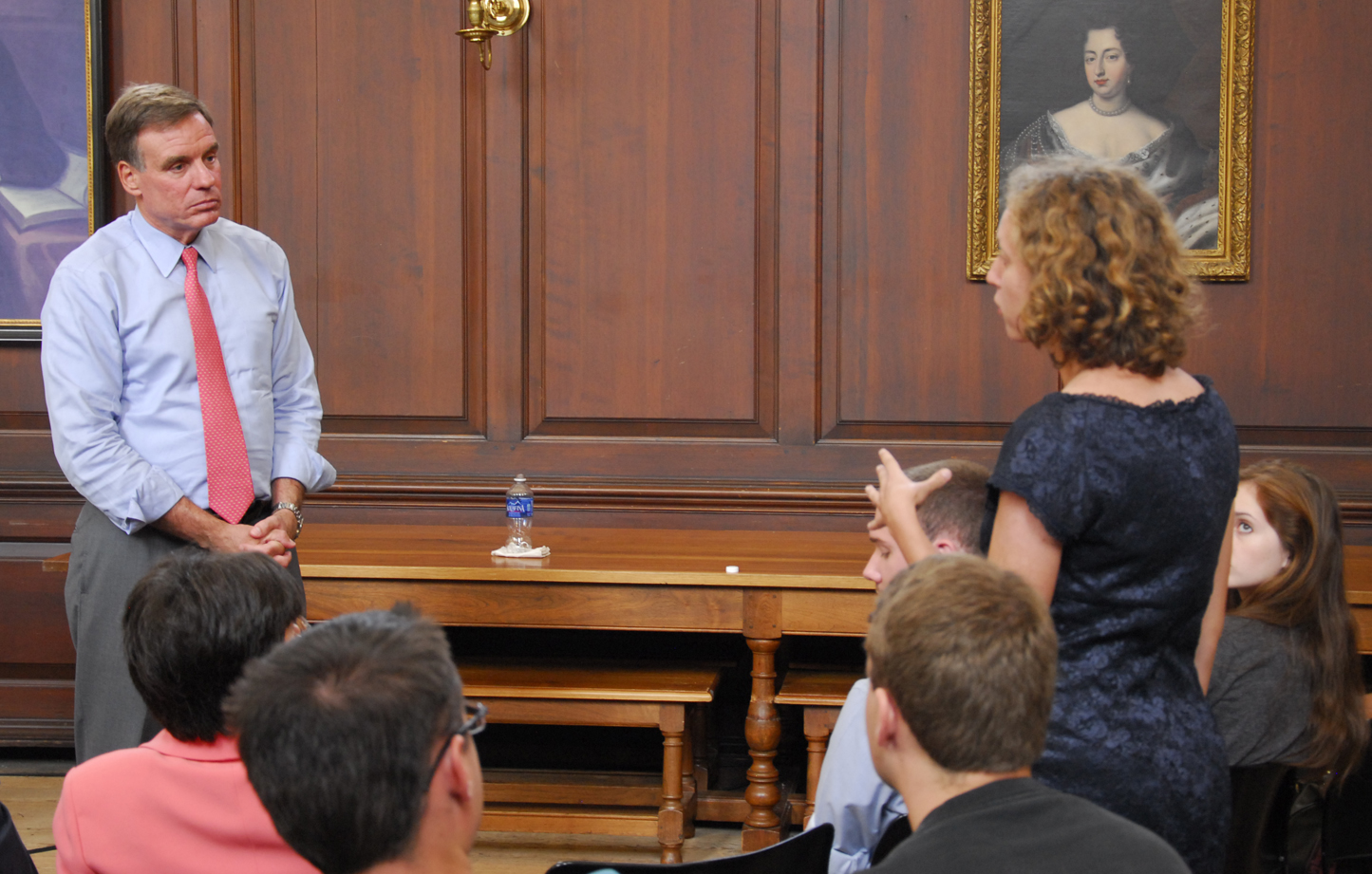
WYDaily sent an identical questionnaire to each candidate for the U.S. Senate seat currently held by incumbent Democrat Mark Warner, who is wrapping up his first term in office. Warner faces Republican challenger Ed Gillespie and Libertarian challenger Robert Sarvis. Warner’s answers are presented here unedited. The election takes place Tuesday.
Gillespie and Sarvis did not return completed questionnaires.
1. Fluctuations in the state budget are resulting in funding cuts for the College of William & Mary and local school districts. What will you do at the federal level to ensure Virginia schools and colleges are adequately funded to produce graduates ready to take the jobs of the future?
As the first in my family to graduate from college and a product of public schools, I recognize the importance of our public institutions in preparing our children for a global economy. I think we need an education system that gives everyone a fair shot.
When I was Governor, we made the largest single investment in K-12 education in Virginia history and we created programs to help turn around underperforming schools. As Senator, I have worked with state officials to get more funding for our higher education campuses across Virginia.
Equally important to funding, we need to make college more affordable for students. My Know Before You Go Act would help provide students and their families more access to understand and compare the price of college. I have several bipartisan proposals that would help borrowers pay back loans. The first, a bill co-sponsored with Senator Rubio, would provide the option of an income-based repayment structure so that graduates are not saddled with crushing monthly payments out of college. The second, a bill co-sponsored with Senator Thune, would allow employers to gives their employees the option of using up to $5,000 to go towards paying down student debt.
2. Has the Patient Protection and Affordable Care Act been the right fix for the nation’s healthcare system? Explain your answer. What changes, if any, would you propose?
What I hear when I travel around Virginia is that Virginians want this issue fixed — they are tired of healthcare being a political football. Virginians don’t want to go back to the days when people with pre-existing conditions couldn’t get healthcare coverage, women were charged more than men for their health care, and parents couldn’t cover kids on their plans until age 26.
I have put forward specific legislation to fix the Affordable Care Act that includes a copper plan that would allow for a cheaper option, cutting back on the overly bureaucratic reporting requirements on small businesses and a Republican idea that would allow insurance companies to sell products across state lines for more competition.
I believe we need to keep what is good and fix what needs to be fixed in the health care law. My opponent’s plan would repeal the good and replace it with a new system that independent folks have said is “shortsighted” and “would serve as another major economic disruption.”
3. James City and York counties contain larger than average elderly populations, which are expected to grow in the coming years. What is your plan for ensuring Medicare and Social Security remain solvent in the future?
Medicare is critical to providing quality affordable health care for our seniors and Social Security has been a lifeline for millions of Americans since its inception. It is important that seniors who have paid into the systems receive the benefits they deserve, and we must ensure that these programs remain solvent for future generations.
 4. Though the first phase of a widening of Interstate 64 on the Peninsula has been funded, uncertainty lingers about how to pay for such projects with the Highway Trust Fund only solvent through December. What is your plan to ensure expensive transportation projects like widening I-64 have the funding they need?
The long-term funding problem affecting the Transportation Trust Fund is a crisis. We need to address this issue in a comprehensive way, rather than kicking the can down the road yet again. I think one of the solutions is a piece of bipartisan legislation I sponsored call the Bridge Act. This provides the country with an infrastructure funding authority that allows us to leverage private capital for investment quality projects, like the widening of I-64.
While it won’t solve every problem, if it was combined with a permanent funding source, it would go a long way in allowing us to bring in new revenue streams to ensure infrastructure projects are adequately funded.
We also need to pass the Marketplace Fairness Act. I have supported the law, which would ensure that companies selling goods online would pay their fair share of taxes. And it would also provide a funding stream for important transportation projects in Virginia. Without this legislation, the gas tax in Virginia will rise by as much as six cents a gallon.
5. Defense-related spending accounts for more than 40 percent of the economy in Hampton Roads. Many Historic Triangle residents depend on federal contracts, agencies and the military for employment, but sequestration continues to dampen these sectors of the economy. What is your plan for sequestration? Do you want it to remain in place or are you committed to ending it?
Sequestration is stupidity on steroids. Across the board cuts with no evaluation of what is working and what isn’t working is a bad business decision. Arbitrary cuts to our military is not the right approach when we face challenges around the globe.
No one has fought harder to stop the draconian sequester cuts — I voted for both Republican and Democratic bills to reverse the sequester — and the Navy even awarded me with their highest civilian honor — the Navy Distinguished Public Service Award — for my efforts to help our military avoid the cuts.
The truth is that we need a commonsense plan to reduce our debt and deficit. That is why I was proud to be a part of the Gang of Six, a bipartisan group of Senators who put forth a plan to fix our nation’s balance sheet.
6. EPA regulations have or will soon alter the methods by which power can be generated for Virginia in the coming years. For example, Dominion Virginia Power’s Yorktown Power Station will be forced to shutter two coal-fired units to comply with clean-air regulations. Please explain why this is or is not an acceptable outcome.
I joined 51 other Senators calling on the EPA to extend their review of regulations to ensure that we have the science and data right. We must analyze the rule and determine its impact on the individual power plants, reliability, and consumer cost so that we make the best decisions both for our economy and society.
Most importantly, it is vital that our country move towards a more all-of-the-above approach that includes coal to meet our energy needs. We need to find ways to use coal in a cleaner way… because regardless of what we do China and India are still going to build 800 new coal power plants. We need to push American innovation to find cleaner ways to burn coal.
And while we have become the largest energy producer in the world, we can do more to increase energy exports. That is why I support exporting natural gas, which will create jobs here while also helping Europe become less reliant on Russian gas and energy.
