


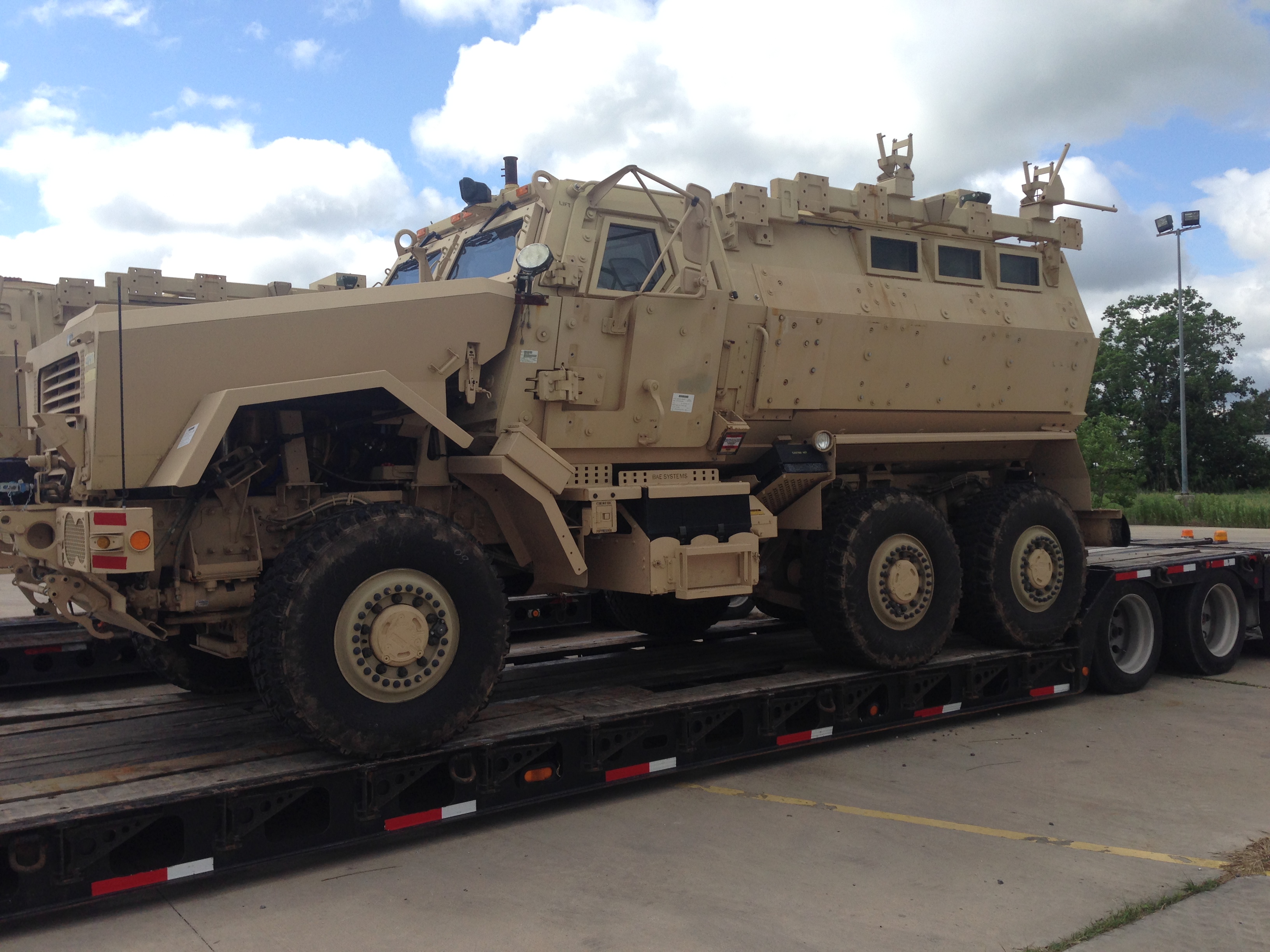
The MRAP is designed to keep U.S. soldiers safe from armor-piercing roadside mines and bombs in Iraq and Afghanistan.
Now it’s found a new job: augmenting the responsive capabilities of the York-Poquoson Sheriff’s Office. YPSO took custody of the armored vehicle, known as an MRAP — mine resistant ambush protected vehicle — in May.
YPSO got the MRAP through a military program seeking to repurpose surplus equipment. No local tax dollars were used to purchase the vehicle from the military, and the cost to ship it from Texas to York County was covered by assets seized from drug dealers, said York-Poquoson Sheriff J.D. “Danny” Diggs.
“We intend to use it more for storms,” Diggs said. “We hope we never have to use it as a tactical vehicle.”
Diggs said the vehicle is designed to function in up to 2 feet of standing water, which should make it useful during weather events that lead to standing water in the county.
“It could check on maybe even rescue citizens who get stranded in high water,” YPSO Capt. Jimmy Richardson said. “That’s what we though right off the bat.”
Diggs said deputies routinely use chainsaws to remove trees from the roadway during storms. The MRAP is equipped with a large winch system, which will allow them to more easily clear the roadway.
Diggs said the vehicle would also be used in situations where deputies are taking gunfire from a suspect. He pointed to a situation at an apartment complex a few years ago, when a suspect shot at deputies with a rifle. That suspect committed suicide, however Diggs said “having a MRAP would have been great for the safety of our deputies.”
Richardson brought up the North Hollywood Shootout, a 1997 incident in California when two heavily armed men robbed a bank and wounded several police officers before they were shot and killed.
“They were trying to line police car doors with bullet proof vests to try to get in there and rescue the officers,” Richardson said of that incident. “[With the MRAP] you could roll in, rescue the officer and roll out.”
Diggs said the MRAP is an additional resource in the event of an active shooter situation.
“Think of it as a generator,” Diggs wrote in an email. “You very rarely need one, but when you need it, you just can’t go out and get one. You have to plan ahead.”
He said to those who are concerned law enforcement is militarizing that his deputies already have guns and the authority to take a person’s life under “very limited” circumstances, and the vehicle is simply another tool available to them.
“If the public is afraid that the MRAP will be wrongfully used, then they have a bigger problem with the trust level of their local law enforcement than the issue of having an MRAP,” Diggs wrote in the email.
The MRAP is currently being stored at a fire station in the county. Diggs said the plan is to outfit the vehicle with markings identifying it as a YPSO vehicle and a set of emergency lights.
He said the vehicle had a sticker valuing it at $733,000 fully equipped, however it has been demilitarized which, according to his research, places it at about $400,000. YPSO’s MRAP comes equipped with a new engine and a spare set of tires.
Defense News, a newspaper covering military and defense issues, reported in January that the U.S. military spent $50 billion to acquire about 25,000 MRAPs since 2007. With the drawdown of U.S. combat forces in Iraq and Afghanistan, the vehicles are no longer needed.
While some MRAPs are being retained for military service and others are being given to law enforcement agencies, many others met a different fate: mothballing, storage in warehouses and scrapping.
