



During his two years in the House of Delegates and on the campaign trail in 2013, the message from District 93’s Mike Watson centered on one word: jobs.
Though the Republican delegate did not win re-election last November, that focus is as strong as ever.
“Jobs are everything,” Watson said in an interview with WYDaily. “I didn’t go [to Richmond] for any other reason. A lot of things happen after jobs — economic growth means more money to go into other programs.”
He plans to remain engaged with his former colleagues in Richmond — some of whom are carrying his bills in the new session — to continue to help businesses in Virginia grow and prosper, thereby creating more jobs.
Del. Christopher Head (R-17) is carrying a bill of Watson’s in this session that seeks to allow Virginia companies to view their commercial credit reports at no cost. That bill would provide companies a path for disputing inaccurate statements in the report, as well as get a notice of a perceived inaccuracy from a company included in its report if the company and the credit reporting agency are unable to come to an agreement on the removal of that inaccuracy.
Del. Rick Morris (R-64) is carrying a bill of Watson’s that looks to allow university students charged with some kind of misconduct to have a lawyer represent them during any university-level hearings.
“Some things can cause a student to be expelled, perhaps even criminal charges to be filed,” Watson said. “You’ve got a hearing and they can’t have an active attorney advising them or speaking or asking questions, and it’s all being recorded and is admissible in court. For the rights of the student, you should have the opportunity to have an attorney present if you want.”
Beyond his bills that are being carried by other House members, Watson will remain engaged in several other places.
He announced this week he will host a radio segment on WMBG AM 740 called “Light and Liberty — A Legislative Update,” where he will spend 10 minutes discussing General Assembly proceedings and legislation that could affect Williamsburg, Newport News and James City, York, New Kent, Charles City and Gloucester counties. That program, now underway, airs each Friday at 4 p.m. throughout the eight-week General Assembly session.
That program will help him to assuage what he said was one of the things he learned while in office — that what goes into a bill and transpires in Richmond does not always make it into the message that gets back to constituents.
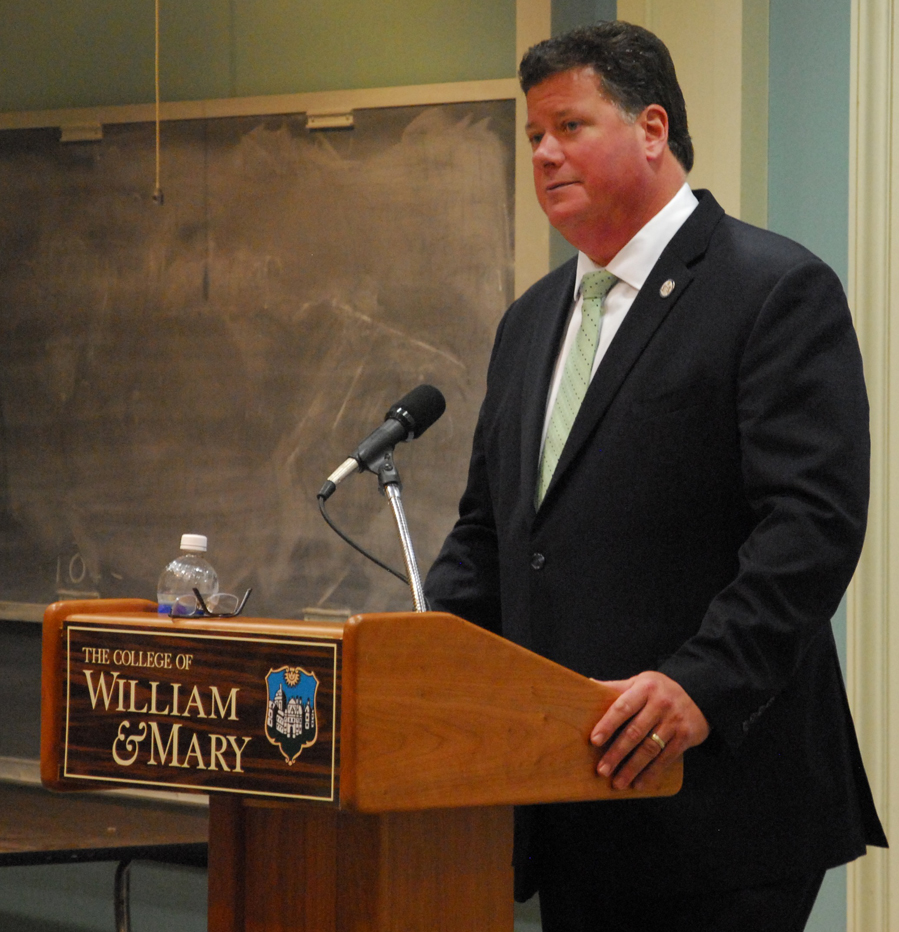
Watson will continue to work with the Business Development Caucus, a group in the General Assembly of which he was a founding member. He, along with Head, and Dels. David Ramadan (R-87) and Michael Webert (R-18), were all freshman delegates in 2011 who owned businesses.
“We were just talking, sharing stories, all about the challenges we’ve had,” Watson said. That translated to the four looking to sit down together and write bills. Head then suggested bringing more people in, which they did. The group ended up with 27 legislators who now regularly travel around the state and meet with companies to learn about the issues their facing and potential remedies that can be crafted in the legislature.
One of those meetings took place in James City County, when four BDC members traveled to Busch Gardens to meet with several local businesses in August. At that meeting, the owner of a company that has employees who analyze soil prior to the installation of sewage equipment said employees of the Virginia Department of Health regularly compete with his employees while regulating them.
At that meeting, Watson said he would speak with the department about rectifying the issue. Now, a bill he helped draft with other BDC members is being carried in this session by Webert that would require several governmental agencies to create a work group with people from the private sector to identify governmental services that are operating in “inappropriate direct competition” with the private sector.
Though Watson lost his seat in the General Assembly, he will continue to be involved in the BDC as a “chairman emeritus.” He wants to use that position to continue to work on workforce development, which he believes is fundamentally important to creating jobs. He plans on helping to promote Blueprint Virginia, a lengthy plan from the Virginia Chamber of Commerce that seeks to better position the state to attract the jobs of the future.
Looking back, the former delegate is happy with what he accomplished in office. During his time in office, Watson got several bills he introduced signed into law.
One bill requires criminal history background checks for people who work in secure detention facilities for juveniles. Another allows wine from an out-of-state winery that is owned by a Virginia restaurant owner to be sold at the owner’s restaurant.
Watson also got a workforce development bill of his signed into law that creates a grant program for companies that donate new machinery and equipment to Virginia community colleges and vocational schools.
“Students come in and get training for a real job that exists with the equipment they’ll be using in the field, the company makes a contribution and gets a tax grant back, plus they get trained employees,” Watson said. “That’s a win for everybody.”
He was a co-patron of the sweeping transportation bill that passed in 2013, opening up new revenue streams and promising forward movement on large-scale transportation projects. That bill, the first significant reform in 27 years, has already been instrumental in clearing the way for a widening of Interstate 64 on the Peninsula from Jefferson Avenue to beyond Fort Eustis Boulevard.
Constituents mentioned the need to address I-64 and transportation issues to Watson second only to their desire to see unemployment tackled, he said.
So he began to keep a notebook in his vehicle where he logged bridges, overpasses, mile marker measurements and other topographical information that would dictate where new lanes should be installed. He said the $4 billion to $7 billion floated by the Virginia Department of Transportation to widen I-64 from Newport News to I-295 was not feasible all at once, so segmenting the work was the best alternative. By using the notebook, he was able to get a better idea of what segmenting would entail.
After showing his work to Secretary of Transportation Sean Connaughton, he said he received a call from Gov. Bob McDonnell saying the segmenting idea would be in his forthcoming transportation plan labeled as a priority.
He then went down the road again, this time to Newport News where he joined McDonnell in announcing the transportation plan.
“That was the approach I took: Let’s start with what we can afford,” Watson said.
Now that Watson is out of office, he said he plans on using his freed time for his family and to focus on his business, Control Automation Technologies Corporation. His company just won a contract from NASCAR to calibrate digital pressure gauges used in the races.
When asked if he would consider running again in two years, he said he will “certainly stay engaged.”
“Would I? Yes. Will I? Maybe. Probably, I guess I would say right now, but things change,” Watson said. “What I’m looking for is the best method to get some of these things done. If it’s outside elected office, then that’s the way I’ll go. If it’s with elected office, that’s how I’ll go.”
