


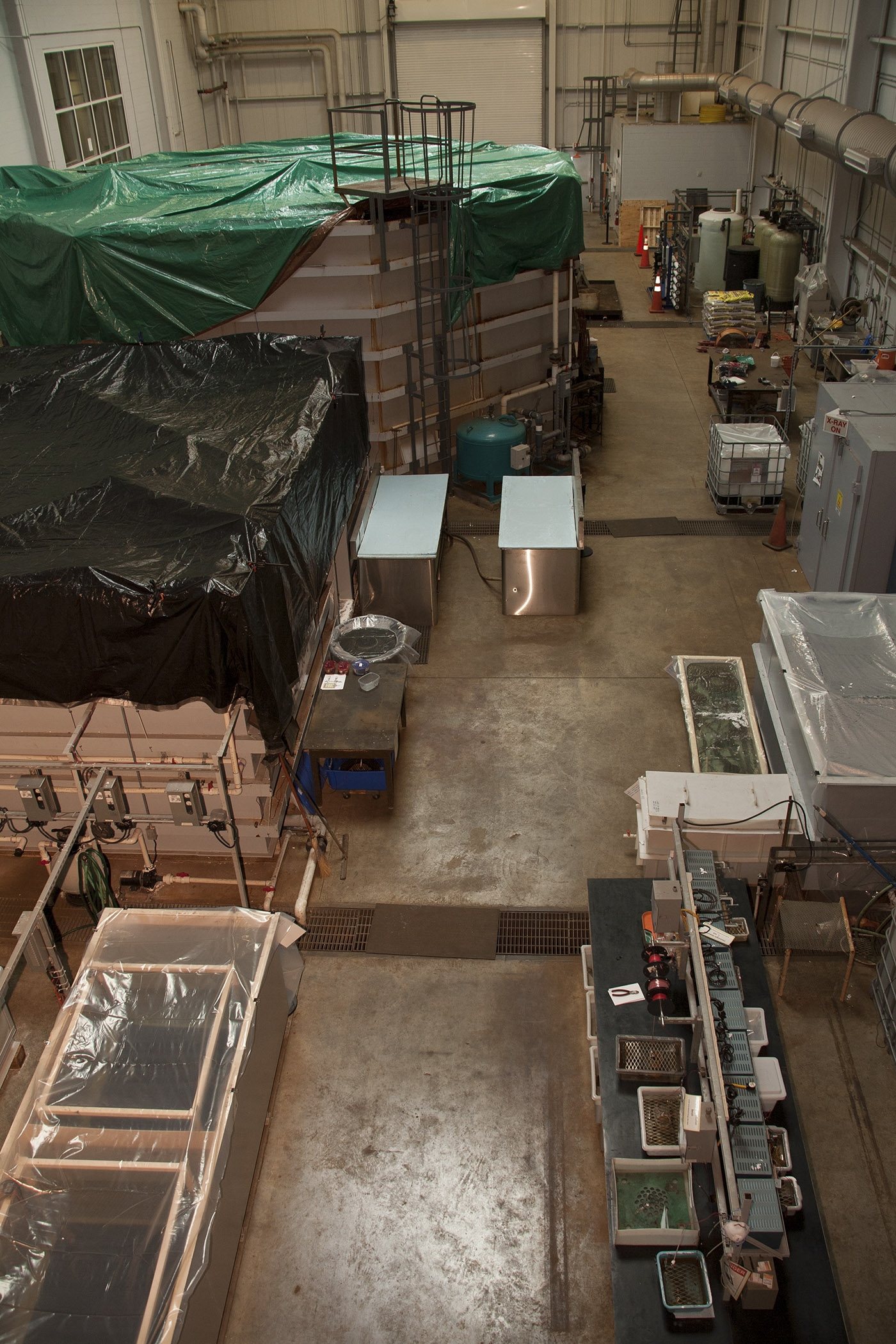
Because of insufficient federal funding, the publicly visible portion of the Mariners’ Museum USS Monitor conservation area is shutting down.
The Mariners’ Museum in Newport News has served as home to about 1,500 artifacts and pieces of the USS Monitor since their recovery from the wrecked Civil War ironclad discovered off the coast of Cape Hatteras in 1973. The ship’s 120-ton revolving gun turret — the first to be used on a ship of its time — was recovered in 2002 and put on display at the museum in a custom 90,000-gallon tank.
In the publicly visible wet lab, the tank housing the turret — as well as tanks that hold the Monitor’s steam engine, Dahlgren guns and carriages and condenser — is being covered with tarps, shielding it from public view. Active conservation efforts are halting, as well.
The U.S. government owns all Monitor artifacts at the museum, which is responsible for conserving the artifacts through an agreement with the National Oceanic and Atmospheric Administration.
The museum and NOAA had two agreements: one requiring the museum to protect the artifacts and another requiring the museum to remove salt from the artifacts to eventually introduce them into regular exhibits. The agreement requiring the museum to remove salt from the artifacts to stabilize them — at a cost of about $500,000 per year — expired at the end of last year.
The agreement stipulated NOAA would help the museum with funding, but did not commit any set amount or percentage. In 2013, NOAA committed $50,000. In 2012, the 150th anniversary of the Battle of Hampton Roads, NOAA committed no funding. Prior to 2012, NOAA was committing “substantial funding,” said John Warren, the museum’s manager of public relations
Now, NOAA is waiting for Congress to approve a budget before committing any funding toward the Monitor’s conservation. Warren said the museum is hoping to hear some news from NOAA in about a week.
The museum will also seek a new agreement with NOAA that would provide funding for this year and would have NOAA commit long-term funding in the full annual amount, saving the museum from that expense.
While the wet lab, which is a 5,000-square-foot portion of the museum’s almost 10,000-square-foot conservation lab is closed, artifacts will still be conserved and the five-member lab staff will still be working. Closing the 5,000-square-foot public piece is an effort to save money, but the conservation effort will be ongoing so the museum will still be footing that bill. Warren said the museum does not break down conservation costs by area, so he was unsure how much money closing the wet lab would save.
Anna Holloway, curator for the Monitor Center, said leaving the tanks uncovered causes the solution conserving the artifacts to evaporate, which leads to additional costs to replace the solution. The tanks will be covered with tarps so the solution cannot evaporate as quickly.
“It was easier, in a way, to close down the wet lab because we don’t have to have lighting, there’s no offices in there, there’s nothing like that,” Holloway said. “It’s killing us, you know, but we have to do this.”
In an effort to provide aid to the museum, state Sen. John Miller (D-1st District) submitted a budget amendment requesting up to $500,000 in state funding for the museum’s conservation costs. Miller’s request allows for the possibility of federal funding but if none is provided, he requests the state provide the full amount.
“I just want to ensure that The Mariners’ Museum is just made whole in this process. You know, if the federal government comes up with all the money then that’s even better,” Miller said. “I think it is vitally important that these artifacts continue to be conserved and if the federal government won’t live up to its commitment, then Virginia should.”
In late November, U.S. Sens. Mark Warner (D) and Tim Kaine (D) and U.S. Reps. Bobby Scott (D-3rd District), Rob Wittman (R-1st District), Scott Rigell (R-2nd District) and Randy Forbes (R-4th District) sent a letter to NOAA requesting information about future plans to fund the Monitor conservation efforts.
“We would like to request a plan for completing the preservation of these nationally significant artifacts,” the representatives’ letter reads. “While we appreciate the funding constraints that NOAA and other agencies face in these tight budget times, these are federally-owned National Marine Sanctuary resources. It is important that this tangible history not be left to decay due to lack of funds. Our offices stand ready to assist in any way we can to facilitate an equitable path forward.”
A response to the letter has not yet been received.
If funding from NOAA, or another source, is not secured, the entire lab and conservation effort may have to shut down, Warren said. Closing the wet lab was the first visible step to take. If the lab closes, the five workers there may be reassigned to other jobs within the museum.
Though only five people work in the lab, Warren said the entire museum staff of nearly 100 people is responsible for some portion of the USS Monitor exhibit because it is such an integral part of the museum’s function. Artifacts that have already been conserved — about 60 percent of the total artifacts recovered from the shipwreck — are on display in the museum. Also, visitors can walk on the deck of the reproduced Monitor, stop in sailor living quarters and create a virtual ironclad.
Despite the Monitor being a trailblazer in its time, the U.S. Navy’s first iron ship and the first with a turret that allowed the ship to fire at enemy forces no matter their position, the exhibit has fallen short of attracting the number of projected annual visitors. The $31 million, 64,000-square-foot USS Monitor Center opened in 2007 and was projected to increase the museum’s attendance to 200,000 annual visitors. Instead, the museum typically sees about 60,000 visitors annually, Warren said.
For more information about the museum and the Monitor exhibit, visit the museum’s website. The museum has started a petition seeking 10,000 signatures to garner funding for the wet lab. As of 6 p.m. Friday, the petition had nearly 700 signatures.
