


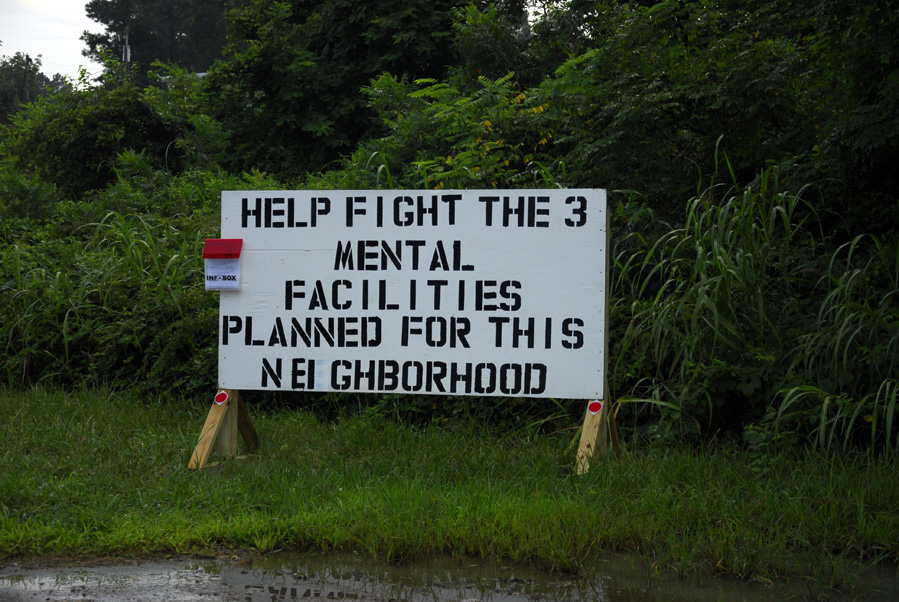
A proposal that would have three homes for the mentally disabled built in the Lackey area of York County has attracted attention from local residents, with signs being erected in the neighborhood that urge residents to oppose the project.
The signs have a box of flyers that tell residents the project will come with a slew of problems.
“The negative effects of these businesses will be felt by all of us,” the flyer said. “Increased traffic, lower home values, unable to sell our homes, potentially dangerous people in our neighborhood and around our children.”
David Coe, the director of Colonial Behavioral Health who will present the proposal to the York County Planning Commission at their Aug. 14 meeting, said the criticism directed toward the project is not accurate.
“These are not individuals, as has been alleged, with drug problems,” Coe said. “They’re not sex offenders or violent people. That’s not who is there, and that’s not who is going to be there. There’s not going to be much in the way of additional traffic on the roads. The residents don’t drive.”
The proposal calls for three 2,600 square foot, single-story homes to be constructed in Lackey. One would be placed at the corner of Boundary Road and Sycamore Lane, while two others would be on Spring Road. Those streets are nestled in a quiet neighborhood that straddles Battlefield Tour Road in Colonial National Historical Park.
“The houses would look like other homes on the road,” Coe said. “They are the same homes built in other communities. The only difference is who is living inside. Neighbors will look across the street and see just another house.”
Coe said it’s common to place the mentally disabled in homes like those that are proposed.
“By and large these [homes] are in residential neighborhoods across the country, including Tidewater,” Coe said. “It’s nothing at all out of the ordinary.”
Documents posted to the Planning Commission’s website that outline the project say the houses will have full-time support staff who monitor and care for the residents. Each house would have up to four occupants, and the operation would be monitored by the Virginia Department of Behavioral Health and Developmental Services.
The flyer alleges Lackey was selected for the homes because it is “viewed as a low income neighborhood where we would not oppose such businesses.” The flyer went on to say, “The zoning commission is trying to take advantage of us and would not propose these businesses in a wealthy neighborhood.”
York County Supervisor Don Wiggins, who represents the district where the homes would be placed, said many of his constituents have called him to express the same sentiment.
“All but one have been opposed to [the project],” Wiggins said. “I think the reason there is so much opposition to it is that people don’t really realize who the people are who are going to be living there. For the most part, they’re thought to be criminals—drug addicts, sex offenders. These are all things I’ve heard. One lady said ‘well now I’m going to have to lock up my relative in the house and keep her from going out because she’ll be raped by these people.’”
Wiggins said the opposition to the project is rooted in a lack of information.
“These people are not criminals,” Wiggins said of the residents who would be occupying the houses. “They’re not sex offenders. They’re none of those things. I was asked this question: ‘How would you like it in your neighborhood? You do everything here in our neighborhood because it’s poor.’ I understand where these people are coming from if what they’re saying is true, but it’s not true. Would I allow it in my neighborhood? Of course.”
Wiggins met with Coe earlier this week where he learned the ins and outs of the project.
“These people need somewhere to live,” Wiggins said. “What they’re looking for is a place where they can have a garden out in the backyard.”
The residents who would be moving into the houses currently live in apartments elsewhere in York County. The new homes would allow them outdoor space and a larger interior in which to live.
The Planning Commission will host a public hearing at the Aug. 14 meeting where anyone can get up and speak for up to three minutes concerning their thoughts about the project. The commission will then vote whether to recommend the Supervisors approve the project. Proposals typically take about a month to go from the Planning Commission to the Supervisors.
