


After two removal processes stretching over five years that extracted nearly 14,000 tons of debris, 58 tons of metal debris and 2,488 separate pieces of munitions—including two 60mm mortar shells—a small block of land at Camp Peary requires no further action, according to a government document released for public review.
The document, called the Decision Document for No Further Action at Site 25, is available for review at the Williamsburg Regional Library and the Tabb Library in Yorktown. The Virginia Department of Environmental Quality and the U.S. Navy both agree that no further action is required at the site, according to the document. Once the public review phase is finished by the end of January, the process of restoring the site will be concluded unless a member of the public raises any tenable objections, said Jim Gravette, an environmental project manager for Naval Facilities Engineering Command Mid-Atlantic.
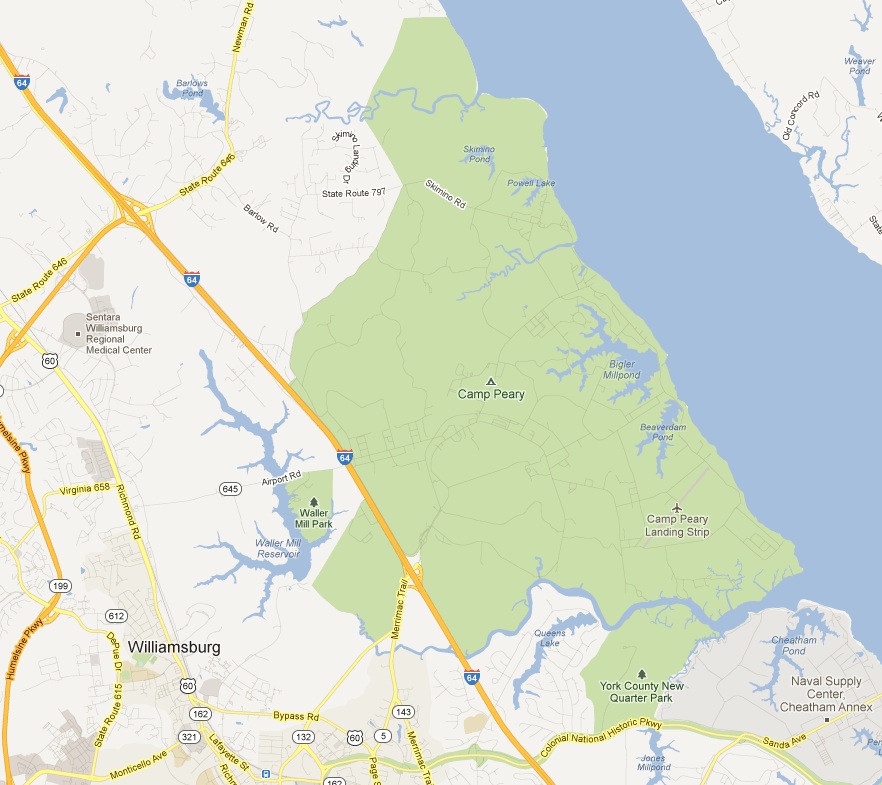
Site 25 is a small block of land near Bigler Mill Pond and the coast of the York River. According to the document, “no unacceptable risks remain to human health or the environment in soil, sediment, surface water, or groundwater, thereby allowing for unlimited use and unrestricted exposure at Site 25.” Because of this, the no-action approach has been selected rather than further removal action.
“Unlimited use” means that Camp Peary officials can use the land in whatever fashion they deem appropriate.
“You could put a daycare center there or an industrial facility. It’s basically like your backyard at this point,” Gravette said. “There’s nothing left to do in the site itself.”
This is not the first time Camp Peary has been connected to potentially hazardous waste. In April 2009, residents of the Historic Triangle learned that Waller Mill Reservoir could have been contaminated by toxic waste from Camp Peary. The safety of the water for drinking was never in question then, as the material released, Polychlorinated biphenyl, which was used in transformers and other electric machinery until it was banned by Congress in 1979, have limited water solubility.
The problem in the Waller Mill contamination was that PCBs can linger in silt and the tissue of animals who live in the water. Testing by the Navy concluded that PCB levels on fish in the Waller Mill Reservoir were within acceptable risk limits to humans.
Camp Peary was established in 1942 at a training base for Navy “Seabees.” Seabees constitute construction battalions, which are used in the construction of many projects for the Navy. Though the Navy still owns Camp Peary, it’s currently in use by the Department of Defense as a training facility, according to the document.
Site 25 is approximately five acres and was used as a debris disposal area from 1962 to 1966, according to the document. Included in the extracted debris was “roofing materials, miscellaneous household debris, tires, bleach bottles, cans, various metal refuse, construction and demolition debris, lumber, yard waste and charred debris.” PCBs were also detected during at Site 25, according to the document.
The first removal action was in 2001, when the two mortar shells were discovered. The second removal action, which spanned from 2008 to 2012, revealed additional munitions and “explosives of concern.” By the time the second removal action was finished, no debris of any kind remained on site, according to the document. Any munitions on site were handled by Camp Peary personnel.
A pre-removal screening of the site for purposes of determining its impact on human health risks identified a number of problems that were characterized as potentially “unacceptable risks:”
- The presence of Aroclor-1260, a PCB, presented potentially unacceptable carcinogenic risks
- A carcinogenic risk from poly-aromatic hydrocarbon in the surface and subsurface soil. PAH is a chemical that’s typically found in asphalt.
- Arsenic, manganese and iron in surface soil, though these are not carcinogenic, according to the document
- The presence of lead detected in the soil at “concentrations above acceptable risk levels for human receptors”
- Dissolved antimony and cadmium, which are often found in soil near roadways and chemical dump sites, that could pose a non-cancer hazard
According to the document, a post-excavation sampling of soil revealed that no excess of PCBs, lead or PAHs remained at Site 25. In addition, groundwater from the site is not in use as drinking water, and it is unlikely that it would be used for that purpose as the water is naturally of a “poor quality” and has “insufficient yield potential.” Camp Peary obtains its drinking water from the City of Williamsburg.
In addition to the mortar shells, personnel in the 2001 cleanup removed “concrete, metal fencing, utility poles, glass bottles, bumpers, mufflers and tires.” In the 2008-2012 cleanup, debris including “crushed 55-gallon drums, perforated metal plating, and construction debris” was removed from Site 25. By April 2012, excavation was complete and the areas that had been excavated were filled in with six inches of fresh topsoil.
According to the document, Site 25 is not in use by Camp Peary personnel and will likely continue to remain unoccupied in the future.
The document became available for public review at libraries on Dec. 20. It is available for a 30-day review period, and any public comments received by officials will be included in a final document that is forthcoming.
