


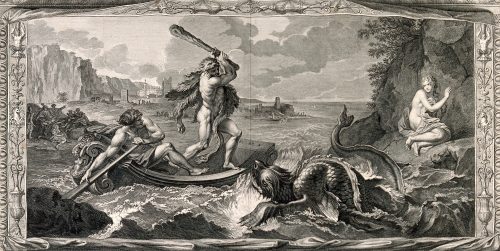
WILLIAMSBURG — Georgia Irby, professor of classical studies at William & Mary, will deliver the fall Tack Faculty Lecture “Sea Monsters” at Sadler Center’s Commonwealth Auditorium on Oct. 27.

Irby researches the history of Greek and Roman science with a focus on cartography, geography, and hydrology in the ancient Mediterranean, according to an announcement from the university. Her course “Why Water Matters” grew into a two-volume book project, and she has a forthcoming paper on the topic. The course is an exploration of all aspects of Greco-Roman society, focused on how the ancients interacted with and interpreted the natural world, with a focus on water.
After being asked to write a book chapter on sea monsters, and recently teaching mythology — another of her passions — Irby pursued the subject further. Her lecture will cover how sea monsters are conceptualized from various components, as well as what they represent.
“I like seeing where mythology and science and religion all intersect, which is a lot of what’s going on in the lecture I’m giving near the end of the month,” Irby said. “Sea monsters are really interesting because they kind of exist both in myth and reality. So some questions are, how do they come to be? What are they made of? What do they mean? What do they mean from the perspective of the sailors and what do they mean from the perspective of the sea monster?”
Irby looked at a mixture of factors when considering her topic.
First, she looks at appearance. Are they scary biologically? How does the appearance of various sea creatures influence the stories of Greek and Roman sea monsters, such as octopods, sharks, and seals?
Another factor she considers is the physics of water and how it alters the appearance of submerged objects. How has imagination influenced the perspective of creatures under the surface of the sea, which also influences artistic interpretation and creativity.
Interpretation is also considered. Irby notes in her research how these monsters can be created to give a “dragon-slayer” feeling to a story since a sea monster can be conquered but a storm can’t. The perspective of the sea monster is also considered — which creatures belong in the water vs those that don’t.
The lecture is open to anyone who would like to attend. It’s also acceptable for children, as discussions of the darker aspects of Greco-roman history were left out of the lecture. The presentation aims to be both scholarly and fun, and will include video, music and props. A reception will follow.
The lecture will begin at 7 p.m. on Oct. 27. Admission is free and open to the public. Free parking is available on-site. Attendees are asked to RSVP. Learn more about Irby on her William & Mary faculty page.

