


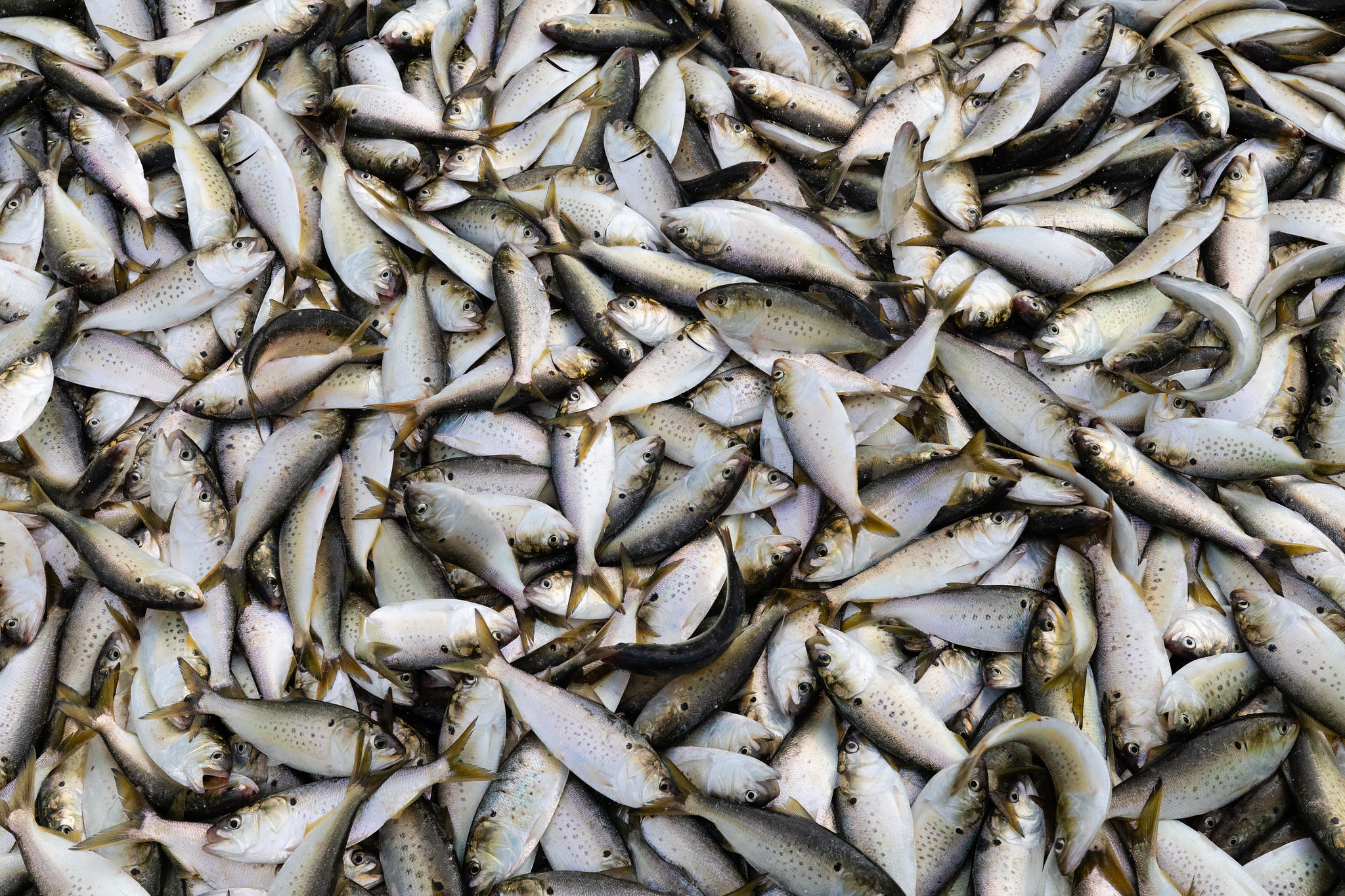
ARLINGTON — Menhaden fisheries along the East Coast will have to reduce how many of the forage fish they catch in 2026 by 20%, or a limit of 186,840 metric tons, after the Atlantic Menhaden Management Board voted this week to make the change to help striped bass populations and other species that depend on the small oily fish.
The Virginia-based reduction fishery Ocean Harvesters, which contracts with Omega Protein, will still be subject to the special cap of 51,000 metric tons of menhaden within the Chesapeake Bay’s limits. Though there are also efforts to try and lower the Bay cap, the amount the fishery can catch in the open ocean will be impacted by the new limit starting next year.
“There will likely be some operational adjustments required at our Reedville facility to comply with a 20% harvest reduction; we are evaluating the extent of those changes now,” Ocean Harvesters said in a statement. “Looking ahead, pushing harsher cuts in 2027 and beyond—particularly in the absence of new data— would impose needless harm on working families and a 150-year-old fishery, without ecological justification under the Ecological Reference Point risk analyses.”
Ahead of the meeting, the Menhaden Fisheries Coalition said they would agree to precautionary reductions of no more than 15%. They said that amount would guard against overfishing and protect the incomes of workers at the fisheries.
This move comes two years after the board voted to allow an increase in menhaden harvest caps based on stock assessments at the time. The 2025 assessment shows that menhaden are not over-fished but are below thresholds of producing offspring to maintain the population.
Environmental groups like the Chesapeake Bay Foundation have been using the striped bass and osprey populations, which have shown signs of concerning decline, as a proxy for the need to bolster menhaden numbers. Fishermen have reported menhaden entering the Bay in the summer, which is months behind their usual schedule.
Representatives from up and down the East Coast have their own concerns about the forage fish population impacting other seafood species that are economic drivers for their states.
Maryland has been pushing back against Ocean Harvesters, claiming the sole reduction fishery in the Bay is harming the state’s seafood and bait industry.
Robert Lafrance, a board member from Connecticut, said during the meeting that the group needs “to continue to put pressure on making certain that the science moves forward, and making certain that we have the availability for the species where they need to be again — Maine, Massachusetts, New Hampshire, Rhode Island, that’s where the lobster fishery is.”
The initial proposal for the cap reductions was set at 50%, which fishermen and advocates for the menhaden fisheries said would devastate the industry. A second proposal would have ramped up the reductions over three years, starting at 20% in 2026 and gradually increasing it up to the 50% limit that some studies suggest is needed to protect the striped bass population.
“Economically, it’s going to cost jobs, it’s going to cause an issue,” said Joe Cimino, a board member from New Jersey. “With striped bass, we talked about socioeconomic all the time, and this one, we don’t, and that’s kind of strange, considering it has the best stock assessment of any species we deal with. So why is this not also an equally important element to this?”
The final decision was to opt for the 20% next year, which is more than the fisheries wanted and significantly less than conservation groups wanted, and to revisit the cap again at the next annual meeting before the 2027 numbers are determined.
“Our understanding of menhaden as a species and of the ecosystem suggests that we need to take a reduction, not just a small reduction, a significant reduction,” said Caitlin Craig, with the New York State Department of Environmental Conservation. “So I would encourage this board to think, just as we were confident in increasing the total allowable catch when the science says we should, that we need to be as willing to take reductions when the science indicates that that’s warranted as well.”
The Chesapeake Bay Foundation, which has been a lead driver for restricting the reduction fishing of menhaden in the Bay, said there is still not enough research into the fish population inside the estuary where they are seeing crab and osprey populations dwindle.
“This is nothing more than a performative nod to ecosystem-based fisheries management. The ASMFC failed to fully respond to the science, jeopardizing the ability of menhaden to fulfill their role in the food chain,” Will Poston, CBF forage campaign manager, said. “This lack of meaningful action is not only risky for menhaden, but also the many fisheries and small businesses that depend on a thriving ecosystem.”
The Science Center for Marine Fisheries recently funded a study to investigate the type of research that is needed to understand the scope of the health of menhaden schools in the Bay and if further caps would be needed. There have been multiple efforts in the General Assembly to fund that kind of research that have failed to pass.
“New Chesapeake Bay–specific limits are not warranted,” Ocean Harvesters said in a statement. “With SCEMFIS now funding a Chesapeake Bay research roadmap — led by scientists from UMCES’s Chesapeake Biological Laboratory, VIMS, and NOAA — to define what a scientifically defensible, ecologically meaningful Bay cap should look like, the Board should await those results before adding new measures.”
Virginia Mercury is part of States Newsroom, a nonprofit news network supported by grants and a coalition of donors as a 501c(3) public charity. Virginia Mercury maintains editorial independence. Contact Editor Samantha Willis for questions: [email protected].

