


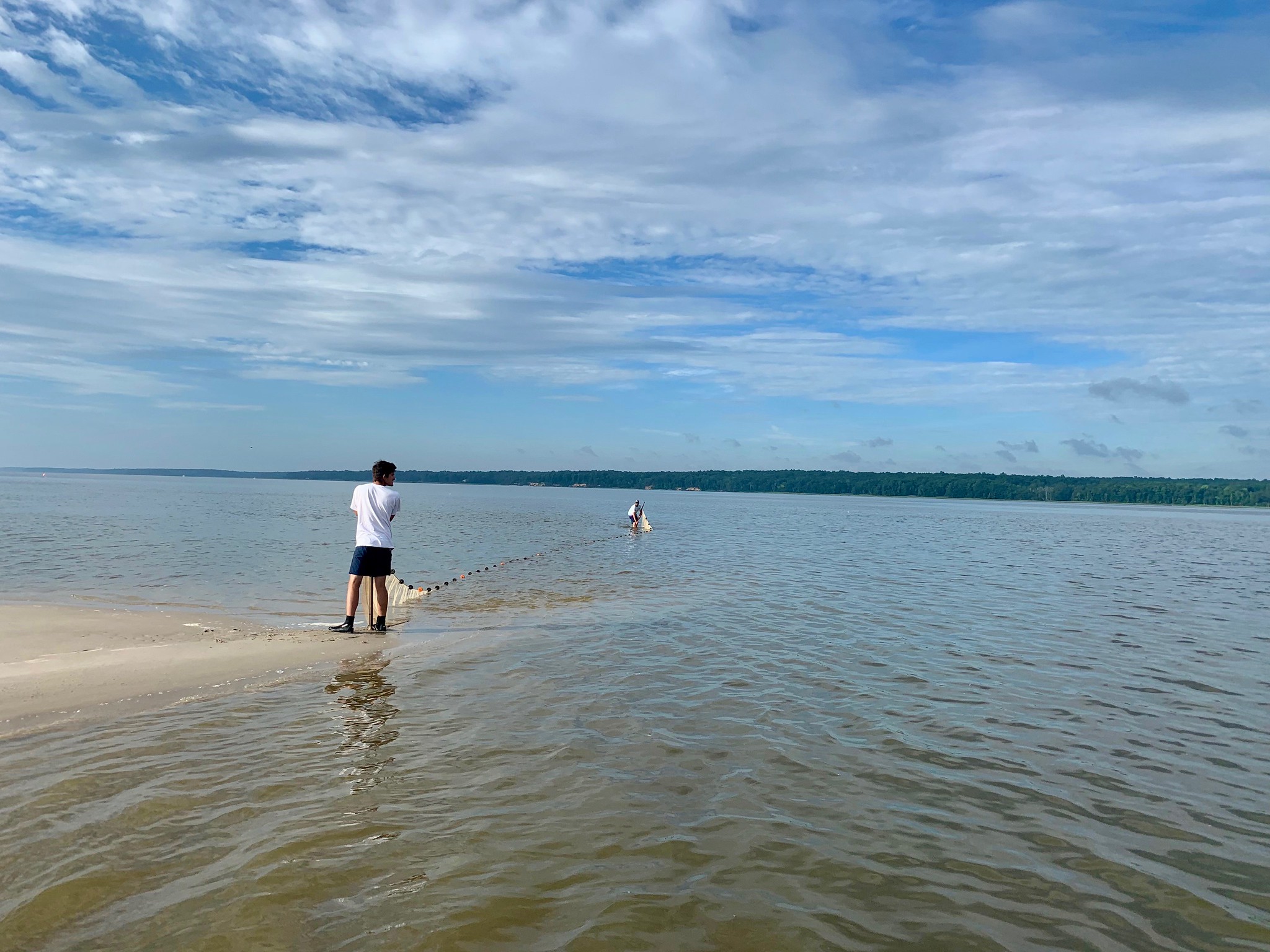
GLOUCESTER POINT — Researchers at William & Mary’s Batten School & VIMS recently announced preliminary results from an ongoing long-term survey suggest an average year class of young-of-year striped bass was produced in the Virginia tributaries of the Chesapeake Bay in 2025.
The 2025 year class, representing fish hatched this spring, will reach fishable sizes in three to four years, according to the Batten School & VIMS.
The survey recorded a mean value of 5.12 fish per seine haul in the Virginia portion of the Chesapeake Bay. The 2025 value is similar to the historic average of 7.77 fish per seine haul and represents an improvement over the previous two years of below-average recruitment in Virginia tributaries, according to the announcement.
The Batten School & VIMS explains striped bass are an important top predator in the Chesapeake Bay ecosystem and a valuable resource for commercial and recreational anglers. Mary Fabrizio, a professor at the Batten School of Coastal & Marine Sciences & VIMS, directs the Juvenile Striped Bass Seine Survey and notes that the economic and ecological values of striped bass lend significant interest to the year-to-year status of their population.
“By estimating the relative number of young-of-year striped bass, our survey provides an important measure of annual and long-term trends in the Bay’s striped bass population,” said Fabrizio.
According to the Batten School & VIMS, the survey team samples fish from 18 index sites in the Rappahannock, York and James River systems. Scientists sample each site five times from mid-June to early September, deploying a 100-foot seine net from the shore. Captured fish are counted, measured and returned alive to the river. In 2025, scientists in Virginia measured 1,004 juvenile striped bass at index sites.
VIMS began conducting the Juvenile Striped Bass Seine Survey for the Virginia Marine Resources Commission and to support coastwide stock assessments for striped bass in 1967. The survey is now the second-longest continuous striped bass index in the U.S., it said.
The striped bass population in the Chesapeake Bay has rebounded from historic lows in the late 1970s and early 1980s, according to the announcement. Since then, the population increased to the point that striped bass in the Bay and elsewhere along the Atlantic Coast were considered recovered. Years of heavy fishing followed, after which scientists determined that the striped bass population was overfished.
According to the Atlantic States Marine Fisheries Commission’s (ASMFC) 2024 Atlantic Striped Bass Stock Assessment Update Report, the stock remains overfished but is no longer experiencing overfishing.
The Maryland Department of Natural Resources conducts a similar survey within Maryland’s portion of the Chesapeake Bay. More information about the Maryland DNR seine survey is available on its website.
For more information about current striped bass management and regulations, visit the Atlantic States Marine Fisheries Commission website.

