


RICHMOND — As Virginia’s various government agencies wait to hear how the federal budget will affect their funding, some departments have already seen significant cuts that are putting a hold on important hazard mitigation projects and emergency management support.
In an effort to understand the full scope of federal cuts on the commonwealth, state House members have been hosting committee meetings in communities across Virginia. In a Friday meeting in Norfolk, which increasingly faces rising sea levels and coastal land loss, officials shared projects and goals that will not move forward.
“This is fiduciary responsibility in making sure that we’re preparing our communities for what is 100% coming,” said Jay Ford, the Virginia Policy Manager for the Chesapeake Bay Foundation. “And if we don’t, we’re going to be holding the bill at a multiplier many times higher on the backside. It’s about making limited tax dollars go further, and the right move there is to invest in climate resilience on the front end.”
According to the Chesapeake Bay Foundation, projects in the region that have already had their federal funding cut include:
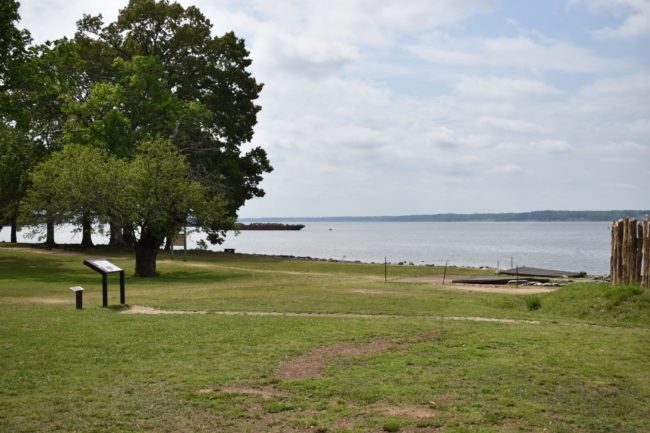
- Jamestown Rediscovery Foundation — $300,000 for flood mitigation from the National Endowment for the Humanities.
- City of Hampton and nonprofit Wetlands Watch — $20 million for flood mitigation at Aberdeen Gardens from the Environmental Protection Agency
- Newport News — $517,000 for Stoney Run Flood reduction improvements
- City of Portsmouth — $24 million for improvements to the Lake Meade Dam
- Hampton Roads Planning District Commission — $200,000 for updates to Hazard Mitigation Plan
“People got caught up on buzzwords and that’s super unfortunate. But each administration will have different priorities,” Ford said. “But at the end of the day, if someone actually looked at these projects, these are infrastructure, plain and simple.”
The Lake Meade Dam funding was part of the cancelled Building Resilient Infrastructure Communities program that was discontinued by FEMA earlier this year. It also had allocated $12 million to improve Richmond’s water treatment facility that has been plagued with issues leading to multiple boil water advisories this year.
“When we’re looking at dam safety or we’re looking at a neighborhood where more than a quarter of the citizens live in the flood zone, it has nothing to do with this bigger picture of climate change. I mean, that is exacerbating the issue, but this is just about people and water quantity and health and human safety,” Ford said. “…the end result is, we have neighborhoods that are less safe as a result of that, and we have a high risk situation with flood damage to personal property and risk to human safety.”
Ford said the loss of research and data from the U.S. Geological Service and National Oceanic and Atmospheric Administration due to funding cuts harms local municipalities that rely on that information to form their resiliency and infrastructure plans. He highlighted the work being done at universities across the commonwealth that can help fill some of those gaps.
“We have tremendous capacity, but we’re not really centralizing it in any way to make sure everyone’s working together to help protect Virginia communities. And we’re really under investing in them,” Ford said.
Local governments are now looking for alternative funding streams for projects that have been cut. While it is unclear the scope of what the federal government will be willing to pay for as larger budget debates are carried out, some of the projects are being retooled in the application process to submit to other agencies as infrastructure projects rather than solely resilience projects.
In terms of state funding for resiliency projects, Virginia is still missing out on millions of dollars for flood mitigation because Gov. Glenn Youngkin removed the state from the Regional Greenhouse Gas Initiative, or RGGI. While the Floyd County Circuit Court ruled his removal of the state from the program unlawful, the state has not been placed back into the program while appeals play out, Inside Climate News reports.
“We’ve had the situation now where scores of localities have finished a resilience plan. They’ve sent it to the state hoping that was going to unlock these community flooded preparedness dollars, and the pool has just shrunk significantly because we’ve gotten out of RGGI,” Ford said.
With flood mitigation projects taking a backseat, the Virginia Emergency Management Association (VEMA) is urging legislators to find a way to fund their work without federal help, or at least less of it. VEMA supports state agencies, schools, higher education institutions, businesses, faith-based organizations, and others in emergency situations.
Unlike The Virginia Department of Emergency Management, VEMA is more focused on advocacy and expanding emergency management to corners of the state that may not have a full time emergency manager in place.
“One dollar spent in mitigation renders six dollars worth of cost savings in a future disaster,” said Jared Hoernig, co-chair of VEMA’s legislative committee. “You know that is significant if we can relate to the studies like for the Hampton road area where there was a $15.6 billion potential loss if we had a category three hurricane that hit Hampton Roads.”
Virginia Mercury is part of States Newsroom, a nonprofit news network supported by grants and a coalition of donors as a 501c(3) public charity. Virginia Mercury maintains editorial independence. Contact Editor Samantha Willis for questions: [email protected].

