


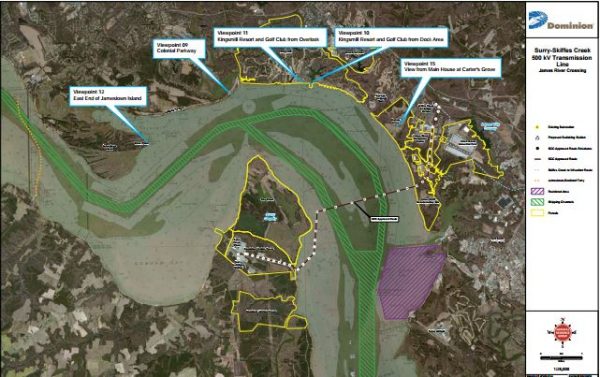
A conservation group was in court in Washington D.C. on Wednesday asking a federal judge to temporarily block the construction of the Surry-Skiffes Creek Connector.
The National Parks Conservation Association — a Washington D.C. group that aims to protect and preserve national parks — filed a lawsuit on July 12 in federal court against the U.S. Army Corps of Engineers and Secretary of the Army Robert Speer, challenging their approval of the high voltage transmission line project over the James River.
The group seeks a preliminary injunction against the Army Corps of Engineers and the Secretary of the Army to stop the construction of the Dominion Energy project.
A preliminary injunction is a temporary court order requiring a person, corporation, or organization to act or not to act in a specific way. The court order can only be issued if the National Parks Conservation Association can prove that its interests will be irreparably harmed if a judge doesn’t step in, according to the Cornell Law School Legal Information Institute’s database.
U.S. District Court Judge Royce Lambreth did not make a ruling on the case Wednesday, according to Pamela Goddard, director of the Chesapeake and Virginia regions for the National Parks Conservation Association. Goddard said the groups expect the judge to issue a ruling in the next few weeks.
The group hopes to force the U.S. Army Corps of Engineers to conduct an environmental impact statement, which would require more intensive study of the overall project.
Skiffes Creek has faced public opposition since it was proposed, but the project has continued to move forward. Dominion Energy Virginia has said the lawsuit won’t stop the utility company from beginning construction of the project by Aug. 1.
“Every other alternative fails to meet the need or has greater environmental and cultural impacts,” said Dominion spokeswoman Bonita Billingsley Harris. “No amount of additional study will change the facts. Additional delay is contrary to public interest. The Army Corps and other approving agencies followed the law and based its permitting decisions on sound legal basis after considerable study and input from the public and various other constituents.”
Still, the lawsuit alleges the project will have “significant and irreversible impacts in the heart of one of our nation’s most important historic regions.”
“It would be impossible to select a more historically and culturally significant location to construct and operate this project,” the suit states.
The lawsuit cites WYDaily news coverage of Dominion’s intentions to build the lines regardless of the court case as evidence for an injunction.

Dominion Energy intervened in the case in late July, becoming a defendant along with the Army Corps of Engineers and the Secretary of the Army, according to court records.
Organizations including the Coalition to Protect America’s National Parks, American Rivers, and the Sierra Club, as well as former National Park Service Director Jonathan Jarvis, have filed amicus briefs — so-called “friend of the court” papers they hope will persuade the judge to grant an injunction.
“The way to look at it is that Congress has protected this entire district from Jamestown to Colonial National Historical Park and Carter’s Grove,” said Tyler Sniff, an attorney who represents the Coalition to Protect America’s National Parks, American Rivers and Jarvis.
Sniff said his clients don’t want to see the power lines go up on a site with such historic value.
“This area’s supposed to be protected for its historical significance,” Sniff said. “It’s not going to have the same setting or feeling if you let the power lines cut through these protected resources.”
Requests for comment were sent to all parties involved in the case. Requests to the Department of Justice, Dominion Energy Virginia, and the United States Army Corps of Engineers were not immediately returned.
This article originally included a quote from past coverage from Dominion spokeswoman Bonita Billingsley Harris. It has since been updated with a quote directly related to the federal court appearance Wednesday.

