


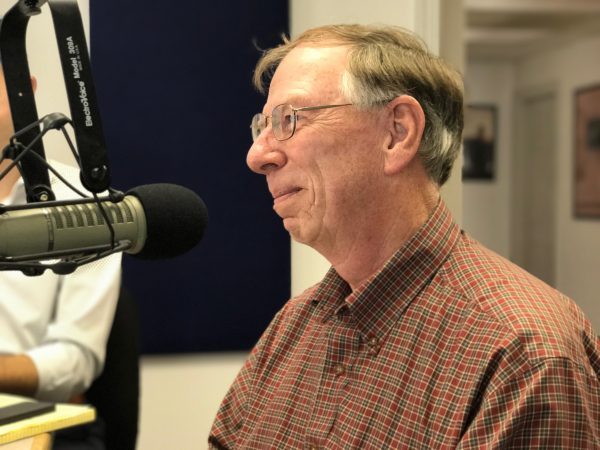
James City County Supervisor John McGlennon stopped into the WYDaily and Tide Radio studios on Aug. 9 to speak about the Surry-Skiffes Creek Connector, nonpartisan redistricting, and affordable housing in the county.
Listen to the interview and read the full transcript below.
Local Voice Interview with John McGlennon on 92.3 FM The Tide with WYDaily reporter Steve Roberts, Jr.
Steve Roberts, Jr.: This morning I want to talk with you about Skiffes Creek, that’s the Surry-Skiffes Creek Connector. It’s a project proposed by Dominion Power. It’s going to cost about $185 million dollars, and it’s supposed to bring 500 kiloVolts of electricity over the James River to James City County.
Supervisor John McGlennon: That’s right. I voted against allowing that substation to be put in place at our meeting in July. A big part of the reason for that was that it seemed entirely out of scale with the surrounding neighborhoods. We have a number of relatively modest neighborhoods in that area.
They already have a lot of industrial impact in that community, but this was going to be plunking down an enormous, basically a $50 million industrial plant in the middle of their neighborhood. And the fact that it’s surrounded, virtually on every side, by major arteries that in the event of an emergency could really cause problems both in terms of getting access to that switching station and to people trying to get in and out of the area.
Roberts: And you represent that area, that’s Grove.
McGlennon: I do. Obviously, I’m concerned what’s going to happen with those folks in those areas. They’ve been asked to put up with a lot of impacts. We have great industry in James City County. They employ a lot of folks. They do a great deal for our economy. But at some point, you have to ask if the residents of one particular area have done enough.
Roberts: We’re going to talk about redistricting in James City County.
McGlennon: At the request of several citizens I did sponsor a resolution that included the platform of an organization called One Virginia 2021, it’s an organization that’s been lobbying for several years for a nonpartisan redistricting plan for the state legislature and our congressional districts.
I took that resolution and added to it a requirement that the James City County board also agree to use non-partisan principles to devising our own supervisor and school board districts. Unfortunately, it failed on a three to two vote.
But as most folks who are involved in the question of redistricting know, it takes a lot of time to convince people that just because they’ve been successful in the process doesn’t mean it’s a fair or a good process. Virginia is fourth worst in the country in terms of competitiveness, we are 5th worst in the nation in terms of compactness of our districts.
I think a lot of folks will tell you they’re totally bewildered by which district they happen to live in. They hear numbers but the number doesn’t necessarily bear a relationship to political units that they really think about like their city county or town, and they really ought to say I live in the district centered on the city of Williamsburg, or it’s the James City district.
Roberts: Looking through the Virginia Public Access Project, the last election you ran for in 2015 you won by 42 votes. A lot of critics have said this is an “incumbent saving program.” They said things were already done right.
McGlennon: One speaker who is intimately involved in this process of partisan redistricting said it was an “incumbent protection plan.” The fact of the matter it was a some-incumbent protection plan and a some-incumbent removal plan. I take great pride in having won the last two elections by very narrow margins despite the fact that those lines were drawn in some ways to make sure that I couldn’t return.
The first way in which it happened is that I was moved from the district that I had been representing for about a dozen years into a new district. That’s great, but I had to reintroduce myself to those people to make sure they knew what I was going to do for them.
Roberts: Is this the death of nonpartisan redistricting in James City County?
McGlennon: I doubt it. This is an issue that goes on and on until we can get some kind of resolution. I still think there’s a very good chance that the Supreme Court will come in and say that partisan redistricting can go too far and we have to create a set of standards by which to judge when that happens.
McGlennon: Sure we’ve seen a lot of changes in our housing market over the years. I would say when I first came on the board one of the interesting aspects of housing in James City County was that so much of it was happening at the relatively high end, but that’s changed.
The average home price has declined significantly. Most housing is being built not by custom builders but by national firms who are coming in and building developments that really do look quite a bit alike from one place to the next as opposed to the variety that we found in earlier times.
But where we really have a big problem is we talk about a bedroom community, and we do have a lot of folks that commute out of the area to work. One of the things we also need to recognize is we have a lot of folks to come here and retire. We have a lot of visitors. That means we have a very large service economy, and many of those service workers are not paid very large sums of money and have a real challenge finding affordable housing in this area.
That’s a real challenge though, it means you’re likely to have some governmental involvement in it because the market is not going to find a way very easily to satisfy those kinds of needs. Of course, we do have a lot of great organizations that are doing some terrific work here like habitat for humanity, and housing partnerships, there are a number of volunteer organizations that are working.
When I hear the families that are going to be purchasing these homes partly through their sweat equity — the work they’re going to do on building the homes or on volunteering with Habitat for Humanity or ReStore — it’s just a catalog of the folks who keep our community moving and our economy functioning and our citizens well cared for.
Roberts: Is the county doing enough?
McGlennon: I guess I’d say, we are doing a pretty good amount, but we are going to continue to look for ways in which we can help Grove or other neighborhoods to help reach their full potential.

