



No decision was issued by the Supreme Court of Virginia on Tuesday after its justices listened to lawyers representing James City County and other groups appeal a decision that approves a 500kV power line proposed to cross the James River near Carter’s Grove on steel towers up to 295 feet tall.
A decision in the case is not likely to be released for several months.
The county is joined by the Save the James Alliance and the James River Association in its appeal of the State Corporation Commission’s decision to approve the line.
German chemical company BASF Corporation also filed an appeal of the SCC’s decision, which was heard by the justices in a separate hearing on Tuesday.
The county is seeking to quash construction of the line, which would run over the James River from a point on the Southeastern edge of Hog Island State Waterfowl Refuge in Surry County to land owned in Grove by BASF. From there, it would go to a proposed switching station near Skiffes Creek.
For the county, SJA and JRA, construction of the line would mar a waterway instrumental to the nation’s founding and key to a continued understanding of the area’s significance. For the county, that could mean economic fallout from tourists less interested in visiting the area because of the tarnishing of the river’s vistas. The line would be visible from historic sites including Carter’s Grove, the Colonial Parkway and Black’s Point on Jamestown Island.
The justices said little during the hearings. They focused their questions and remarks primarily on a motion by Dominion’s attorney Joe Reed to have the joint appeal from the county, SJA and JRA dismissed. His motion sought the dismissal on procedural grounds, citing the timing and manner of the trio’s filing of its notice to appeal the SCC decision. The justices did not rule on the motion.
Andrew McRoberts, a lawyer representing the county, SJA and JRA, spoke before the justices of the historical value of the section of the James River where the line is proposed to be built. He said the towers, which would feature lights and colored balls as precautions to aircraft, would represent an “intrusion” into a “pristine area.”
He said the SCC’s analysis of the project route failed to consider separately the need for the line and whether the route reasonably minimized any fallout on the area’s historic assets. He argued state law requires the SCC to consider the need for the line and the fallout on assets separately, something he said did not occur.
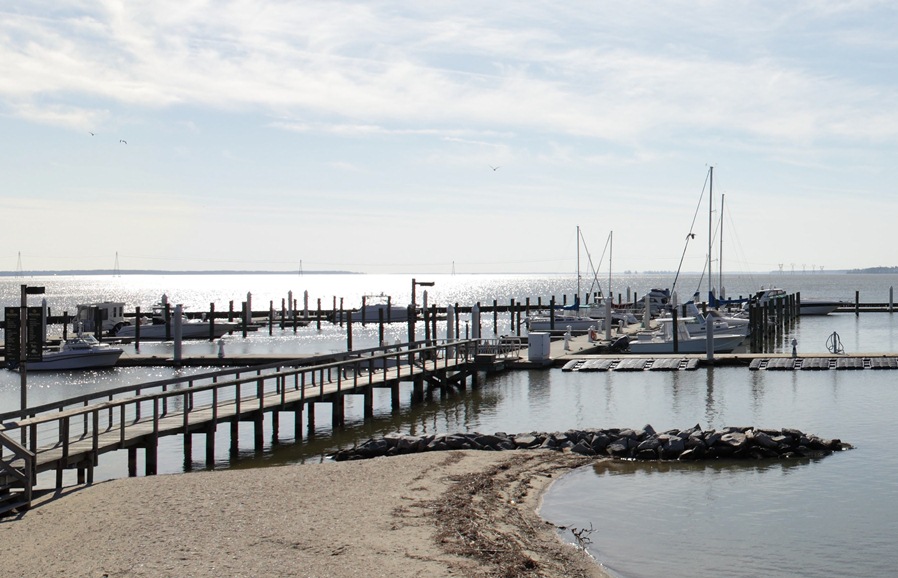
McRoberts focused much of his argument on a part of the SCC decision that states the proposed Skiffes Creek switching station is part of the transmission line. He argued the definition of a transmission line excludes switching stations, thereby granting the county the authority to require Dominion to apply for a special-use permit to construct the station.
The SCC’s lawyer, John Dudley, said the SCC ruled the switching station is an inseparable part of the transmission line because without it, the transmission line could not carry power. If the switching station is found to be part of the line, state law would prohibit the county from using its special-use permit process to try to regulate construction of the switching station.
Michael Quinan, the lawyer representing BASF, told the justices the SCC decision was not in line with state law. He argued the regulators put too much stock in the state’s need for additional power to flow to the Peninsula and not enough in the requirement that the regulators consider whether the project route is one that reasonably minimizes any effects on the area.
He said BASF has spent “tens of millions of dollars” cleaning up the more than 600-acre property from its days as an industrial site to prepare it for its “highest and best use” as a resort. During a November meeting of the James City County Planning Commission Working Group, a team presented the group with conceptual plans for a resort site containing a hotel, timeshares and outdoor recreational areas.
Quinan said the route approved by the SCC cuts through a sensitive area where environmental cleanup is underway, though he noted BASF and Dominion have reached an agreement that would allow the line to be built around it.
He argued the SCC erred in accepting Dominion’s arguments that the approved route was the only one where the line could be built in time. Dominion has long maintained the line is necessary to ensure the stability of the power grid on the Peninsula.

Dudley, the SCC lawyer, said the commission considered that need for the line in its ruling, noting that failure to supplement the power grid on the Peninsula with additional electricity could lead to a situation with blackouts not just on the Peninsula but also in the Richmond area, Northern Virginia and North Carolina.
His remarks echo those of Scott Hathaway, the utility’s vice president for electric transmission who said at a public hearing about the project in September that the line is necessary because of new Environmental Protection Agency regulations forcing the shuttering of the Yorktown Power Station.
Dominion has created a website about the project with a lengthy frequently asked questions section where it addresses several criticisms of the project. Check that out here.
But for the several groups opposed to building the line over the river, the project represents a best case financial scenario for Dominion at the expense of the river’s historic beauty.
“In our view, Dominion has not [fully] explored alternate routes,” said Rob Nieweg, the field director and attorney for the National Trust for Historic Preservation. “Dominion could not put their line in a worse place.”
Nieweg was present in the courtroom Tuesday and said the insistence on building the line at the SCC-approved site is to avoid paying fines to the North American Electric Reliability Corporation. NERC has regulatory authority over power utilities in the U.S. and can levy fines against utilities that are not adequately situated to power their grids.
He said the utility should investigate other alternatives to protect the historic resources people have been working for decades to protect at Carter’s Grove, Jamestown Island and elsewhere in the county. The National Trust produced a video depicting how the line would appear from various historic sites.
Such a move to locate the line away from the historic resources could also generate goodwill toward the utility from the community, he said.
Margaret Nelson Fowler, an SJA founder and trustee, agreed with Nieweg about the utility not going far enough to avoid having to construct the line in the SCC-approved location. She said the power flowing across the river does not have to be generated at Surry Nuclear Power Station and could come from elsewhere in Dominion’s network.
She was also in the courtroom and said she was “pleased” with the proceedings.
“The justices were comfortable with our argument why the case should not be dismissed,” she said. “We thought our arguments were strong as to why the substation isn’t a switching station.”
Related Coverage:
- Preservation, Government Groups to Gather to Share Concerns on Proposed Over-River Line
- Virginia Supreme Court Agrees to Hear JCC Appeal on Dominion’s Over-River Power Line
- JCC Authority Won’t Grant Easement for Over-River Power Line
- Dominion Begins Construction in Surry for Over-River Power Line Despite Missing Permits
- BASF Appeals to James City Authority for Help to Prevent Power Line Route
- State Commission Approves Dominion-Preferred Over-River Power Line
- Dominion Asks SCC to Decide on Over-River Power Line by March
- SCC Hearing Examiner Recommends Against Dominion-Preferred Power Line Route
- Dominion Seeks Extension to Keep Yorktown Station Running Longer
- Dominion May Need to Resubmit Army Crops Application for Over-River Power Line
- James River Association Joins JCC Appeal on Over-River Power Line
- JCC Supervisors Vote to Appeal SCC Ruling on Dominion Over-River Power Line
- SCC Reopens Over-River Power Line Case, Sets Hearing Date
- SCC Reopens Case on Dominion-Proposed Power Line Over James River
