


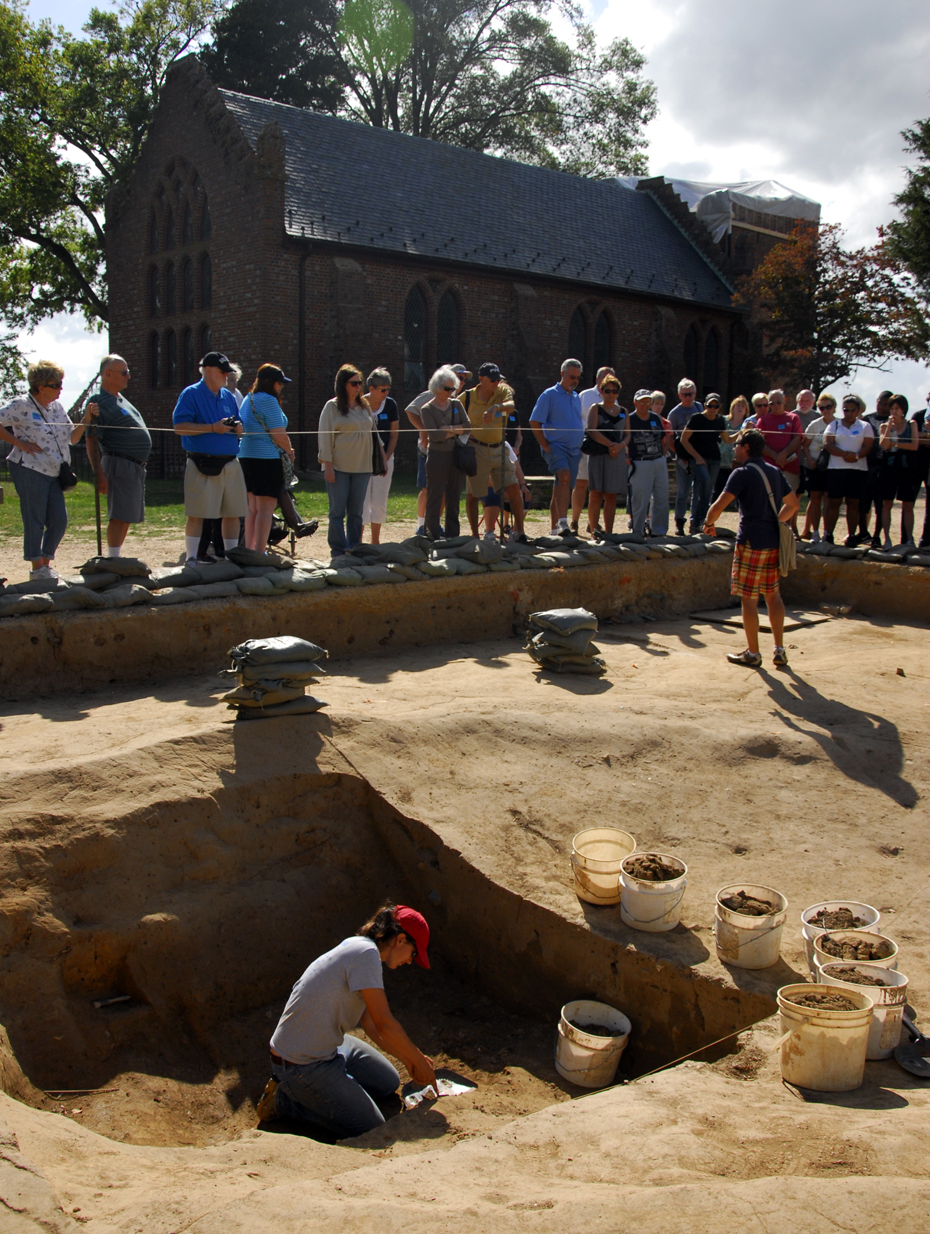
A team of archaeologists from Preservation Virginia has been at work since 1994 uncovering the buried secrets of Jamestown.
When the Jamestown Rediscovery Archaeological Project started, the hope was to find the site of the original 1607 James Fort, which had been written off for more than 200 years as lost to shoreline erosion.
Since then, the team has discovered the fort and more than a million artifacts in the ground. Jamestown Unearthed is a recurring feature in WYDaily exploring the latest discoveries in and around James Fort.
Archaeologists Working to Uncover Cellar Near Edge of Fort
In the last edition of Jamestown Unearthed, the archaeologists were working to determine how early settlers used a pit built immediately outside the fort walls. The presence of postholes and the results of their work has led to the belief a structure of some sort existed over top the pit.
The fort expanded from three sides to five sometime in 1608. Because the way the postholes are positioned, the building would likely have been built into the wall of the fort, said Mary Anna Richardson, a staff archaeologist with Preservation Virginia.
The cellar is believed to be about 14 by 20 feet. Each cellar the team has discovered during the dig was used for a different purpose by the settlers. The cellar was likely used between 1610 and 1620, Richardson said. So far they have discovered plenty of evidence of wild animals but nothing to indicate the cellar existed during the starving time in 1609 and 1610, when food supplies were depleted and a 14-year-old girl was likely cannibalized.
The only other building they have discovered outside of the fort walls has been dubbed “the factory” because of its three hearths, which signify a potential industrial use. Another theory is the factory was used as a trading post with the indigenous people in the area.
The team continues to try to work through layers of trash from the post-James Fort period to try to reach what is known as an occupation layer, where they will find evidence of how the cellar was used. About 1.5 to 2 feet of soil remains between the archaeologists and the occupation layer.
They have also uncovered a sharp, 90-degree slant in the soil which could either be a step or some type of shelving system used in the cellar. Until more of the area can be excavated, the team will not have a clearer picture of how the cellar was used.
Much of that work will have to wait until next year. With the temperatures falling and winter approaching, the team will pause the dig until spring 2015. Thanksgiving week is the last during which they will work on excavations.
The colder months will be spent indoors, analyzing the artifacts they have pulled from the ground, conducting research and planning exhibits for the adjacent museum.
Artifact Spotlight

During the time James Fort was active, Roman numerals were still in use, which made calculations cumbersome. To make it easier, the settlers used small pieces of copper called jettons, which were moved up and down on a gridded table or cloth marked with values to work out math problems.
This jetton, which was found in the trash layer of the cellar, was made by Hans Krauqinckel I of Nuremberg between 1580 and 1586, according to Bly Straube, the senior archaeological curator with Jamestown Rediscovery.
On one side is the Lion of St. Mark. The lion symbolizes St. Mark, the patron saint of Venice. The winged lion clutches the book of gospels. On the other side is an imperial orb under a cross.
About 500 jettons have been discovered at James Fort since the project began. They were valued by the indigenous people, who would sometimes punch holes in them and wear them as pendants, said Dan Gamble, the senior conservator with Jamestown Rediscovery.

These glass pieces, which once formed a wine bottle, were found in the cellar. Alcohol was frequently consumed by the early settlers as the well water was not good to drink, whereas bottled alcohol from the old world did not have that problem.
Gamble is in the process of reassembling the bottle, describing the work as a “jigsaw puzzle that will cut you.”
Related Coverage:
