


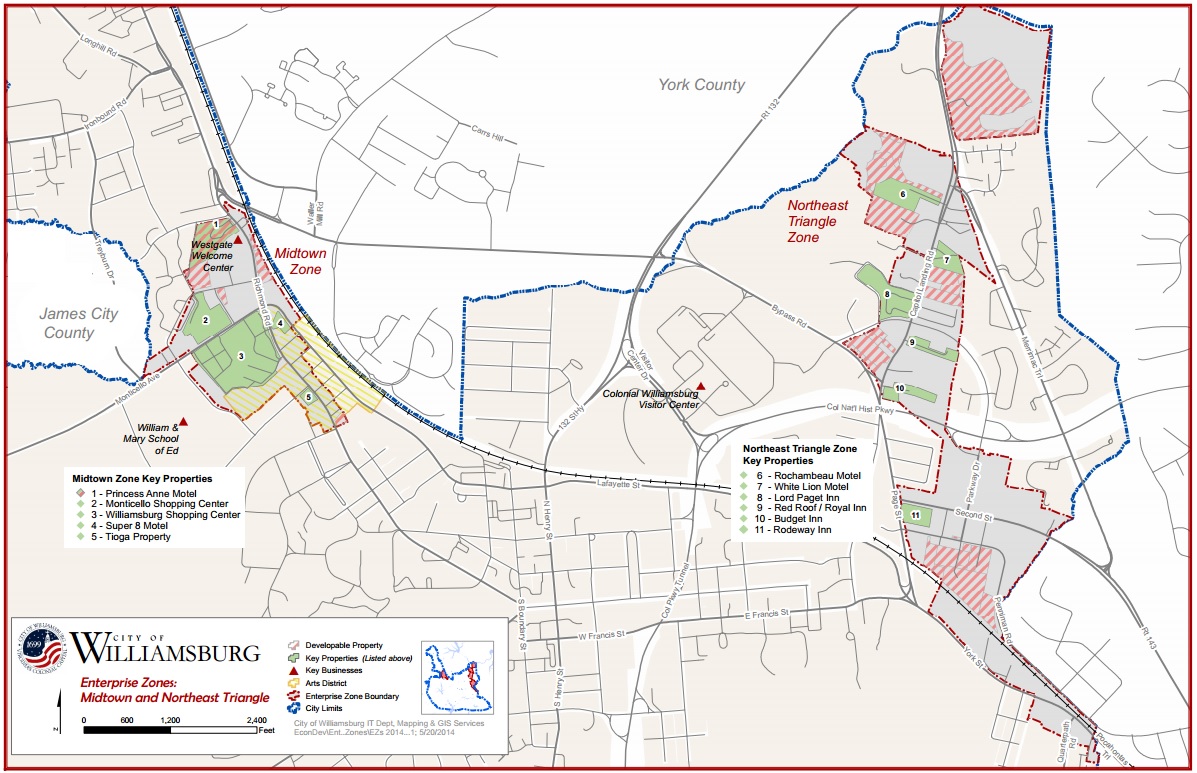
 After a joint application with James City and York counties was rejected last year, the City of Williamsburg will be applying to have two areas within its borders designated a Virginia Enterprise Zone.
The designation, which lasts up to 20 years, would allow both the state and local governments to offer incentives to new businesses within the zones, which are proposed to be Midtown — 86 acres that include a portion of Richmond Road and the area around the Monticello Avenue shopping centers — and the Northeast Triangle — 257 acres around Capitol Landing Road and Second Street.
The state’s enterprise zone program is aimed at creating jobs and encouraging private investment into economically distressed towns.
City Council unanimously approved the Economic Development Authority’s request to apply for the designation at its meeting Thursday. The application is due June 30. If the designation is granted, it would be in effect by Jan. 1 and the council would have to adopt an ordinance specifying the local incentives.
The state, which allows no more than 30 economic zones at a time, will have five openings for enterprise zones next year. The city’s application will be sent to the Virginia Department of Housing and Community Development, which is in charge of choosing the replacements.
Because the state often looks favorably upon regional applications, the city applied with James City and York counties last year in hopes of securing one of the four enterprise openings expected in 2014.
Applications are graded on both their economic distress level and the local incentives that will be offered if the enterprise zone designation is granted. The results showed both counties were among the least economically distressed areas in the state. The distress scale from the state showed the City of Williamsburg at 358 points out of 750, while the two counties remained in the double-digits.
Michele Mixner DeWitt, the city’s economic development director, told members of the Economic Development Authority at their May 14 meeting the other two localities are aware the city will be moving forward without them this year. James City County’s Board of Supervisors approved sending in its own application earlier this week.
“It’s still going to be a longshot,” DeWitt said at the May meeting. “… But it’s a shot worth taking to help revitalize those areas.”
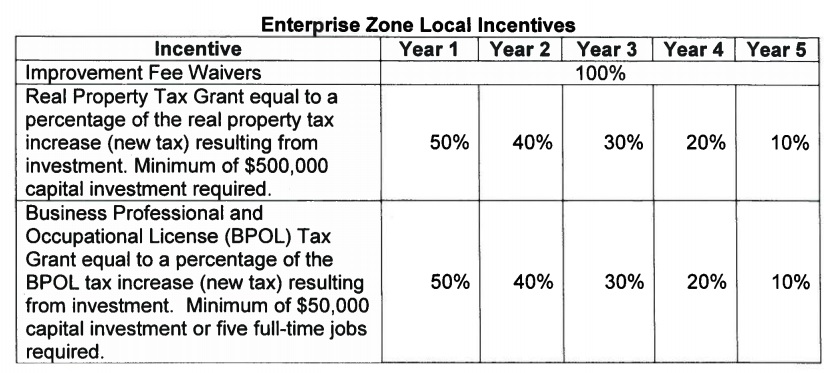 The city is keeping many of the incentives from last year’s application the same, though the funding formulas used to align the city with the other localities last year have been made simpler.
New businesses within the enterprise zones would be given five-year declining grants on real property taxes for capital investments of at least $500,000 and on Business, Professional, and Occupational License taxes for new or expanding businesses that make a $50,000 capital investment or creating five full-time jobs.
“The City will not forfeit or lose any existing revenue from these incentives,” reads a memorandum to City Council. “These are incentives on a portion of future, new revenue that the City does not currently collect but that the proposed [enterprise zone] areas are designed to attract to the City.”
The city is also offering “soft incentives,” DeWitt said, for new and expanding businesses that make a $10,000 investment or create five full-time jobs, such as assigning an EDA board member who will act as a liaison between the businesses and the EDA, showcases of the business at the EDA’s roundtable luncheons and free tuition for local training seminars.
Click here for a full list of incentives the city will offer in its two enterprise zones.
Businesses within the enterprise zones would be eligible for two state grants: the state real property grant and the state job creation grant.
The property grant gives up to $100,000 per building — commercial, industrial or mixed-use — for real property investments of less than $5 million and up to $200,000 for investments of more than $5 million.
The job creation grant offers up to $500 per year for each new full-time position, with the exception of retail, personal service or food and beverage positions, that earns about $12.69 per hour — 175 percent of the federal minimum wage — and up to $800 for positions that earn $14.50 per hour, or 200 percent of the minimum wage.
Related Coverage:
