


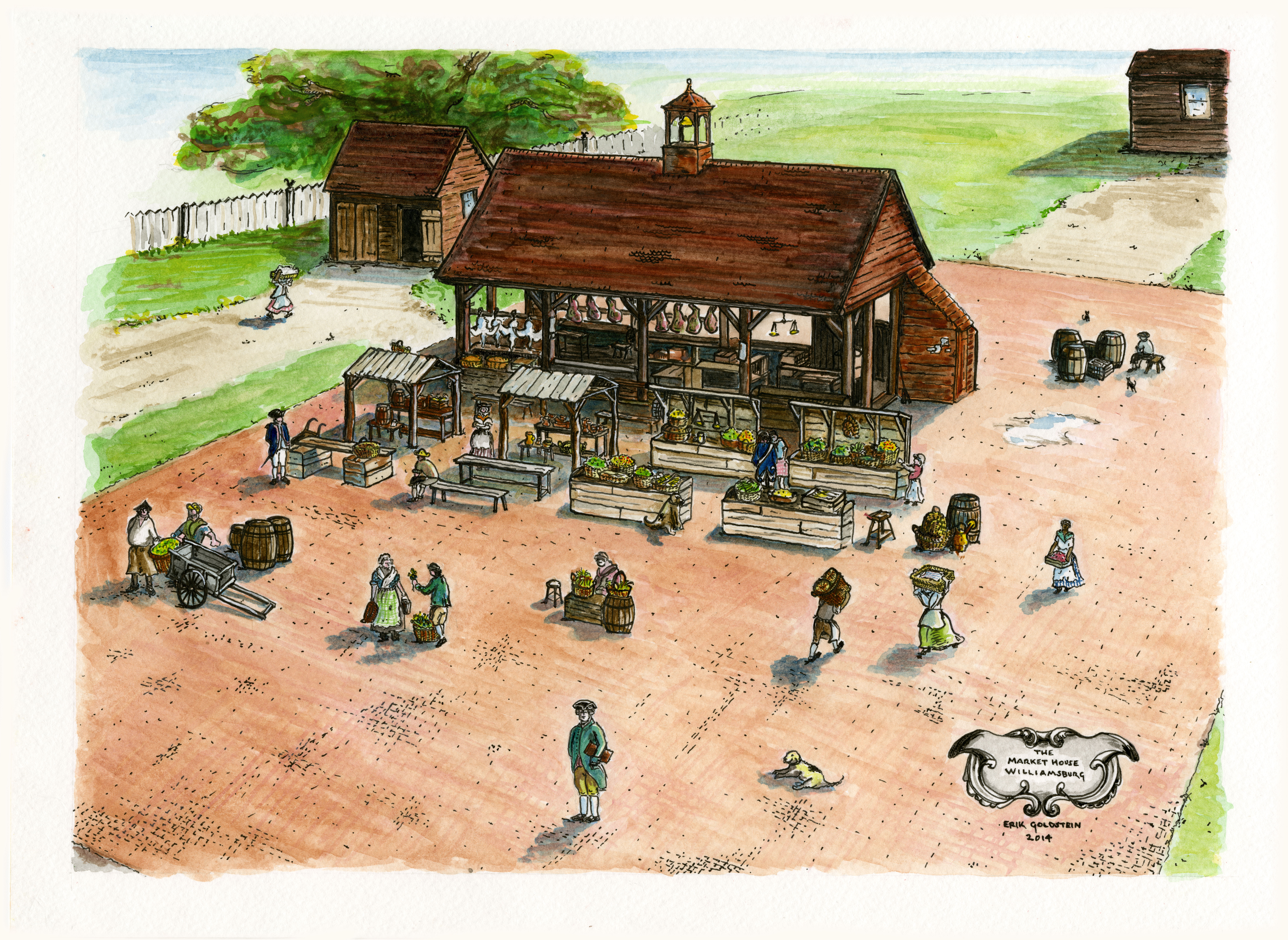
Although the Market House is planned for construction later this year, Colonial Williamsburg’s historic trades workers have spent years laboring over the materials needed to build the open-air market.
At the brickyard, Great Hopes Plantation and in the armoury, historic tradesmen and women are going about their daily duties, but they are all working to forge materials needed to construct the Market House.
After archaeological work last year, Colonial Williamsburg was able to determine the correct placement and size of the last public building to be constructed in the re-created historic town. The Market House, planned for construction at 104 East Duke of Gloucester St. near the Magazine’s Guardhouse, was made possible by a $1 million contribution from Forrest Mars Jr. but would not be ready for construction if historically accurate materials were not available.
The market will comprise a roof, roof supports and a brick walkway and foundation, so copious amounts of bricks, nails and shingles are necessary before construction can begin.
Workers at the brickyard are shooting to make 300 bricks per day this summer as part of a multi-year effort to make more than 52,000 bricks for the Market House, said Jason Whitehead, supervisor of masonry trades. A total of 61,000 bricks are needed for the project, but about 9,000 are planned to be purchased from an outside source – unless the brick makers can pump out the total number needed for the project before its planned construction this fall.
Despite the number of bricks needed for the project, a visit to the brickyard this summer is no different than any other day.
Brick makers still entertain guests with the details of how bricks are made and fired, and visitors can still stamp their feet in a clay pit to help prepare native Virginia clay for molding into bricks.
Rows of bricks lay in the sun to air dry, waiting to be fired in late July or early August or mid-November, before Thanksgiving.
Because the bricks are being fired for walkways and foundations, only the well-fired, hard bricks will be used. About 20 to 30 percent of bricks are over-fired, which causes them to become brittle.
Paving for the Market House is planned to begin in early September, and the foundation for a planned scale house — used to store scales for the Market House — will likely begin at the same time. Bricks fired in November will be used next spring for the Market House itself.

A short drive away from the brickyard, over at Great Hopes Plantation near the Visitors Center, carpenters are using hurricane-felled cedar trees from south New Jersey to make about 15,000 shingles for the Market House.
Between six workers, about 1,000 shingles are coming out of the historic plantation each week.
The cedar trees are hacked into logs and cut into 18-inch sections. Each section is halved, then quartered using a long wedge, called a froe, said Jack Underwood, journeyman Historic Trades carpenter. The outer tree ring, close to the bark, is removed as it is most susceptible to wood rot, and the quarters are split into flat pieces for carving into shingles.
The carpenters sit at their clamp benches — one of which is decorated with a deer skull found in the nearby woods — using their feet to control the clamp and two-handled blades to taper the shingles, and then round off the edges.
Accuracy through modern measurement is not an option; the carpenters align the shingles with their benches to check for straightness and uniformity. Five minutes after starting, the carpenters toss their completed shingles onto a stack and move onto their next ones.
Visitors stop to watch the work and the carpenters explain the process, not slowed by the impending construction project they are working toward.
In the fall, the carpenters will begin sawing support beams — joists and rafters — for the roof, which will laid out at the plantation, chiseled with Roman numerals for assembly, then carted over to the Market House site for final assembly.
At the James Anderson Blacksmith Shop and Public Armoury site, workers are hand-hammering iron bars into nails.
“Our role, really, is the iron and steel components of the project. The Market House really is a large roof, so it means mostly nails,” Master Blacksmith Ken Schwarz said. “As the project progresses, there are some furnishings in the building, which will be hooks, and the tin shop will be making lanterns and lighting, balance scales, hardware for furniture.”
Right now, the armoury is working to produce 15,000 nails. Every shingle needs a nail to hold it, but the gabled ends of the building will eventually require more nails.

Schwarz said someone practiced at nail-making can produce close to two per minute, so the armoury projects 100 can be made per hour.
“The way we approach nail making is … instead of dropping what we’re doing and making 15,000 nails, if we make 75 or 100 nails between our other projects each day, at the end of the year that gives us 20,000 or 30,000 nails,” Schwarz said.
To create a nail, a worker heats a long iron bar until it is red-hot. The end of the bar is hammered into a point and then worked on the anvil corner to define the nail length. Once ready, the nail is cut from the bar and held while the nail head is hammered.
Once the nails are ready, the carpenter’s crew will assemble the building itself, which is planned to be open by late 2015.
“To me, one of the interesting aspects of a project like this is Colonial Williamsburg’s historic Trades had the ability to manufacture every single component of the building and then to furnish it and operate it as well,” Schwarz said. “There really are few institutions in the world that have that capability. It’s a treasure that we have that we sometimes take for granted.”
