


Community participation and input is again at the forefront of a James City County road study.
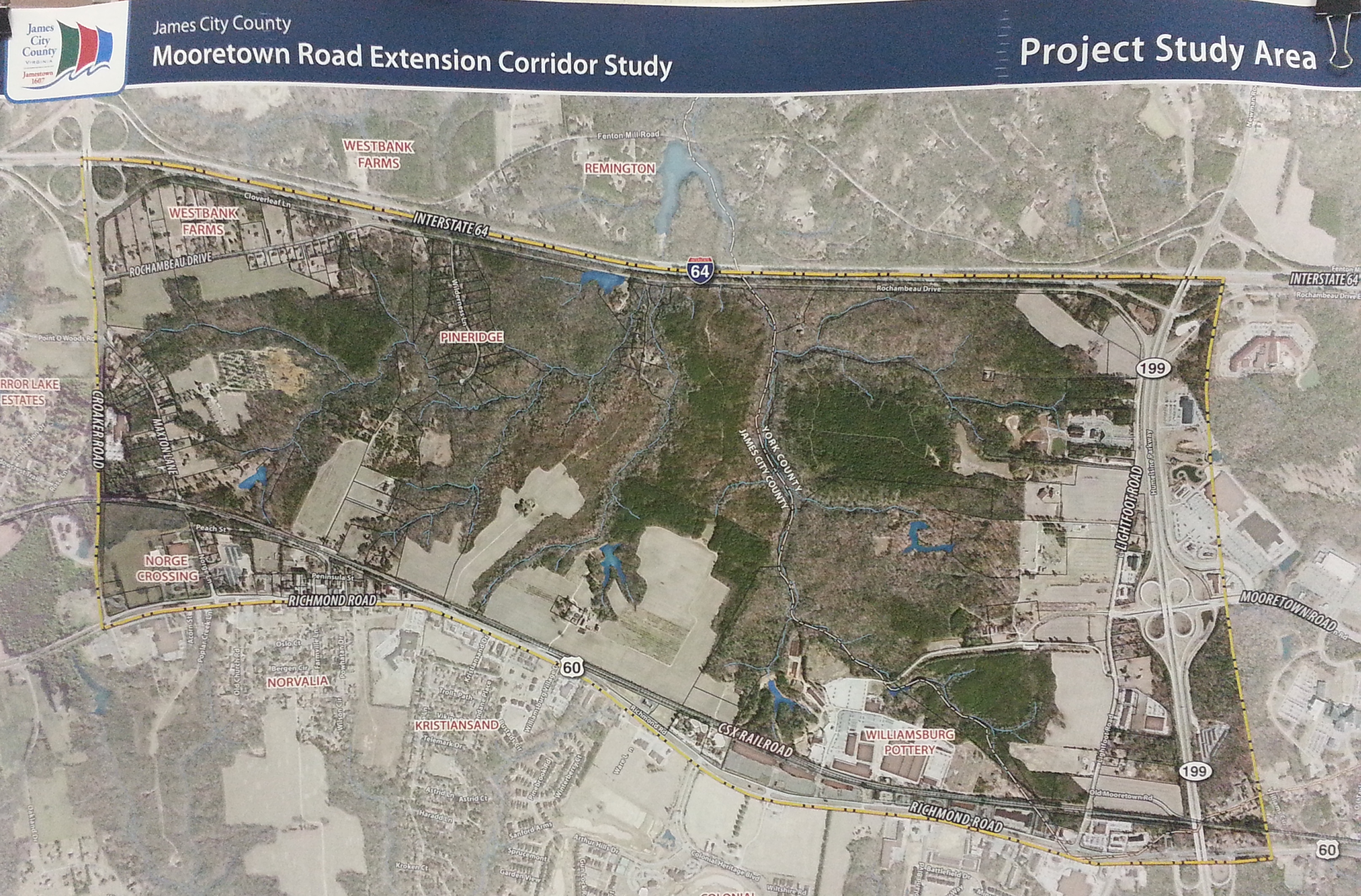
County citizens were invited to provide input at a Tuesday meeting on a possible Mooretown Road extension, which would run between Lightfoot and Croaker roads.
Vanasse Hangen Brustlin Inc. – a planning and engineering firm – has been tasked with delving into the details associated with extending Mooretown Road to execute a full study on possibilities. The entire study will likely last 12 to 15 months and will include multiple public meetings. VHB led a presentation Tuesday about parts of the study completed to date, then invited the public to ask questions and provide comments.
“We’re not here to debate anything. We want your input, your ideas,” said Keith Lewis, a principal engineer with VHB.
Residents who attended the meeting were concerned about the effect of a new road on housing areas and the surrounding land.
“Why do we need another road[?]” one citizen wrote on a comment board at the meeting.
Other citizens suggested using Rochambeau Drive, which one citizen said is “in disrepair,” instead of adding a new road. Croaker Road should not become a bottleneck area, citizens said.
An extension of Mooretown Road would cross property in York and James City counties between Richmond Road and Interstate 64. The land has some streams and wetlands, as well as associated resource protection areas, which serve as buffers from development.

Some areas were identified as being ideal habitats for endangered species, including salamanders and small whorled pogonia, a type of orchid. Whether these endangered plants and amphibians are present has not yet been determined.
Another point of concern to citizens was potential development in the Stonehouse neighborhood in Toano, which could include additional houses and commercial businesses.
VHB staff compiled traffic projections for roads surrounding the proposed extension area using data from the counties about approved development. The company included Stonehouse, Colonial Heritage, The Village at Candle Station, Lightfoot Marketplace and White Hall in traffic data.
Current traffic shows about 17,300 vehicles per day drive on Richmond Road near its intersection with Croaker Road, about 8,500 vehicles per day travel Croaker Road between Richmond Road and Rochambeau Drive, and about 11,600 vehicles per day use Croaker Road on the other side of Rochambeau Drive. For the existing roads, intersections in the area are graded A/B and C/D on an A-F scale.
On the York County side, there are about 7,200 vehicles per day on Lightfoot Road between Richmond and Mooretown roads. About 10,600 vehicles per day travel Mooretown Road near Lightfoot Road. Intersections in the area are graded A/B and C/D as well.
Projections for 2040, which take into account approved area developments, show some numbers nearly doubling.
Traffic projections for Richmond Road near Croaker Road show about 33,700 projected vehicles per day. About 16,300 vehicles per day are projected for the stretch of Croaker Road between Richmond Road and Rochambeau Drive, and about 24,100 vehicles per day on Croaker Road past Rochambeau Drive. The intersections in the area would be graded C/D and E/F for high traffic volumes.
On the York County side, 2040 projections show about 10,100 vehicles per day on Lightfoot Road between Richmond and Mooretown roads, and about 14,500 vehicles per day on Mooretown Road near the intersection at Lightfoot Road. If roads are left as-is, intersections will be graded C/D and E/F.
At the end of March, VHB held meetings with neighborhoods and property owners in the study area. From the meeting, VHB was able to draw several points in support of the extension as well as a few drawbacks.
VHB determined the road could provide:
- job growth opportunities because of new development in James City and York counties
- an expansion to areas that currently suffer from limited access
- additional routes during congestion or emergency travel
The firm also identified drawbacks in that meeting, such as the road would:
- benefit a few large landowners
- hurt environmentally sensitive areas
- come with a high cost both to build and maintain it
- negatively affect the quality of life for existing residents
The possibility of extending Mooretown Road first came on the books in 2005 in York County and 2009 in James City County. Each locality in its Comprehensive Plan included the extension as a study topic.
York County Principal Planner Tim Cross, who was present at Tuesday’s meeting, said York’s position has been the road should be paid for with private funding rather than “scarce public funds.” He said he was unaware of any private parties interested in funding the extension. Cross said he was interested in following the study and seeing where it goes.
James City County has taken the reins on the study but has not dedicated any funding to a new road. The study will provide further insight into whether the extension would be a benefit before the county — or a private developer — decides to put funding toward the new road.
The study will delve into potential benefits of a road extension. VHB will look at environmental conditions, residential areas, existing businesses, existing churches and libraries, current and projected traffic conditions, permitted land use and an area job market analysis.
Once information is gathered, VHB will evaluate alternate roads with citizen input.
“We want to make the decisions that are the best all around and include your comments,” Lewis said.
A final design for the road would not be created until a route were approved, funded and analyzed for environmental concerns.
James City County is looking for public input on the extension; a website has been created for the study. County Zoning Administrator Jason Purse is the point of contact for the study; he can be reached at 757-253-6685 or via email at [email protected]. Additional public meetings are projected for September and December.
