


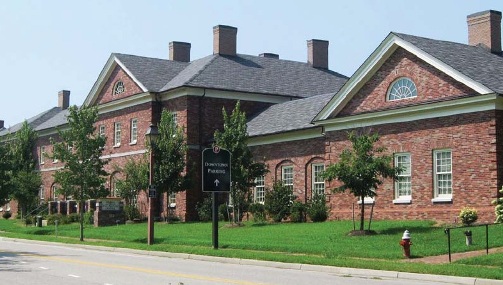
The Williamsburg Health Evaluation Center, a state-of-the-art preventative health care facility, quietly closed its doors over a year ago after being open for just two years.
The 23,332-square-foot Center, currently valued at $5.1 million, opened in March 2009. The center was intended to be an executive clinic and aimed to provide wealthy clients medical services to the tune of about $5,000 per patient, according to a 2006 story in the Daily Press, which also said the Center originally planned to open in late 2007. It offered private suites with living areas, printers and fax machines, and flat-screen televisions, according to a 2009 story in the Williamsburg Health Journal. The building also housed Sentara’s Advanced Imaging Center, which targeted the general population and offered better images with less wait time than a hospital offers.
The Center closed two years after it opened, in March 2011, according to Williamsburg’s Commissioner of the Revenue’s office, though Williamsburg City Council Member Paul Freiling says the uses had been phased out over a period of time. The gradual closing of the facility happened without fanfare and since then, the prime piece of real estate in the city has remained dark and unused.
A Sentara spokeswoman said the imaging equipment was only fully moved out on Aug. 22 this year, and city Economic Development Director Michele DeWitt noted that a broker, Jay Joseph of Harvey Lindsay Commercial Real Estate, was only recently selected to work on leasing the site.
A call and an email to the property owner E.D. “Buddy” David were not returned.
“When the Health Evaluation Center was first proposed, it seemed to be a good use for under-utilized property in the urban section of a key entrance corridor that already was home to buildings of similar or larger scale,” Freiling said, citing buildings such as the Williamsburg Regional Library, the Museums of Colonial Williamsburg, the National Center for State Courts, and the William & Mary School of Law.
The project had other advantages, too, he said. “The ability to utilize pre-existing shared parking meant that more asphalt-covered surface parking would not have to be built. Its proposed use was also of reasonable intensity so that it would not compromise any residential areas.”
Though Freiling said many issues contributed to the building phasing out of use, “as with many of today’s challenged businesses, economic pressures have played a major role.”
The city is hoping the building will not be sitting vacant much longer, and it said as much in the most recent draft of its Downtown Planning Area document: “an important building available for adaptive reuse is the vacant former Health Evaluation Center, a 23,750 square foot building located on North Henry Street.
“This area provides a transition between the Merchants Square commercial uses and the residential uses on the east side of North Henry Street, and is served by the major infrastructure improvements that the City completed in the City Square and Prince George Street areas, including the City Square Parking Terrace and the Prince George Parking Garage.”
DeWitt said the location is a good one for a business looking to locate in a central area. “We think the building will provide a business or a group of businesses a unique stellar quality location downtown.”
When asked what sort of business the city envisioned in the space, she said “all of our professional service uses in our economic development strategic plan would fit.” This includes businesses that offer professional and business services and research and development, as well as cultural arts and niche markets.
Freiling had some words of caution as the city considers its hopes for the future uses of the building. “Care should be exercised about limiting the potential for adaptive re-use by being too restrictive or specific in what we would prefer,” he said. “The building is in place, which already limits to some degree the possible uses.”
Though there are some limits based on the structure itself, Freiling also noted the location is very close to the downtown area and there is ample parking at the facility, all of which could attract a business that will be a positive impact on the city.
“In order for our community to remain strong, we must ensure that our downtown and other business areas remain vibrant. Rather than fear change, we should embrace the possibilities of a dynamic future,” Freiling said.
“We must strive for innovation over stagnation. While everything we do is not guaranteed to succeed, doing nothing would surely be our undoing.”
