


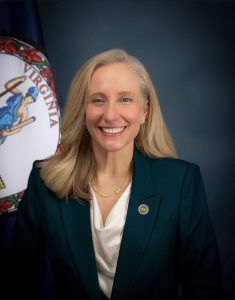
WILLIAMSBURG – Virginia Gov. Abigail Spanberger announced Saturday that she will deliver the Democratic response to the State of the Union address from the Historic Area of Colonial Williamsburg Foundation on Feb. 24.
The governor is scheduled to speak from the site of Virginia’s 18th-century capital, where leaders including Thomas Jefferson, Patrick Henry, George Washington, and George Mason debated independence nearly 250 years ago.
Cliff Fleet, president and CEO of the Colonial Williamsburg Foundation, said, “Civil discourse and debate have been the hallmarks of Williamsburg’s history for more than 250 years.”
“As an educational organization dedicated to teaching about America’s founding, Colonial Williamsburg proudly advances this American legacy by encouraging civic engagement and hosting leaders from all sides of the political spectrum. That 100-year tradition continues next week when Gov. Spanberger addresses the nation from Williamsburg, Virginia — where almost exactly 250 years ago, Virginia’s lawmakers voted after years of vigorous debate to propose independence for all 13 colonies to form a new nation,” he added.
Founded in 1926, the foundation is said to have welcomed U.S. presidents from both political parties, including Dwight D. Eisenhower, Ronald Reagan, George H. W. Bush, Franklin D. Roosevelt, Jimmy Carter, and Bill Clinton. It is said that international leaders have also appeared at the site, including British Prime Ministers Winston Churchill and Margaret Thatcher.
“The Foundation engages people of all backgrounds and beliefs in the ongoing work of America’s Founders to form a more perfect Union,” said Fleet. “We invite every American to experience the unique power of Colonial Williamsburg — to walk in the footsteps of our forebears and discover our nation’s history. And to join us in the educational mission that has sustained us for a century, and now guides us into the next: ‘that the future may learn from the past.’”

