


WILLIAMSBURG — Noting the high number of animal-vehicle collisions on Jamestown Road near Lake Matoaka, Randy Chambers, director of William & Mary’s Keck Environmental Field Laboratory, assembled a group of W&M volunteers to do something about it.
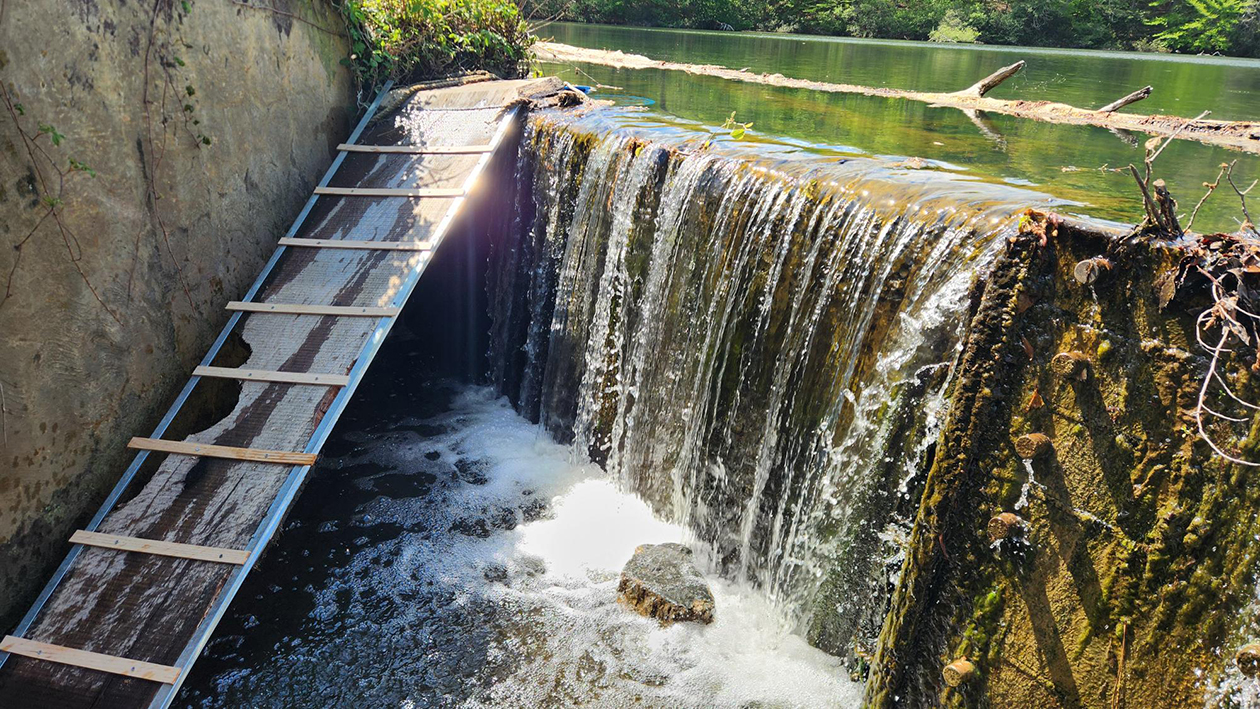
The team, including a landscaper, a woodcraftsman, a naturalist and a student, have successfully installed a wooden ramp that they hope will encourage animals to traverse underneath the road via a culvert instead of risking a sprint across the asphalt, according to a report at W&M News.
So far, they’ve seen success: Video cameras have recorded raccoons, beavers, muskrats and even otters up and down the ramp. The animals’ interest sows hope for Chambers, his team and future generations of Williamsburg’s furry and scaly inhabitants.
For the sake of the otters
According to the university, the North side of Lake Matoaka is kept at bay by a dam, which feeds into College Creek. Since the 1700s, the spillway from the lake to this creek has been intersected by Jamestown Road. A box culvert runs underneath the road, conveying overflow water from the dam to College Creek. But with a four-foot-tall concrete wall forming the Matoaka entrance to the watery tunnel, few, if any, animals use this underground route. Instead, they make a dash for it through traffic.
Many survive, but some don’t.
One animal in particular spurred this project — the river otter, often spotted in and around Lake Matoaka. Unfortunately, Chambers discovered two of them killed by vehicles on Jamestown Road.
While no one knows exactly how many otters there are, Chambers says they sometimes live in groups, so he hopes there are at least three family members left. According to W&M, beyond the affinity for nature that otters inspire, Chambers sees them as a good omen for the local ecosystem.
“Seeing an otter indicates that fish are present — and that the entire web of organisms and microorganisms supporting those fish exists in sufficient abundance,” he told W&M News. “So, when I see otters, I take that as a sign of ecosystem health.”
Unfortunately for the otters, they aren’t the top predator when crossing the road, which they might do when tempted by an easy snack.
“On the College Creek side of the road, the water over the dam forms a plunge pool basin,” said Chambers. “Whenever fish travel through the culvert, they fall right into this pool and get stuck there. For the otters, it’s literally like snatching fish out of a barrel.”
The Safe Wildlife Crossing project
Working with Tony Orband, W&M’s associate director of grounds & gardens, Chambers secured a Green Fee grant of over $1,000 from the university, it said.
The Green Fee program awards money to individuals and groups within the W&M community for sustainability-related projects. A tuition-based student fee, the fund has distributed over $1.75 million to over a hundred projects since 2008.
The grant helped Chambers and Orband purchase wildlife crossing signs, which they set up near the dam. The second phase of their project involved building a ramp down the spillway. To create this structure, the university said they turned to Chris Wagner, technician for the art department, otherwise known as “the guy who builds things.”
Wagner, a skilled woodcraftsman, and his student assistant, Raven Padua, began brainstorming. Since the culvert and spillway are under the jurisdiction of VDOT, the ramp could in no way alter the existing infrastructure. To meet this requirement, they built a wooden ramp entirely from campus-sourced lumber — the result of a partnership Orband had developed with the Virginia Department of Wildlife Resources. Weighing over 200 pounds, it took four people to maneuver the bulky object in place.
The first ramp washed away during a torrential March rainstorm. Undeterred, Wagner and Padua got to work on version 2.0. Anchored in the lake by two big plastic barrels filled with rocks, this version withstood the rain. But it wasn’t prepared for another phenomenon of nature — the beaver. Cameras set up by Keck Research Lab Assistant Cheryl Leu caught one gnawing on its wooden frame. That discovery inspired version 3.0, reinforced with metal sidebars to thwart any future chewing.
Deployed in April, this design seems to be holding. Watched by Leu’s cameras, the ramp is experiencing more and more animal traffic, including several otters. Their trips up and down the slippery structure are aided by little wooden support rungs added by Wagner, the university said.
“So far, we haven’t seen any more dead otters,” Chambers told W&M News. “And the videos show they are becoming familiar with this new structure, so we really hope they’ll identify it as a convenient way to cross the road when the water level isn’t too high.”
A little bit of joy
On a recent fall day, observing students on the newly created pedestrian bridge connecting the West Woods to the center of campus looking down into a pond, Chambers saw a lone male otter in the water.
“Seeing him here means the otter family is alive and well — and not getting hit on Jamestown Road — which ties directly back to our ramp,” Chambers said. “Thanks to the Green Fee, students get to watch this beautiful creature up close on campus. It’s a great reminder of the natural world we share at W&M.”

