


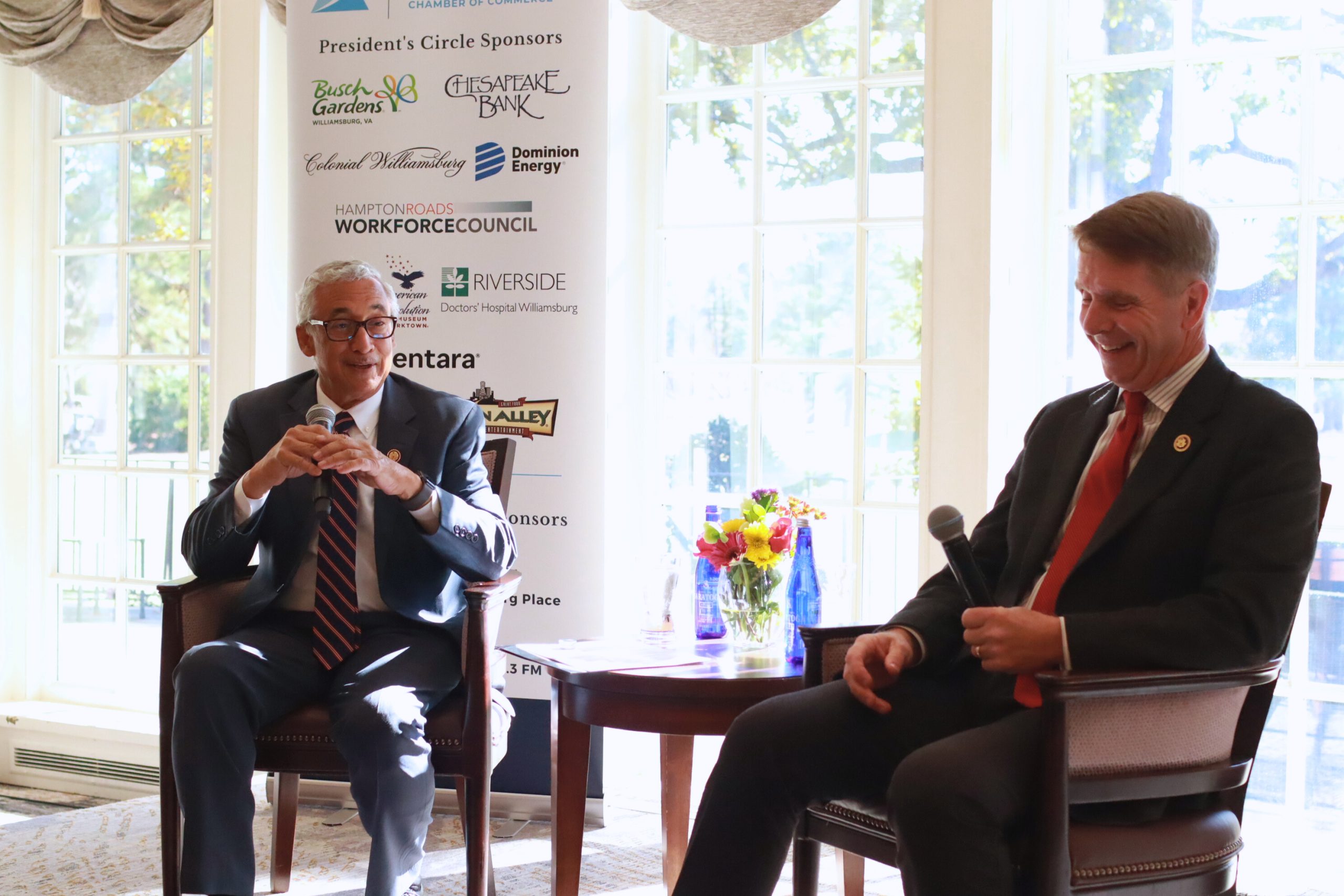
WILLIAMSBURG — U.S. Representatives Bobby Scott and Rob Wittman joined the Greater Williamsburg Chamber of Commerce Friday for A Congressional Conversation at Williamsburg Inn.
Scott, a Democrat, has represented Virginia’s 3rd Congressional District since 1993 and is a ranking member of the Committee on Education and Workforce. Republican Wittman represents the 1st Congressional District and is vice chair of the Armed Services Committee and serves on the Natural Resources Committee.
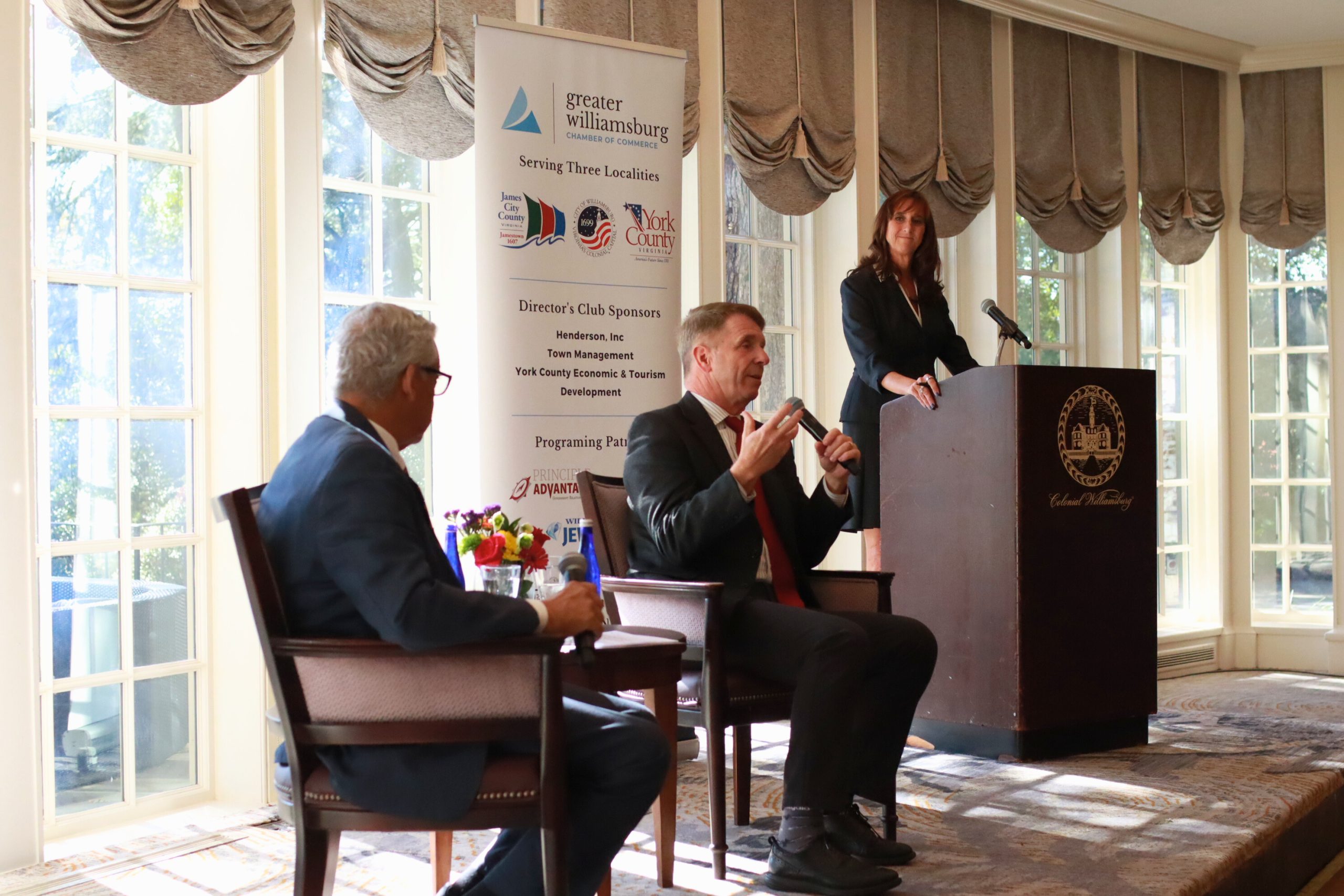
The conversation, moderated by Mindy Carlin of Access Point Public Affairs, covered a variety of topics ranging from regional economic development to legislative priorities to federal policy impacts.
Impact of Virginia’s Recent Election
“I think that the shutdown really was part of it,” Scott said, noting the high turnout and echoing the assessment of Gov. Glenn Youngkin. “Hopefully, that will encourage people to come together, sit down and discuss what we can do to get the government back open. So I think that’s the major, major effect.”
“I think now it’s really our opportunity and responsibility to make sure that we don’t forget that it’s about governing Virginia, about doing what’s right for Virginia,” added Wittmen, noting “The Virginia Way” — doing what’s in the best interest of the Commonwealth. “I think the takeaway from this is the people have spoken, and now it’s our job to get the work of the Commonwealth and the nation done and work together to make things happen.”
When asked how the election will impact the competition for federal dollars for items like infrastructure broadband or workforce development funding, both remained optimistic.
“I think the challenge for us, as Virginia members, is to make sure we are part of the process. And the good news is that Bobby’s a senior member, so within his caucus, he carries a lot of weight as far as the things that can be done need to be done within their caucus. I’m in a position in my caucus to be able to do the same,” explained Wittman.
Wittman added Virginia is one of the few states left where all members of the delegation — Republicans, Democrats, House and Senate — meet for lunch to discuss issues of the Commonwealth.
The Shutdown
“I’m adamant, every time one of these things happens, I believe that they’re avoidable, all of them, and I’m not interested in who gets the blame. I’m interested in what we do to get things reopened. Let’s get the government reopened,” Wittman said. “We always do go back and make sure that our federal employees get paid. The other thing, too, we always make an attempt to do this, sometimes successful, sometimes not, to make sure that our contractors get paid.”
Scott agreed, noting contractors who look like employees — custodial staff, for example — who can’t work when the building is shut down. But, he caution while continuing resolutions are typically not controversial, the president’s take on how appropriate money is, or is not spent, would be a sticking point.
Wittman added that changes needed to happen in the way Congress operates.
“The challenge is, we have a system that kind of leads us to a continuing resolution. This is year 18 in a row where we have a continuing resolution. I believe that there has to be some functional changes in how Congress operates, and some of those things are as simple as saying, get all 12 appropriations bills done before the end of July, and if you don’t, then you’re going to hang around in Washington until all 12 are done.”
Since Friday’s event, seven Senate Democrats and one independent joined Republicans on Sunday night to advance legislation to reopen the government and temporarily keep it afloat until the end of January.
Redistricting
Unsurprisingly, the proposed constitutional amendment that would give the Virginia General Assembly the authority to redraw the commonwealth’s congressional districts mid-decade, backed by state Democrats, drew a mixed response.
“I think it’s horrible that we’re involved in this, but I think it’s frankly necessary,” said Scott, noting how redistricting changed the makeup of North Carolina last year, and moves in Missouri and Texas this year. “It’s regrettable, but I don’t see how Democrats can sit back and allow a piece to be essentially stolen in other states without a response.”
“I think it’s fundamental to what Virginians have spoken to — there was an amendment on the ballot … went through the process, two General Assemblies … and two-thirds of the voters said, we want a bipartisan redistricting committee … and I think that that’s what the voters demand,” countered Wittman. “We can make all kinds of assertions about what’s happened in other states, but the bottom line is, we have to do what is best for Virginia, and what’s best for Virginia, I believe, is making sure that we have a balance in the congressional delegation.”
Federal Programs for Tourism, Hospitality and Historic Economic Sectors
Both representatives advocated a regional approach to tourism.
“One of the things I’d like to see in the region is more of a regional approach on tourism,” said Scott. “There’s so much, so many activities that could be attractive for small conventions, family reunions, and just regular tourists coming to the area that we’re not taking advantage of because we’re not taking a reasonable, strong regional approach.”
“I agree with Bobby, a regional approach is key. And then also looking to what venues attract people,” Wittman said. “What Williamsburg is doing now with the new sports center, you look at what parents do with travel teams and their children, it’s amazing what they do. For us to be able to attract those sorts of activities here is key. Also, having other venues to make sure you have entertainment opportunities with larger crowds … What we want them to do is to come to the region for more than one day. We want this to be a destination travel location.”
Transportation
“I think we made a lot of progress with infrastructure bills, the biggest infrastructure package since Eisenhower,” Scott said. “The money not only did roads, bridges and tunnels, but also mass transit, rail … they’re making progress. And I think the transportation bill gave us the wherewithal to get a lot of projects through.”
“I agree, there’s a lot of good things going on the region. The Gap Project is going to be a big improvement. To be able to move people down the corridor into the Williamsburg Peninsula, Hampton Roads area. The HRBT project is going to have a giant impact in being able to move people efficiently through the region,” Wittman said, also stressing the region is a maritime center, and better using waterways is something to be explored.
Digital Infrastructure
“I think digital infrastructure is key … make sure you not only have connectivity, but you also have speed with that connectivity,” said Wittman, who also stressed the need for security.
He also Congress needed to play a role in the development of artificial intelligence.
“Artificial intelligence is going to play a big role, and I believe Congress, too, needs to set the guardrails on what artificial intelligence does and what it doesn’t do,” he said. “The foundation of artificial intelligence is all about data. Where is the data coming from? Who’s going to control it? How do we make sure that it’s used for the purposes of good?”
Human Services and Health Care
Scott expressed concern for the rising cost of insurance in the Affordable Care Act without the extension of subsidies, a driver behind the shutdown.
“If people lose their insurance, they’re really a burden on everybody else,” Scott said, noting when they get sick and go to the hospital, they don’t pay. “When you go to the hospital with your insurance, you pay a little extra. So everybody’s insurance will go up … Everybody has an interest in everybody being insured.”
“I think the big issue with healthcare is the continually rising cost — rising costs that are faster than the rate of inflation. So, I think we have to go back and start asking some fundamental questions. What can we do to reduce healthcare costs? Because if we’re going to do the things necessary to make sure we continue to enhance accessibility, we have to talk about costs,” said Wittman, who also sees a bipartisan opportunity in reeling in pharmaceutical costs.
Optimism
When asked what brought them hope in the work they were doing, both talked about job training.
Scott cited progress on reauthorization of the Workforce Innovation and Opportunity Act, which had been on hold since last December, saying it was one area where the Education Workforce Committee has traditionally worked together. He also noted the expansion of Pell Grants to job training programs, a provision added to H.R.1 — the One Big Beautiful Bill Act.
“So, we’ve got that underway, but I think we’re working constructively on reauthorization of WIOA, and I think that’s going to be what we’re hopeful for in the Education Workforce Committee,” he said.
Wittman added the Freedom to Invest in Tomorrow’s Workforce Act, something he introduced and was passed in H.R.1, allows 529 accounts to be used for any post-secondary education.
He also spoke of the bipartisan effort to reform the Pentagon’s acquisition process and to draw small, emerging defense companies to the region.
“I think that there’s going to be an incredible opportunity in the years to come here in the Hampton Roads area. In fact, this will be one of those transformational moments where we go from not just building those exquisite ships — those aircraft carriers and submarines — but also go to build those, those small, adaptable platforms, those unmanned aerial systems, those unmanned underwater vessels, unmanned surface vessels, and we put in not just the hardware, but the software engineers that design the incredible things that those platforms can do, all of that’s going to happen Right here in Hampton Roads,” Wittman said.

