



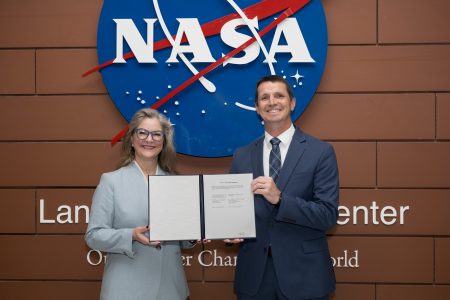
HAMPTON — NASA’s Langley Research Center in Hampton and Embry-Riddle Aeronautical University signed an agreement during a ceremony held Sept. 11 at NASA Langley to advance research, educational opportunities and workforce development “to enable the next generation of aerospace breakthroughs.”
The collaborative work will happen through a Space Act Agreement that will leverage NASA Langley’s aerospace expertise and Embry-Riddle’s specialized educational programs and research to drive innovation in aerospace, research, education and technology, while simultaneously developing a highly skilled workforce for the future of space exploration and advanced air mobility, according to NASA.
Trina Marsh Dyal, NASA Langley’s acting center director, and Jeremy Ernst, vice president for Research and Doctoral Programs at Embry-Riddle, presided over the ceremony.
“NASA Langley values opportunities to partner with colleges and universities on research and technology demonstrations that lay the foundation for tomorrow’s innovations,” said Dyal. “These collaborations play an essential role in advancing aeronautics, space exploration, and science initiatives that benefit NASA, industry, academia, and the nation.”
In addition to forging a formal partnership between NASA Langley and Embry-Riddle, NASA said the agreement lays the framework to support Embry-Riddle’s development of an Augmented Reality tool by using NASA sensor technology and data.
Augmented Reality uses computer-generated elements to enhance a user’s real-world environment and can help users better visualize data, NASA said. Incorporating model and lunar landing data from Navigation Doppler Lidar, a technology developed at NASA Langley, this tool will enhance visualization and training for entry, descent, and landing, and deorbit, descent, and landing systems — advancing our capabilities for future Moon and Mars missions.
“As we work to push the boundaries of what is possible and solve the complexities of a sustained human presence on the lunar surface and Mars, this partnership with Embry-Riddle will not only support NASA’s exploration goals but will also ensure the future workforce is equipped to maintain our nation’s aerospace leadership,” Dyal said.
Embry-Riddle educates more than 30,000 students through its residential campuses in Daytona Beach, Florida, and Prescott, Arizona, and through online programs offered by its Worldwide Campus, which counts more than 100 locations across the globe, including a site at Naval Station Norfolk.
“We are thrilled that this partnership with NASA Langley is making it possible for our faculty, students, and staff to engage with NASA talent and collaborate on cutting-edge aerospace applications and technology,” said Ernst. “This partnership also presents an incredible opportunity for our students to augment direct research experiences, enhancing career readiness as they prepare to take on the aerospace challenges of tomorrow.”
NASA said it is committed to partnering with a wide variety of domestic and international partners, in academia, industry, and across the government, to successfully accomplish its diverse missions, including NASA’s Artemis campaign which will return astronauts to the Moon and help pave the way for future human missions to Mars.
For more information on programs at NASA Langley, visit nasa.gov/langley.