


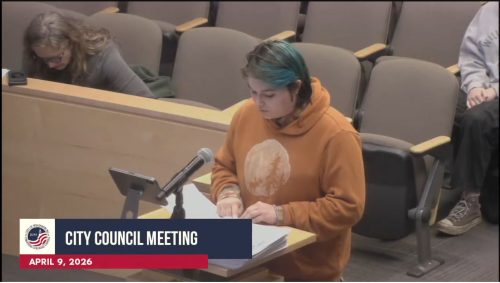
WILLIAMSBURG— During the April 9 meeting, eight individuals raised concerns about the safety of citizens from the Flock Camera License Plate Readers.
According to the city’s police, the use of Automatic License Plate Recognition (ALPR) Systems is primarily for identifying and locating stolen vehicles or vehicles involved in other criminal acts, such as child abduction and drive-by shootings. This is explained to work by recognizing, reading, and comparing motor vehicle license plates against various police databases much more efficiently than officers manually scanning and making comparisons while on patrol.
The Williamsburg Police Department leases access to two automated license plate recognition systems – Flock and Axon. The city explained in its policy that the Flock system consists of stationary mounted readers on poles with solar power, and the Axon system consists of ALPR intertwined in the in-car camera system mounted in police vehicles. A signed Memorandum of Understanding has been executed for both systems, designating responsibility for the safety and security, storage, and retention of collected data.
Flock describes its own cameras as license plate readers, which are motion-activated cameras paired with cloud-based software built specifically for public safety and security.
“I’ve come to speak on behalf of the over 1,400 William & Mary students who voted in opposition to Flock on William & Mary’s campus during a student referendum this March,” said Ella Forlin, who spoke during the city council meeting. Forlen also cited during the meeting that the referendum passed with 89% of student votes. “It is clear that thousands of your constituents are opposed to this technology. I for one oppose Flock due to data sharing concerns and concerns over vulnerable communities who will be and have been harmed by this technology.”
According to Virginia law, when using ALPR systems, the information is not subject to the Virginia Freedom of Information Act. Law enforcement agencies cannot share system data or audit trail data with, or disseminate such data to, any database of any other state, federal, private, or commercial entity. All data must also be permanently deleted after 21 days of the date of its capture.
“Through our conversations with Chief Butler, I know that the William & Mary police department is handling this data carefully and in accordance with the law. However, William & Mary police department scrutinize, and careful use of these cameras does not matter when our data as Williamsburg residents is shared with police departments who are not doing their due diligence,” said Forlin.
In a report from the American Civil Liberties Union (ACLU) Flock’s surveillance has been used by ICE and has been used to find a recipient of an illegal abortion.
Another article published in VPM talked about the different ways in which officers cite different reasons for investigating the same crime when supplying a justification for using ALPR systems.
“Flock has proven to be a valuable force multiplier for our department. At the same time, we take privacy concerns very seriously. Virginia has strict regulations on the use of such technology, and we follow all applicable rules and requirements. Our usage of Flock is carefully monitored internally,” said Williamsburg Police Chief Sean Dunn when asked for comment on the Flock Cameras.
“We review and require justification for every instance the database is accessed. Importantly, we do not share information with federal agencies or agencies outside of Virginia. Using this technology responsibly and protecting the privacy of our community are always top priorities. We have many examples of how this technology has allowed us to quickly identify suspects, resulting in a safer community for us all,” he added.
Currently, there are 32 Flock Cameras in Williamsburg.
In addition, during the meeting, over 500 pledge cards were presented by the Williamsburg Chapter of Virginia Organizing. The pledges came from citizens of Williamsburg and James City County who wanted to see the immigrant communities in the area safe and protected, and don’t want ICE in the community.
“There would be many more signatures if people were not scared to attach their name to something they believe in due to the fear of being targeted simply because their names may flag them as immigrants. Imagine being unable to use your right to petition because of this,” said Freddy van Voorhee, who spoke on behalf of the Williamsburg Chapter of Virginia organizing during the meeting.
“Campus safety is always a top priority. In a message to our community on March 5, Associate Vice President for Public Safety Cliff Everton detailed the university’s layered approach to campus safety and security measures. In those efforts, we are conscious of privacy concerns as well as the public nature of this campus and the necessity for broad situational awareness across our community,” said Suzanne Clavet, University Spokesperson & Executive Director of Media Relations, when asked about Flock Cameras.
No comment was given by City Mayor Douglas Pons or member Ayana Williams regarding Flock Cameras.
The next city council meeting will be on May 14 at 2 p.m. in the Stryker Center. For more information about upcoming meetings or to watch previous meetings, please visit the official website.

