


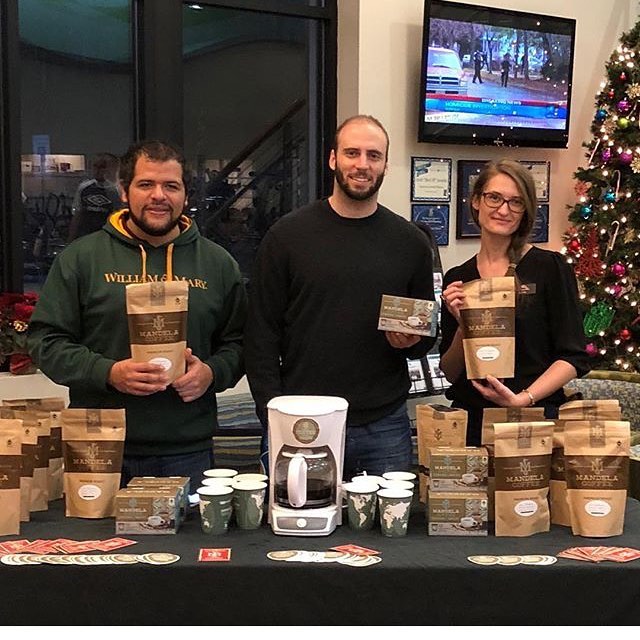
The next time you buy a cup of coffee, you could have the chance to support clean water projects in developing countries.
Mandela Coffee was founded by Cesar Murillo and Lance Zaal in May 2017.
A portion of Mandela’s profits are donated to Water Charity, a nonprofit that helps improve access to clean drinking water around the world. Water Charity claims to have benefited roughly four million people.
The idea came to Murillo when he was a Peace Corps Volunteer in Madagascar, between 2014 and 2016. Murillo worked in a town named Mahajoarivo, where he spearheaded construction of a well to supply villagers with sanitary water.
Before the well was built, villagers had faced severe water shortages, especially during the dry season.
“After a long day of working in the fields I would go and fill my water jug, and often the tap would be empty, it wouldn’t be running,” Murillo said. “I was fortunate enough to have a caring host family who gave me some water, but that’s not an option for 700 million people.”
While Mahajoarivo residents may now have a reliable water source, millions of people around the world don’t.
According to the U.S. Agency for International Development, nearly 800 million people worldwide lack clean drinking water, and the number continues to grow.
“It’s something that’s a problem I think can be solved, and that’s our goal,” Murillo said. “We want to reach as many communities around the world as possible.”
Murilo teamed up with Zaal and the Ignition Center, a business accelerator located on Richmond Road. Ignition offers free co-working space to entrepreneurs and upstart businesses, giving them tools and resources to turn their ideas into profits.
Murilo said that during business studies as an undergraduate, he learned companies put corporate social responsibilities at the bottom of the balance sheet.
However, at Mandela, “That’s our core mission,” Murillo said. “That’s our purpose for being a company.”
But to have money to donate, any company must first turn a profit.
“We realized that having a charitable mission, while noble, is insufficient,” Zaal said.
In other words, the coffee has to have the taste customers are looking for, at a reasonable price.
As a result, the duo has decided to blend premium coffee — and they believe their blend competes with the best on the market.
The beans are sourced from farmers in Columbia and Guatemala, Murillo said. Mandela uses fair-trade practices — meaning their production process is vetted to make sure farmers are paid well and don’t use child labor.

On its website, the company offers eight-ounce bags of coffee for $8.99. Twelve-ounce bags cost $12.99. Twelve-packs of biodegradable K-cups sell for $11.99.
“The customers are able to enjoy premium quality coffee and know that a percentage of their purchase is being used to fund waters in developing countries,” Murillo said.
Mandela has been selling coffee since late October, according to Murillo, and has already generated $2,000 in profits. By the beginning of the summer, their goal is to turn $5,000 a month in net profits, Zaal said.
To do so, they agree they’ll need to get on the shelves of area supermarkets, get more reviews for their product posted online and focus on marketing.
If they’re able to do that, they’ll be able to help provide drinking water to the needy— one cup at a time.
“We want to bring people from all over the U.S. and all over the world and help different communities out,” Murillo said. “What better way than trying to drink a quick cup of coffee?”
Editor’s Note: This story has been updated to note that a portion of the proceeds will be donated to charity. Based on information from the founders, the story originally indicated 10 percent of proceeds would be donated to charity.

