



December carries special significance for World War II veterans, as Dec. 7 marks the “day which will live in infamy”- the Empire of Japan’s bombing of Pearl Harbor in 1941 which brought the U.S. into the war.
This year, December is even more special for Ray Duley, a 98-year-old Yorktown resident who served in the Navy during World War II. Later this month, he’ll celebrate his 75th wedding anniversary with his wife Ruth, and she’ll celebrate her 100th birthday Dec. 8.
“It’s been a good journey,” Duley said in a recent interview. “[We] had a lot of years of happy living together. Had no complaints.”
Duley was born into a farming family in Indiana on March 22, 1919. He was one of seven children and worked as a farmhand until October 1939, when he enlisted in the Navy.
That was “right after Hitler jumped on Poland,” he said. “The writing was on the wall in terms of what was going to happen.”
Life at sea
Duley enlisted in the Navy, rather than being drafted into another branch of the armed forces. He wanted to be around the water and see the world, he said.
He got his wish.
By the end of December 1939, he was placed on the USS Vincennes (CA-44), a 10,000-ton, 588-foot-long cruiser. Before the U.S. had even joined World War II, the Vincennes had taken him to Cuba, the Virgin Islands, Bermuda, Iceland, Casablanca, New York City, Philadelphia, South Africa — and Norfolk, Va.
Duley served as Gunner’s Mate Second Class on the Vincennes, which was escorting British troops to Singapore on Dec. 7, 1941. The ship was in the middle of a storm when word reached the crew of the attack on Pearl Harbor.
The ship was then ordered to escort the British troops only as far as Cape Town, South Africa, before turning around and heading for New York City.
Duley and the USS Vincennes were now war combatants.

After a refurbishing in New York City, the ship was detached from the Atlantic Fleet and sent through the Panama Canal to serve in the Pacific, alongside the aircraft carriers USS Hornet and Enterprise.
One day out at sea, Duley and the crew were informed they would be aiding in the now infamous 1942 Doolittle Raid— the first aerial bombardment of mainland Japan by the U.S.
Duley also saw action in the Battles of Midway and Guadalcanal, where he and the ship’s other gunners provided anti-aircraft defense. For example, on Aug. 7, the Vincennes fended off a ferocious attack by 27 Japanese “Betty” bombers, shooting down seven.
“We were feeling that we could handle anything that they sent at us,” Duley wrote in a family memoir. “I suppose we were a little overconfident and didn’t realize what we were faced with.”
Less than two days later, during the morning of Aug. 9, 1942, Duley and the Vincennes crew faced disaster.
Under the cover of darkness, Japanese ships came within half a mile and the Vincennes took heavy enemy fire. After an order to abandon ship, Duley escaped as the vessel began to roll over.
He and a friend swam about the length of a football field to get to a life raft that was packed with injured American sailors.
Duley hung on to a rope attached to the raft and tread water all night. The next morning, a huge ship emerged from the fog.
“We didn’t know if it was our ship out there or a Japanese ship,” Duley said in an interview.
The ship began dropping depth charges— or antisubmarine explosives— to scare away sharks that smelled blood in the water, Duley later learned.
Fortunately, the ship was American. Duley was picked up after roughly ten hours in the water. According to the website The World War II Database, more than 300 of his fellow sailors from the Vincennes were killed and more than 200 were wounded.
 Afterward, Duley received survivors’ leave, and the Navy sent him to Philadelphia for the commissioning of his new light cruiser, the USS Santa Fe. During his holiday leave, he went to Boston and got married.
A blind date, a night of dancing, and a wartime marriage
Duley had met Ruth Garland in August 1940 on a blind date. Ruth’s family lived in Boston, and her sister Alvia was dating a man who was stationed on the Vincennes when it docked in Philadelphia. Alvia set up a double date and paired Ruth with another sailor. But that sailor was sent on emergency leave — and Ray took his place on the date with Ruth.
“He was a good friend — look what happened to me,” Ray said with a laugh.
Ray and Ruth spent the night dancing. They dated for nearly two-and-a-half years—corresponding and visiting each other when Ray was granted leave— until their wedding on New Year’s Eve in 1942.
Duley returned to combat days later, aboard the Santa Fe. After the war, he was honorably discharged in October 1945. Before long, he returned to the Navy and served until his retirement in June 1962.
Tending to his tomatoes and visiting Ruth
In October 1962, Duley took a job as a Nuclear Weapons Inspector at the Yorktown Naval
Weapons Station.
He and Ruth had two daughters, Nancy and Barbara. Ruth worked for the Fort Eustis

(Courtesy Barbara Duley Richards)
Transportation Center until 1975. He retired in 1976.
Even in retirement, Duley remained active in the military community.
He founded the Yorktown Branch of the Fleet Reserve Association in the 1970s, which represents the interests of veterans from the Navy, the Marines and the Coast Guard, and their daughters said Ruth founded the Ladies’ Auxiliary of the branch.
According to Branch President Gerald Chiappazzi, Duley is still heavily involved in the FRA to this day and has befriended many of the younger members.
“Everybody comes in and shakes his hand and he talks to them for a while, Chiappazzi said. “He likes to hear everybody’s war stories.”
In the Yorktown house where he’s lived since 1966, Duley still tends to his tomato plants and keeps things in “ship shape,” according to his daughters.
And while his hearing was damaged by the guns he manned during the war, he learned to read lips long ago and loves to talk with friends and family.
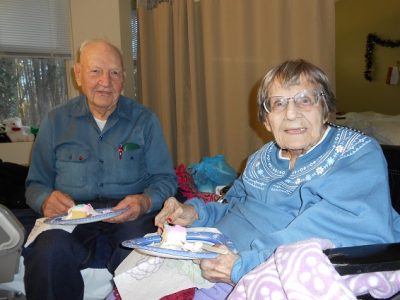
He visits Ruth every day for an hour or more, talking with her and bringing her favorite snacks. She has developed Alzheimer’s and lives in a nursing home, he said.
She has forgotten some faces, but not his.
“When he shows up— brilliant, she just lights up,” said Barbara Richards, their daughter.
Ray will be with Ruth to celebrate her 100th birthday Friday, along with his daughters and some members of the Fleet Reserve Association.
But he remains humble about his wartime experiences, and content with the nearly century-long life he’s lived.
“It’s been a good run,” Ray said. “If I had to do it over again, I’d do it pretty much the same.”

