


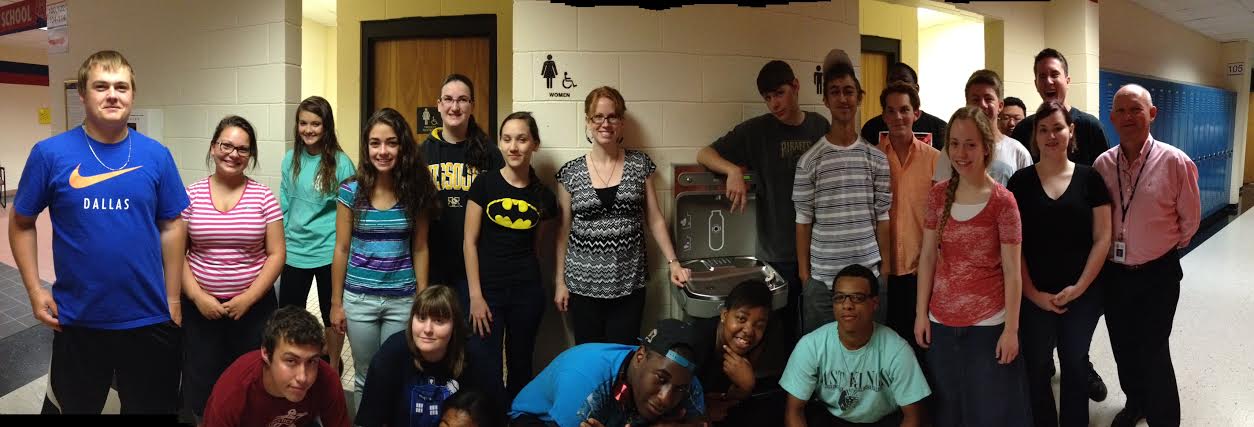
When Grafton High School’s environmental science students were taking out the building’s recycling, they made a surprising discovery: The school recycled an average of about 800 plastic water bottles per month.
That number did not include all of those that landed in the trash can.
Calandra Lake, who teaches two classes of environmental science students as well as earth science, wanted to help her students empower change in the school. Having learned about issues in pollution stemming from disposable water bottles, they were eager to make a change on a small scale in order to combat a global problem.

Lake had used a bottle-filling water fountain installed at the College of William & Mary’s recreation center, where she uses the gym facilities.
In addition to the spout as on a standard school water fountain, the station filters water before quickly filling bottles when they are placed under a sensor in the back of the unit.
Lake said the school’s regular fountains make it difficult to maneuver a refillable bottle under the water stream, and also fill bottles slowly. She thought the station would be a novel and convenient way to cut back on the disposable water bottles she sees throughout the building.
Lake presented the idea of a bottle-filling station to her students and they jumped to take on the project.
“They were actually really excited about it,” Lake said. “They loved the idea of something permanent in the building that was from their class, but that also capitalizing on that whole environmentally friendly scene.”
With a goal in mind, teacher and students set out to bring the fountain to a Grafton hallway.
Lake said a fountain like the one they wanted typically runs around $2,000. She approached Elkay Fountains, a company that produces them, about a possible discount for the school. Elkay offered a fountain for just under $500.
“I was very impressed and very grateful,” Lake said.
While she applied for and was awarded a mini-grant from askHRgreen.org – an initiative of the Hampton Roads Planning District Commission to encourage environmental practices in southeast Virginia – students set out to raise the remaining funds. Rather than trying to raise funds from within the school by selling candy bars or other products, which Lake said can be challenging toward the end of a school year, they turned to the local community.
Her co-educator Jim Bowling compiled a list of local business for students to contact, and they crafted donation request letters. In a collaborative project, with assistance from a Grafton English teacher, the students learned skills that went beyond the science project.
“I thought it would be good experience for the students, too, since they’re about to be going off to college [and] jobs, that they get some experience in the professional field,” Lake said.
Wayne Harbin Builder Inc. and Peking International Restaurant both came forward to close the funding gap for the fountain.
It was installed Friday, and by the end of the day Monday had prevented the use of 156 disposable bottles.
Lake has been excited to hear her students already talking up the fountain to their peers. She said they brim with pride that they helped bring it to the building and encourage classmates to bring reusable water bottles.
