

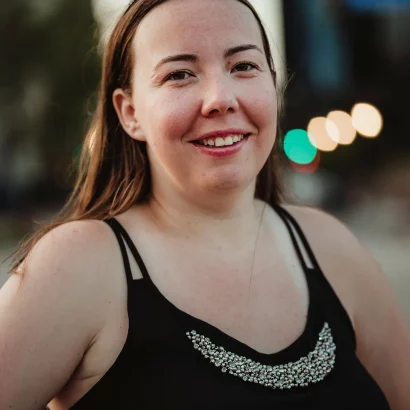

YORK COUNTY — Suzy Mink was just 25 years old when she was chosen as a torchbearer for the 1980 Lake Placid Winter Olympics.
After an application process that included an essay on how she embodies the Greek ideal of the whole man, an interview with the Director of the Torchbearing Relay and the Chief of Ceremonies, all judged by ten officials and a test run, Mink was chosen as a finalist.
In January of 1980, Mink was among a select group who had the honor of participating in the Olympic Torch Relay, which started at the base of the Coleman Bridge in Yorktown.
That year, the run began in Virginia, and Mink had the honor of being the first person to carry the flame once it arrived. Additionally, after the Olympic Committee met her, she was tasked with creating the relay route throughout the commonwealth.
“Not only was I a runner, but I helped design the route. They had a rough idea of how they wanted it to go, but I did a lot of reconnaissance on the route, including a lot of trips to Yorktown. I put together the dinner the night before with the Governor at Nick’s Seafood Pavilion. I was the only runner that was a part of organizing behind the scenes in addition to holding a full-time job,” Mink recalled.
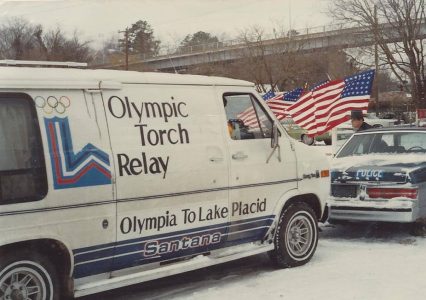
She was also one of four runners chosen as captains for the 1980 run.
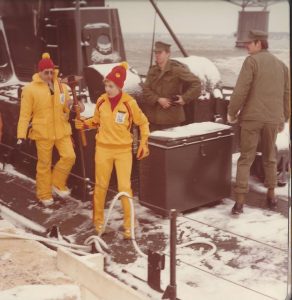
The day ahead of the run, a flame from the Athens Olympic cauldron was flown to Langley Air Force Base. It was then placed on a naval surface craft and sent up the river 21 miles to Yorktown, where the torch run kicked off. Along the route, the torch also made a stop in nearby Colonial Williamsburg.
Mink recalled the ceremony on the day the run started in Yorktown as nothing short of special.
“It was freezing cold and snowing. I get off the boat with freezing feet at the dock on the York River and the relay officially began. It was incredible,” Mink said.
From Yorktown, the torch traveled almost 700 miles over the course of nine days, when it was ushered into the Olympic Stadium in Lake Placid to light the cauldron for the two-week-long 1980 Lake Placid Winter Olympics.
Along the way, Mink said there was one instance that made her extremely emotional.
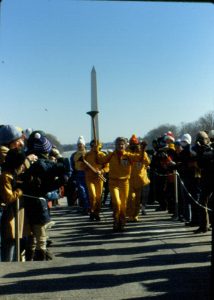
“We ran from Mount Vernon through the parkway in Alexandria across Memorial Bridge and up the steps of the Lincoln Memorial. Being the Virginia runner, I took it across the bridge, and came up around the steps of the Lincoln Memorial up to the top of the steps with a huge crowd and the only person I could see was my dad standing there,” Mink recalled.
The 1980 Games were notable for the Miracle on Ice hockey game between the U.S. Men and the Soviet Union. The U.S. team was an underdog in the competition, with only a few members having minor league hockey playing experience. The game came down to the final 12 seconds of play when Mike Eruzione scored, securing the victory over the heavily favored Soviets. The U.S. would go on to win the gold medal against Finland.
The U.S. ended the 1980 Winter Games with 12 medals, six of them gold. Mink attended each medal ceremony as part of the Torch Relay team.
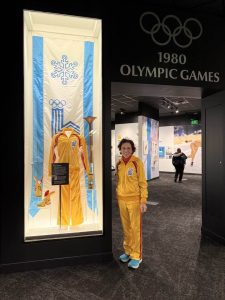
While 1980 was decades ago, Mink has not forgotten one of the most historical events of her lifetime. Wanting to pass on her experiences to the next generation, she donated one of her runner uniforms from the torch relay to the Lake Placid Olympic Museum.
To this day, Mink gets choked up about her experience.
“Along the route, it was just amazing to see all the different American people coming out to revel in the magic of the Olympic flame. There was something so magical and they were there just waiting as long as they needed to wait to see us come by,” Mink said.
To commemorate the 1980 Olympic Torch Run, a plaque was placed alongside Riverwalk Landing, close to the base of the Coleman Bridge. It is located near the site of the official starting line for the 1980 torch run.