


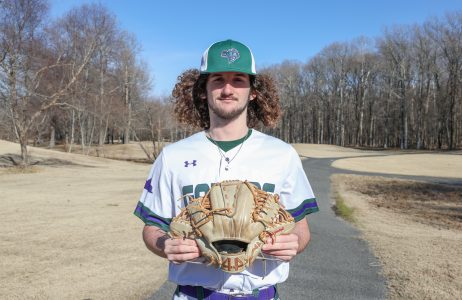
HAMPTON — Ambidextrous pitchers, those who can throw left-handed and right-handed, are rare and usually trace their talent to a childhood injury. Not so for Virginia Peninsula Community College’s Zack Easton, although he did break the pinky finger on his right hand as a youth.
While he didn’t say he was naturally right-handed, he did most things on that side as a
child, except for throwing a football.
“We always used to play football in elementary school, and I always played quarterback
lefty,” Easton said.
He then suffered an injury to his right hand.
“At that point, it was just like, ‘Oh, well, why not continuously use it?’” he said about his
left hand. “The only thing I’ve had trouble doing is trying to cut anything with scissors lefty.”
Easton soon discovered many things came naturally to him as a lefty and he’s been doing
both ever since. He can write with both hands but mostly uses his right. He eats with his left, shoots pool with his left and can shoot a basketball with both hands.
On the baseball field, he can also play shortstop and bats right-handed but will be
concentrating on the mound for VPCC. Coach Shane Harrison and his assistants discussed
having Easton play in the field in the fall but thought the team would benefit more by having Easton pitch.
“But once every week, once every week-and-a-half, he takes ground balls also, and
swings the bat a little bit just to keep him sharp, because we may need him there one day, too,” Harrison said.
Easton graduated from Hermitage High School in Richmond in 2021 and attended Paul
D. Camp Community College for two years. He was used sparingly as a reliever his first year and redshirted his second. He then took a gap year, during which he was a pitching coach at his high school alma mater, before joining VPCC in fall 2024.
He will graduate in May with a health science degree and is studying kinesiology.
Harrison plans to use Easton as a starter on weekends and a reliever, if needed, for
midweek games.
Easton must declare before each batter which way he will pitch.
The batter, if a switch-hitter, then gets to choose which side he wants to hit from. But Easton said he rarely switches sides from batter to batter. He’s more apt to do it between innings.
“It really all depends. If I get in a groove with one arm, then I’ll stay on that. But if not,
then I’ll just flip it around,” he said.
Most of the time it doesn’t cross the opponent’s mind that he can pitch from both sides,
he said, and it takes them a minute or two to realize he has switched when he does it between innings.
Harrison is fond of saying he’s getting two pitchers for the price of one in Easton.
A big advantage that might be overlooked, said his coach, is how being able to throw
with both hands affects his fielding.
“If there’s a close play at third (or first), instead of turning his body, he can just drop his
glove and throw with the hand already facing the base,” Harrison said.
Harrison, who has been involved in baseball for more than three decades, has never
coached or faced an ambidextrous pitcher before but has heard about a few.
Harrison said it takes time to get used to seeing Easton pitch from each side.
“It’s a sight to see,” he said. “It’s something (his teammates) like to see. I can only imagine what some of the teams are going to be like when they see it.”
For more information on VPCC athletics, visit vpccgators.com. For more
information on VPCC, visit vpcc.edu.

