


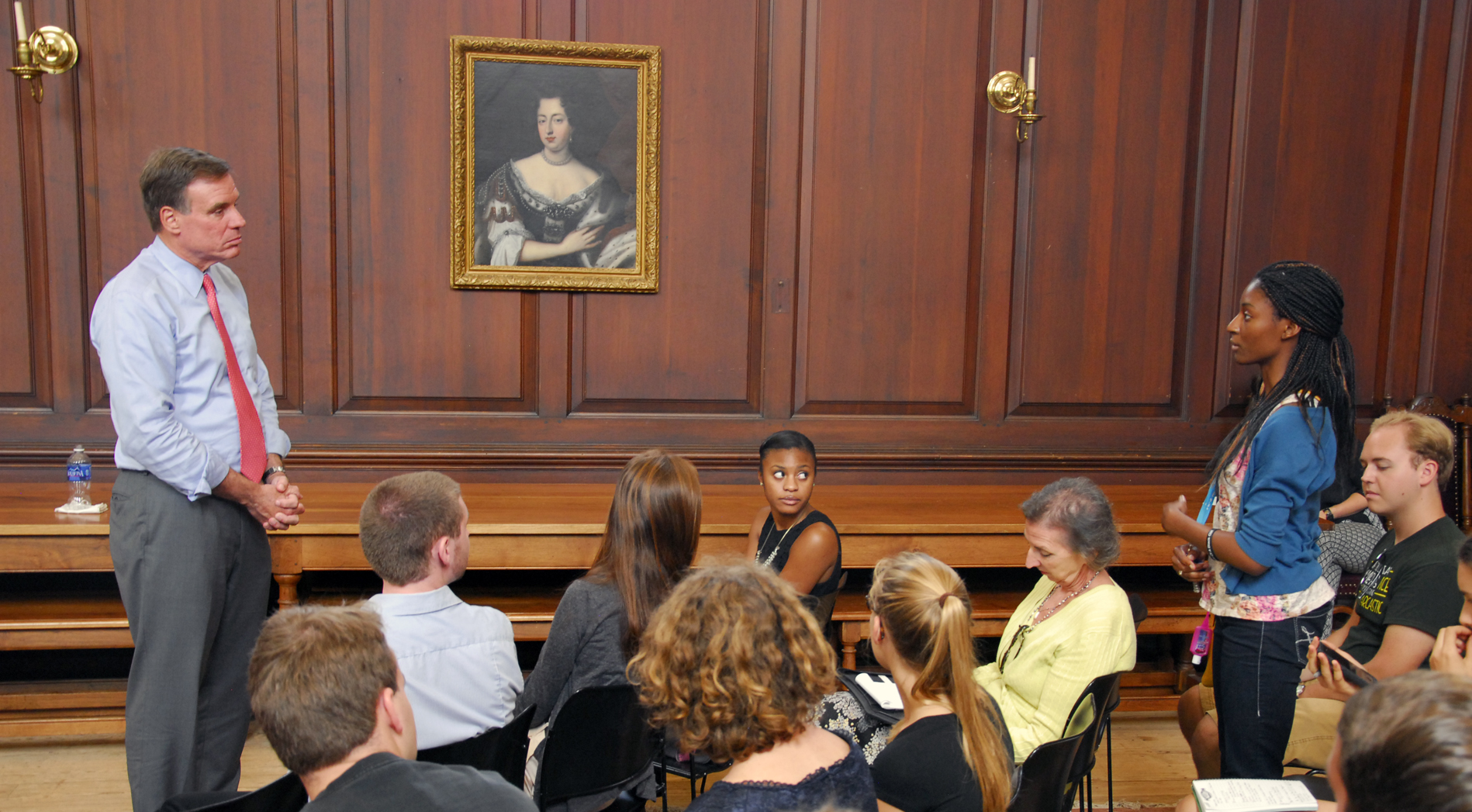
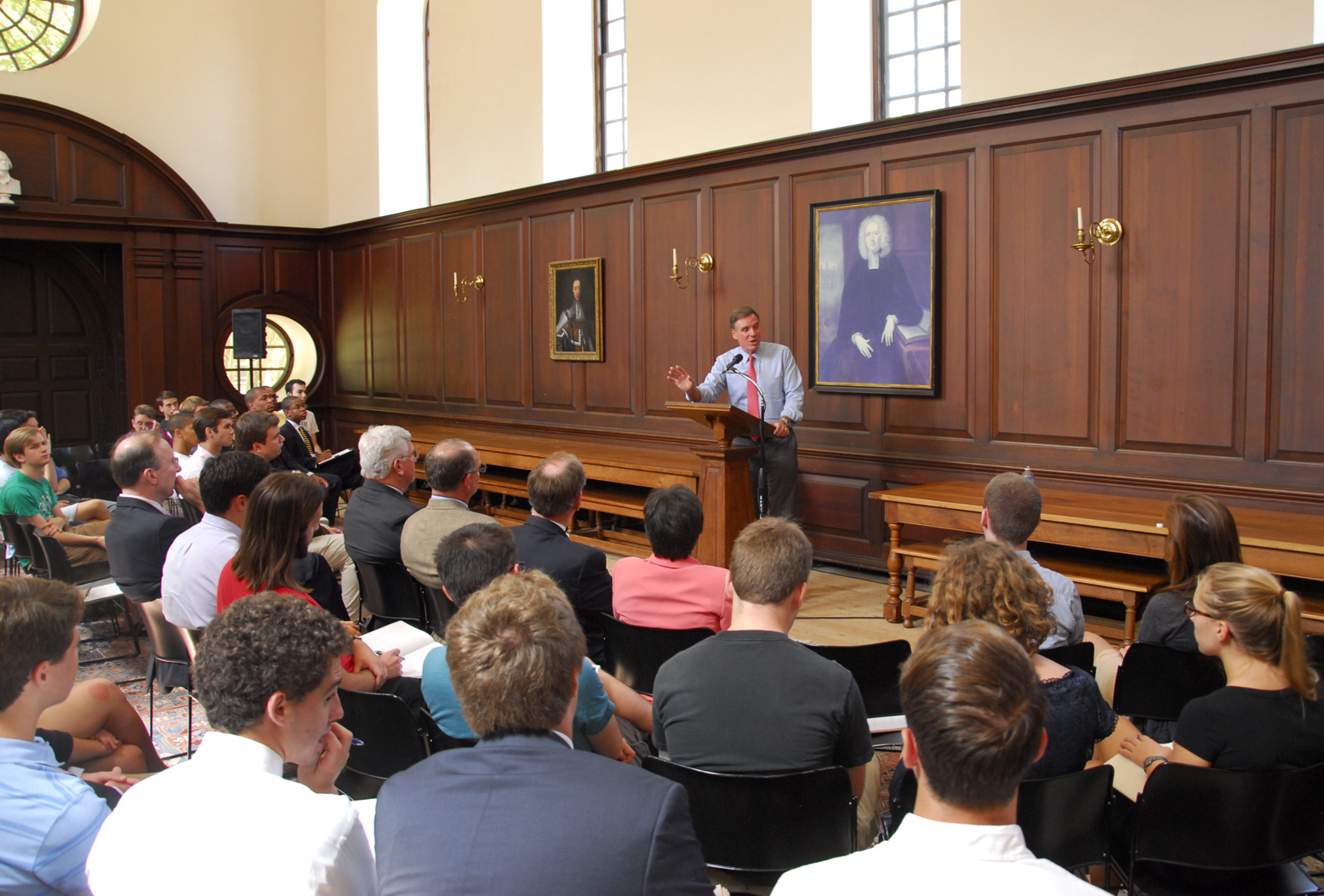
U.S. Sen. Mark Warner visited the College of William & Mary on Tuesday to talk student loan debt and the bills he has introduced to try to reform practices at the university and the federal level that contribute to the $1.2 trillion in student loans currently on the books.
The stop was part of his Tackling the Student Debt Tour, a three-day run involving numerous higher education institutions in the state. He shared details on the legislation he has introduced and then answered questions from William & Mary students in the audience, many of whom focused on how legislation could emerge from a politically gridlocked Washington, D.C.
Warner, who said he is a first-generation college student who graduated with $15,000 in student loan debt, said if he graduated today, the number would likely be much higher and he would not be where he is today. He said he hears more people discussing student loan debt than any other issue when he travels throughout the state and talks with his constituents.
In July, he joined U.S. Sen. Marco Rubio (R-Fl.) to introduce the Dynamic Student Loan Repayment Act, which would create an income-based repayment system that consolidates multiple loans into one and imposes temporary caps on how much income can be directed toward student loans to safeguard against periods of unemployment or low earning.
“If we found a way to refinance the banks, why not student debt?” he asked.
He said the law would allow more latitude for someone to try to create a business or to make investments in houses, cars or starting a family, saying economic recovery is jeopardized if too many people are bogged down with cumbersome loans.
Warner is also a cosponsor of the Student Right to Know Before You Go Act, a piece of legislation introduced in May 2013 that would require institutions of higher education to furnish data regarding graduation rates, student loan debt, employment prospects, potential future earnings and costs associated with attending that institution to a website where it would be easily accessible for people looking for schools.
“This should not be some mystery tour,” Warner said of looking for a school. “You should be able to Google the cost of a school.”
He said there is resistance to the legislation from some colleges and universities that do not want to publicize that kind of information but it is essential for people who want to make informed decisions about taking on student debt.
The Employer Participation in Refinancing Act, a bill partnering Warner with Sens. John Thune (R-S.D.) and Kelly Ayotte (R-N.H.), would offer a pathway for employers to pay down an employee’s existing student debt with pre-tax dollars.
One person in the audience asked about debt forgiveness for people who join service organizations like Americorps or Teach for America, but Warner said the funding levels make forgiveness “challenging.”
“Who is going to pick up the cost of the debt?” he asked before saying some loan forgiveness is a good idea in the cases mentioned by the student.
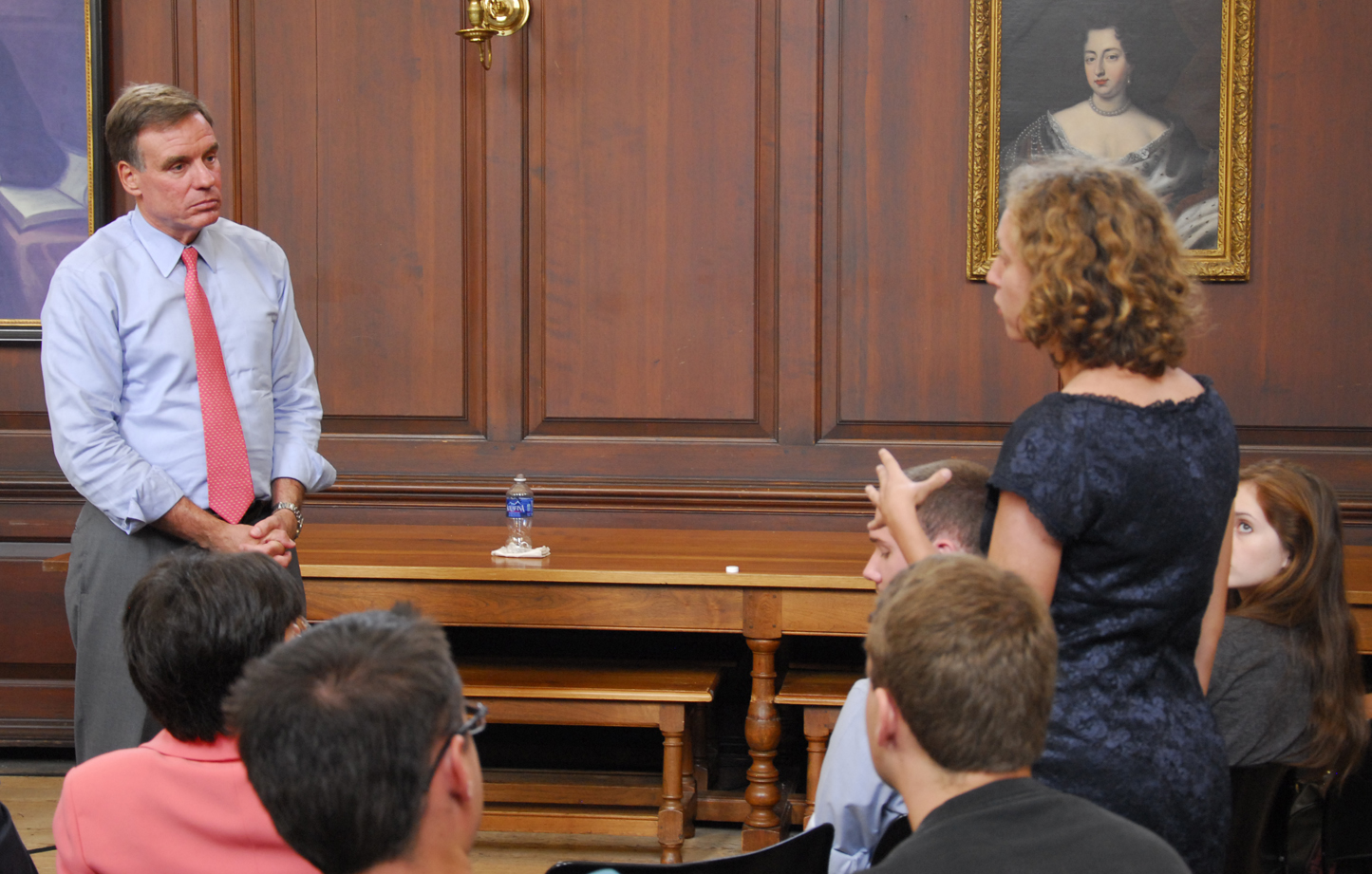
Another person asked about potential funding increases to higher education. Warner said he “does not see how it happens” with current revenue streams, saying a look at how resources are allocated might better serve institutions of higher learning.
He said it might be a disservice to students that their four years in college are likely better than the 10 that follow in terms of amenities, a condition he said is the opposite of his time in school, when the “dorms stunk and the food was awful.”
Prior to Warner’s remarks, William & Mary government major Jacob Deal, a former intern of Warner’s, spoke about how he is a first-generation student who is faced with student loans.
“Many of us have had to mortgage our education with student debt,” Deal said. “The only alternative to learning on credit is not going to school.”
Like Warner, Deal said student loan debt is a barrier to investing in a business and buying a car or house.
Warner said there is no Democratic or Republican solution to student loan debt, which recently surpassed credit card debt as the leading source of household debt in the nation.
After a student asked about how student loan debt is connected to the national debt, Warner said the tax code as it is currently written does not generate enough revenue. He mentioned soaring costs in Medicare and Social Security as the items prohibiting more investment in higher education, noting that little will change until Democrats are willing to reform entitlement programs and Republicans are willing to reform the tax code.
During a discussion of the current political landscape in Washington, Warner said he believes in independent redistricting committees for every state and the Supreme Court of the United States’ 2010 decision in a case that has come to be known as Citizens United — the decision prohibits the government from restricting certain political expenditures by corporations, unions and other associations — was the wrong decision.
Warner encouraged students to be active in the political process and to regularly vote.
“All you do by disengaging is turn the keys over to the extremes,” he said.
The three bills are currently being considered in Congress. The Dynamic Student Loan Repayment Act and Employer Participation in Refinancing Act are both in the hands of the Senate Finance Committee, while the Student Right to Know Before You Go Act is in the Senate Banking, Housing and Urban Affairs and Senate Health, Education, Labor and Pension committees.
The percentage of bachelor’s degree students graduating from William & Mary with debt appears lower than the state average. College Spokesman Brian Whitson referenced a 2013 State Council of Higher Education for Virginia report which said 43 percent of undergraduates from the school have student loan debt, with a median of about $20,000. He compared that to the state average of 57 percent of students graduating with a median debt of about $24,000.
Whitson also noted the U.S. Department of Education shows a student loan default rate of 0.8 percent for William & Mary, which he said is one of the lowest of any public four-year institution in the nation.
