


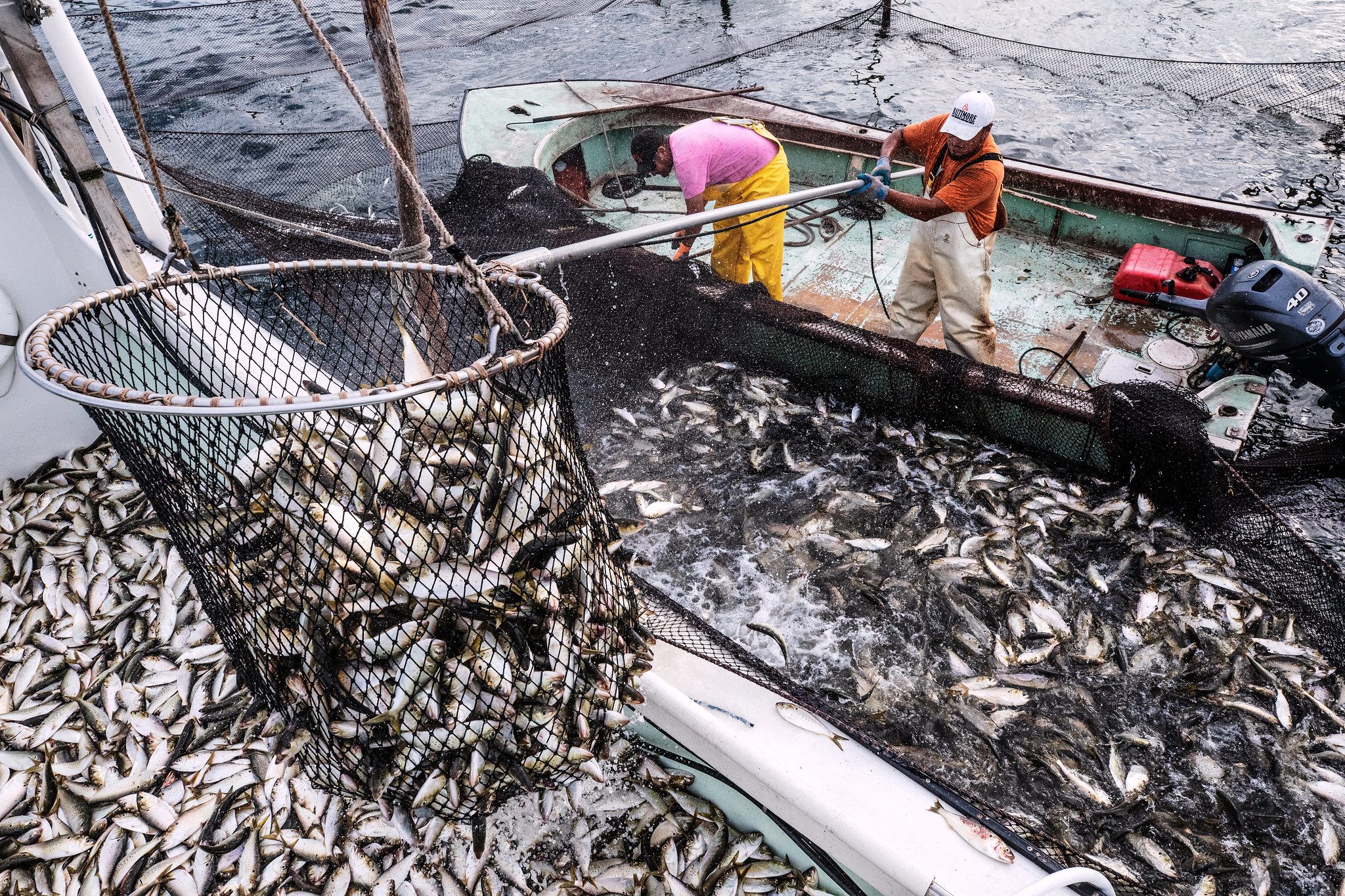
RICHMOND — Menhaden, the controversial oily fish, are making waves early in the General Assembly legislative session.
Three bills have been filed that would curb menhaden catches by the only reduction fishery allowed in the Chesapeake Bay and to study the population, which some conservation groups have said is declining in the Bay and spurring suffering among other species.
Ocean Harvesters, which contracts with Omega Protein, is a purse seine reduction fishery in Reedville, Virginia. They are the only reduction fishery allowed in the Bay, as surrounding states have banned that kind of industrial scale fishing. They frequently are blamed for the challenges posed to the menhaden population within the Bay.
Conservationists have been sounding the alarm over starving osprey populations, which researchers use as a proxy for menhaden as they are a key part of the birds’ diets.
Maryland members of the Atlantic Menhaden Management Board have also claimed that fewer menhaden have been able to travel up to their shores for fishermen to harvest in years past, a point that Ocean Harvesters has fiercely denied and said data does not support.
Del. Betsy Carr, D-Richmond, sponsored House Bill 1048 that would halt all purse seine fishing of menhaden in the Virginia portion of the Chesapeake Bay until it can be scientifically proven that the fishery does not negatively impact other fisheries or species that depend on the forage fish to survive.
Ocean Harvesters said that broad language could mean the fishery shutters permanently.
“The cost would be real and immediate in the Northern Neck, where these measures threaten hundreds of jobs for fishermen and plant workers, along with paychecks, benefits, and health insurance in a rural region with few comparable, full-benefit alternatives,” Ocean Harvesters said. “These bills would disproportionately hit a largely minority, union workforce and punish working families while ignoring the science-based management already in place.”
Carr’s other bill, HB 1049, would implement quota periods so that the amount the fishery is allowed to harvest, which is already limited by a specific cap of 51,000 metric tons, would be spaced out over certain times so that the menhaden could potentially move through the Bay.
The proposal is similar to a suggestion by the Maryland representative in the menhaden management board, which opted to restrict menhaden harvests by 20% along the entire East Coast.
“HB 1049 goes further than the Maryland delegation proposal by restricting rollover of unused quota between periods and layering on an observer requirement for a portion of trips, which are additional operational burdens without a clear conservation payoff,” Ocean Harvesters said.
Carr could not be reached for comment on her bills.
The General Assembly has attempted and failed to pass legislation in the past to conduct a Bay- specific study on the menhaden populations. There’s another attempt on the docket this year.
Sen. David Marsden, D-Fairfax, proposed Senate Bill 474 to establish the Atlantic Menhaden Research Fund to be used by the Virginia Institute of Marine Science to conduct the menhaden population study and report to the General Assembly each year.
“Directly and indirectly, menhaden are essential to the livelihoods of countless Virginia small businesses, families, and communities. Responsibly managing the fishery protects the menhaden industry’s own workers, who have the most to lose if the fishery collapses,” said Will Poston, the Chesapeake Bay Foundation forage campaign manager.
The three bills have not yet come up for hearings in the General Assembly.
Virginia Mercury is part of States Newsroom, a nonprofit news network supported by grants and a coalition of donors as a 501c(3) public charity. Virginia Mercury maintains editorial independence. Contact Editor Samantha Willis for questions: [email protected].

