


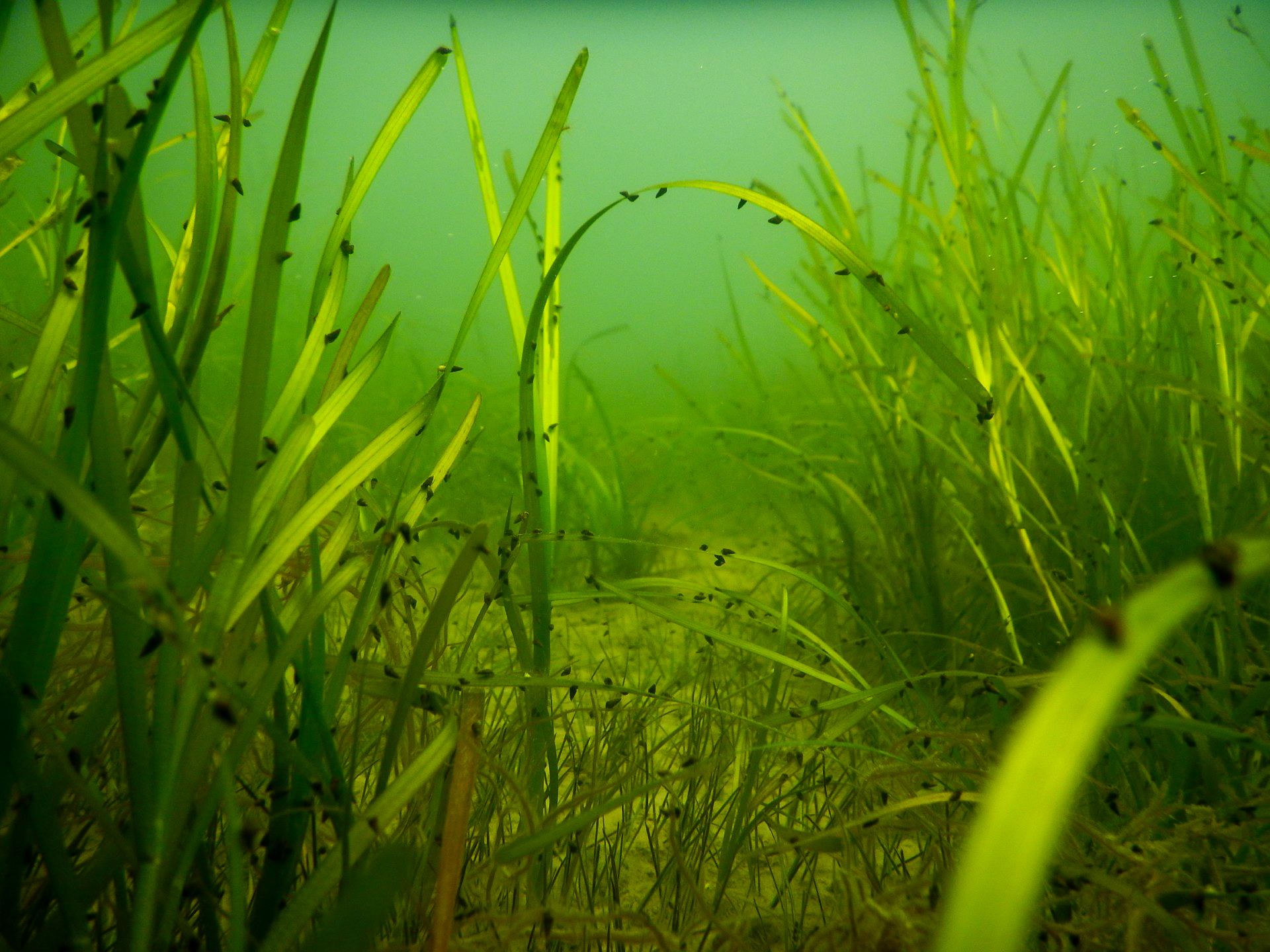
GLOUCESTER POINT — A new study from researchers at William & Mary’s Batten School & VIMS shows that a seagrass swap could have ecological impacts across the Chesapeake Bay’s food webs, fisheries and ecosystem functions.
Beneath the surface of the Bay, eelgrass is giving way to its warmer-water relative, widgeon grass. Published in Marine Ecology Progress Series, the study reveals that while both seagrass species offer valuable habitat, they support marine life in very different ways. Researchers estimate that the continued shift from eelgrass to widgeon grass could lead to a 63% reduction in the total quantity of invertebrate biomass living in seagrass meadows in the Bay by 2060.
“Several factors including water quality, rising temperatures and human development are threatening eelgrass in the Chesapeake Bay. In its place, particularly in the middle Bay, widgeon grass has expanded due to its ability to tolerate warmer, more variable conditions,” said Associate Professor Chris Patrick, who is also director of the Submerged Aquatic Vegetation Monitoring & Restoration Program at the Batten School of Coastal & Marine Sciences & VIMS. “However, the two grasses provide structurally distinct habitats that shape the animals living within.”
All grasses are not created equal
Lead author Lauren Alvaro and her team surveyed and compared habitats consisting of eelgrass, widgeon grass, as well as mixed beds in Mobjack Bay, documenting everything from burrowing clams and snails to crabs and fishes.
The findings showed that while widgeon grass supports more individual invertebrates per gram of plant material, eelgrass meadows are home to larger animals and have more plant biomass per square meter. As a result, eelgrass supports a greater total animal biomass per square meter.
“Our findings suggest that we’re likely to see a fundamental shift in the structure of the food web that favors smaller creatures as eelgrass is replaced by widgeon grass,” said Alvaro. “The eelgrass meadows produced fewer animals, but they’re bigger and more valuable to predators like fish and blue crabs.”
The bigger picture
The researchers estimate that current seagrass habitats in the Chesapeake Bay support approximately 66,139 tons of invertebrate biomass living in the sediment and amongst the grass beds and produce 35,274 tons of new animal biomass each growing season. Termed “secondary production,” this is the biomass the habitat makes available to higher levels of the food chain, VIMS said.
If seagrasses continue to shift as expected, by 2060 secondary production could be reduced by more than 60% if nothing is done to limit nutrient runoff into the Bay — the largest threat to submerged aquatic vegetation. Even in a best-case scenario, VIMS said the Bay could still lose approximately 15% of secondary production biomass.
“Within the limits of our study, it wasn’t possible to determine whether it was the meadow’s physical structure, the meadow area, or available food sources that contributed to greater numbers of fish in the eelgrass meadows,” said Alvaro. “This makes it difficult to accurately estimate fishery-level impacts of changes in meadow composition, but several lines of reasoning support an expectation of reduction in numerous commercial and recreational species.”
As states within the Bay’s watershed work to maintain and improve the health of the estuary, the team hopes their findings will help inform management decisions and restoration strategies.
Visit the website for the SAV Monitoring and Restoration Program for more information about seagrass research at the Batten School & VIMS.

