


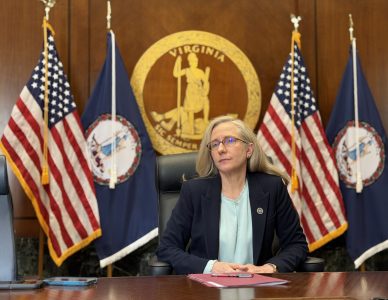
Gov. Abigail Spanberger is stepping directly into the regulatory fight over the proposed $67 billion sale of Dominion Energy to Florida-based NextEra Energy, becoming the first Virginia governor to formally intervene in a case before the State Corporation Commission.
Spanberger announced Thursday that she will seek intervenor status in the case, giving her administration the ability to question both companies, review documents and argue for conditions related to customer electric bills, Virginia jobs and the state’s energy future.
“The action of actually formally intervening, it is an unprecedented one as a governor, I do acknowledge that,” Spanberger told reporters during a Zoom call Thursday afternoon. “But frankly, the size and scope of this merger application is also unprecedented.”
Spanberger said she decided to intervene after reviewing the companies’ application and hearing from Virginians concerned about what the transaction could mean for the commonwealth. If approved, the deal would place Virginia’s largest regulated electric utility under the ownership of an out-of-state company.
The move does not give the governor the authority to approve, reject or rewrite the merger. Those decisions remain with the SCC, the independent regulatory body responsible for determining whether the transaction serves public interest.
“The decision to approve or deny, or potentially put a whole new set of parameters in place or offer a whole new set of parameters of a potential deal to Dominion and NextEra, that authority still lies with the SCC,” Spanberger said.
But intervening will allow her administration to submit questions and raise concerns that Dominion and NextEra must answer as the commission reviews the proposal, she said, a process that’s now underway with regulators expected to approve or reject the deal in about six months.
Other individuals and organizations may also seek intervenor status.
What Spanberger wants from the deal
Spanberger first disclosed her plans Thursday morning in an op-ed published in The Washington Post, writing that she is “deeply skeptical” that selling Virginia’s primary regulated electric utility to an out-of-state company would benefit the commonwealth.
“I have serious questions about what this deal would mean for us,” Spanberger wrote. “And as governor, I intend to get answers and be a voice for Virginians in the process.”
On the afternoon Zoom call, she said she’ll judge the process by three key questions: Whether it lowers customers’ electric bills, protects Virginia jobs and keeps the state moving toward reliable, locally produced clean energy.
Any approval, she said, should include a “substantial financial benefit” for customers. Rising electricity costs remain one of the most common concerns she hears from Virginians, she said.
She also said that protecting Dominion’s Virginia-based workforce — from lineworkers across the state to employees at the company’s headquarters in Richmond — will be central to her review.
Spanberger is also seeking assurances that a combined company would continue investing in projects already underway, including Dominion’s offshore wind development off the coast of Virginia Beach.
“Virginia is home to the largest offshore wind development that we are seeing on the East Coast,” she said. “That’s a point of pride for many Virginians, and any company that might be inclined towards buying Dominion Energy would have to ensure that they also prioritize extraordinary investments, but extraordinary projects like that one.”
Dominion and NextEra filed their merger application with the SCC on July 15, formally launching the commission’s review.
Under the all-stock agreement, NextEra shareholders would own 74.5% of the combined company, while Dominion shareholders would own the remaining 25.5%.
The merger would create the nation’s largest electric utility, serving roughly 10 million customers in Virginia, Florida, North Carolina and South Carolina. Together, the companies would control about 110 gigawatts of generating capacity and a large-load interconnection queue totalling another 130 gigawatts.
The companies have proposed $2.25 billion in shareholder-funded bill credits for customers across Dominion’s three-state service territory. Those credits are intended to offset merger-related costs for two years, although whether customers would see additional long-term savings remains unclear.
The transaction also requires approval from regulators in North Carolina and South Carolina, along with the Federal Energy Regulatory Commission and the Nuclear Regulatory Commission.
Last month, Republican Sen. David Suetterlein of Salem and Del. Joe McNamara of Roanoke County called for a special legislative session to consider extending Virginia’s review period. They argued the state could lose negotiating leverage if its regulators act before officials in other states complete their reviews.
Both lawmakers renewed their call following Spanberger’s announcement Thursday, arguing that her intervention alone would not give regulators enough time to scrutinize the deal.
“Adding another party to a rushed decision doesn’t help Virginia’s working families,” they said in a joint statement, calling the governor’s plan “improvised and constitutionally uncertain” while noting that the SCC would still have fewer than 180 days to review what they described as the largest proposed utility merger in U.S. history.
Suetterlein and McNamara said Spanberger’s “best and plainest lawful option” is to call lawmakers back to Richmond to extend the review period, an approach they said has support from Republican and Democratic legislators, a former Republican governor and Lt. Gov. Ghazala Hashmi.
Linking the merger to affordability
Spanberger said Thursday her merger review fits into her effort to hold down energy costs, pointing to more than a dozen energy-related laws she signed this year.
Among them is a new energy-consumption tax intended to ensure data centers shoulder more of the costs associated with their enormous demand for electricity.
Her announcement came a day after the SCC directed Dominion to develop a new rate structure that would shift more of the cost for future transmission infrastructure onto data centers and large-load customers requiring those upgrades.
Spanberger’s administration had urged the commission to avoid placing those costs on residential ratepayers.
Dominion has more than 200 transmission projects planned or under construction as it expands Virginia’s electric grid to meet demand from the state’s more than 600 data centers.
Spanberger said she expects to formally intervene in the coming days before submitting questions and other filings for the SCC to consider.
“For me, the priority is to be able to build upon the work that I have been doing as it relates to energy affordability,” she said.
Virginia Mercury is part of States Newsroom, a nonprofit news network supported by grants and a coalition of donors as a 501c(3) public charity.

