


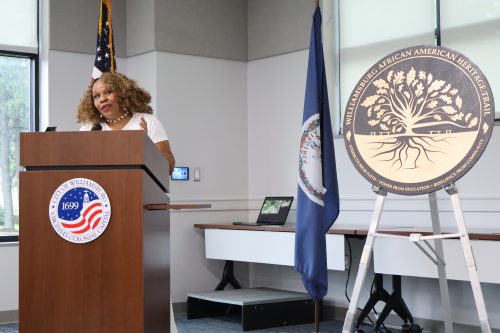
WILLIAMSBURG – Even as rain fell throughout the morning, the African American Heritage Trail groundbreaking on June 19 drew a strong community turnout inside the Williamsburg Police Department community room.
The indoor “groundbreaking” opened with a welcome from Williamsburg City Manager Michele Mixner DeWitt, followed by remarks from the Rev. Reginald F. Davis of Historic First Baptist Church.
“We hope that this African Heritage Trail will be one of information and one of inspiration, but let us all remember that we are all God’s children and from one blood he made all nations and people,” Davis said.
Plans for the trail date back to 2020. Funded by a $357,000 federal earmark, it includes a trailhead at Lafayette Street, a public restroom, and the trail’s first stretch, from Lafayette Street to Scotland Street. The city estimates the total cost of the project to be about $2.75 million and has secured $875,350 in funding.
Remarks were also given by city Mayor Douglas Pons, Colonial Williamsburg Foundation CEO Carly Fiorina and Fanchon Glover, senior advisor to the William & Mary president. The keynote speaker was Johnette Gordon Weaver of the African American Heritage Trail Advisory Committee and a member of the Williamsburg Descendant Community.
“I grew up riding my bike out of that neighborhood that was all-Black into the historic area … being told sometimes by visitors to the town that I don’t really belong over there, and now, there’s a trail that tells the story,”Weaver said. “This trail proves that we are one Williamsburg.”
Fiorina echoed that sentiment in her own remarks.
“[This trail] is a permanent public reminder, an inescapable truth that we must tell the whole story. Nostalgia is not history, propaganda is not history, history is history, and to tell history we have to tell the whole story,” she said.
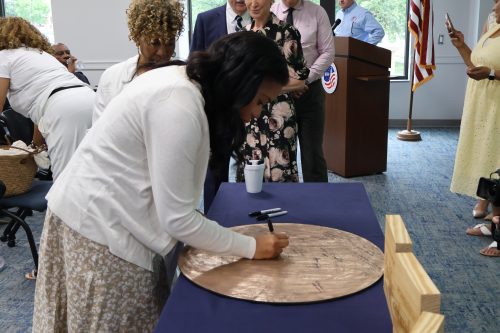
Because of the weather, the traditional outdoor groundbreaking was moved inside. A bronze trail marker was instead turned so both dignitaries and community members could sign it as part of the ceremony.
After the groundbreaking, attendees were invited to First Baptist Church for a reception and to try the virtual version of the trail, designed for those unable to walk it in person.

