


WILLIAMSBURG — The Library of Congress has acquired twenty photographs created by William & Mary Professor Eliot Dudik for its permanent collection.
The photographs collected were part of two different collections, “Broken Land” and “Paradise Road.” Ten pieces from each collection make up those selected for admission to the library’s permanent collection.
Broken Land
“Broken Land” was taken between 2011 and 2016. While all of the images were taken on Civil War battle sites, Dudik says the photos were not about the battlefields themselves.
“They were intended to consider the divisions that existed in the country, in the U.S. at the time that I was making that work and comparing it to what led up to the American Civil War,” he explains. At the time, he had been traveling around the South. “I was quite startled by the anger that I was witnessing and people that met, and trying to understand and wrap my head around the divisions that existed in the country then, and, you know, the seethingness that I experienced then, was what was the impetus for that work. Really trying to understand where that division came from, what it was exactly, and where it was heading.”
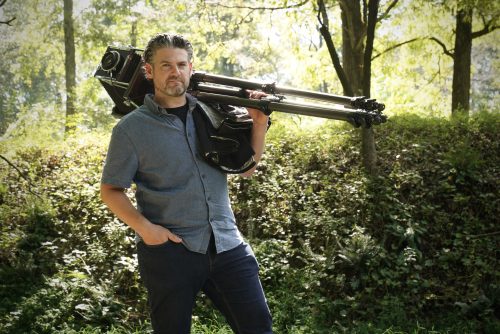
The photos were taken with a Banquet Camera, which Dudik explain was typically used for taking pictures of large groups of people in the 20th century. The film used inside the camera is large, and he notes that, as such, photos can be printed large, and that is how the photos are typically exhibited. This intention is for people to feel like they can walk into the landscapes.
View “Broken Land.”
Paradise Road
Around the same time — 2013 to 2018 — Dudik started working on “Paradise Road.” The series features different places across the nation that were called Paradise Road, highlighting that there is no one definition of paradise.
While Dudik said he didn’t set out to photograph every single road called Paradise Road in the country, he did want to photograph a lot of them. He also wanted to make sure he got photographs from every region of the country, which he accomplished.
“I expected to find a lot more diversity when I started the project. I expected to find a very different scene and very different people in all the different places I was going to go, but I was surprised to find it was more the same than different,” Dudik said, noting most of the photos were from rural areas.
Similar to “Broken Land,” this collection was also made with a large-format film camera, using one sheet of 8-by-10 film. He said the process was very slow and meditative, as well as contemplative and expensive.
View “Paradise Road.”
Photograph Production
With both collections, Dudik only took one photograph at any one place. He spent a lot of his time, be it on a battlefield or on the Paradise Road, wandering and considering what one photo would represent that place.
“One of the interesting things about both of those projects is that it allowed me to travel all over the country and meet people and see places that I wouldn’t ever see otherwise, because it kept me off the highway,” Dudik said.
Dudik does the vast majority of his work himself, something he said is not common. The only thing he doesn’t usually do himself is develop color film. He said he usually sends his color film to New York to develop and then the film is sent back to him.
All of the work in “Paradise Road” and “Broken Land” was drum scanned, a process which he explained is the highest quality scan one can make and something he also does himself in his own studio. He also does his own color balancing, color toning, printing and framing.
The Acquisition
The acquisition of Dudik’s works by the Library of Congress was something he said was many years in the making. Around 2019, the photo curator from the library reached out to him after seeing his work at an exhibition in Colorado. Shortly after, Dudik was told they were interested in the pieces from “Broken Land.”
“[The curator] was interested in that work specifically, but he was also interested in other things that I’d been working on. So at that point, it was kind of difficult to determine what exactly to bring up there for our first meeting. So I brought a heavy-duty cart, because I anticipated trying to drag many boxes of prints and books and things across Washington, D.C. to try and get to the Library of Congress to sit down and share with him various prints from various bodies of work, and that’s what I did,” Dudik recalled.
“I got this cart and I had, I don’t know, six or seven boxes of prints and books and stuff, and drug it across D.C. up to the Library of Congress building, I sat down with him for several hours and went through things and then things just slowed down with the pandemic in terms of zeroing in on exactly what they wanted and it was kind of a slow process, moving back and forth,” he added.
Finally, in 2025, the acquisition took place. The final bits of paperwork were finished and was completed in late spring. He spent most of the summer making the prints for the library and sending them off, though Dudik said he wasn’t sure if they’re available to the public yet.
For more information about Dudik and his works, visit his website.

