


August 1 will mark the end of a musical era and the start of a new one in Colonial Williamsburg.
Decades after the museum’s tavern balladeers program started, the group of musicians has been replaced with a tavern musical troupe. While the differences may sound minor, the new programming will be a slimmer version of the former program.
Over the past month, Colonial Williamsburg has phased out more than a dozen balladeers, who worked for the foundation as private contractors entertaining tavern guests.
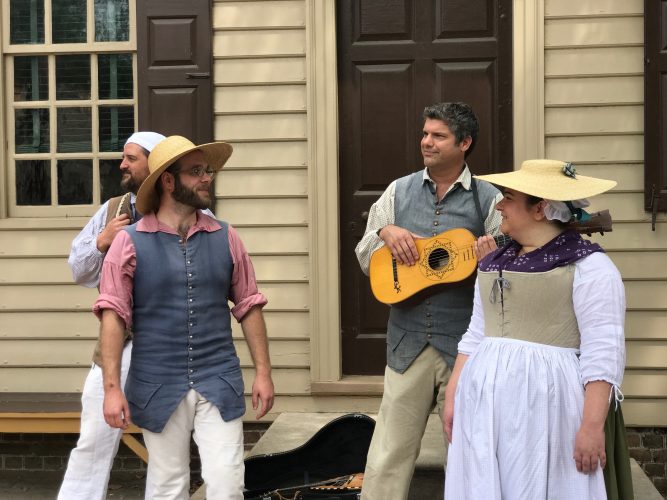
The new troupe playing the taverns — The Watermans — will perform the same tunes diners have come to expect, but will move from tavern to tavern every half hour, according to a Colonial Williamsburg news release.
The former balladeer program was staffed by contract workers, which means transitioning to the new program did not require an official layoff or firings. Colonial Williamsburg did not give an exact number of contract workers involved in the more than 40-year-old program, but a petition circulated when the changes were first announced stated there were 21 balladeers.
The new musical ensemble has five full-time members who play a variety of instruments. One of the job requirements for the new staff includes the study 18th-century Virginia musical history at the Rockefeller Library in the Bruton Heights Complex, said Ted Maris-Wolf, vice president of education, research and historical interpretation at Colonial Williamsburg.
Emmy Award-winning troupe leader Wayne Hill called the structural changes an evolution of “Colonial Williamsburg’s musical needs.”
“The idea of having an ensemble provide that music, day in and day out, was an opportunity that I strongly wanted to be a part of,” Hill said. “We won’t be coming in the dining rooms in the manner that we did in the taverns in the past. It will be less obtrusive.”
But former balladeers such as David Gardner, a 49-year-old school teacher who played at Colonial Williamsburg for 25 years, say the move is detrimental not only the way they view historic interpretation in Colonial Williamsburg, but to their pocketbooks.
“The Balladeer income was approximately one third of my income,” Gardner wrote. “It will impact me and my family pretty severely.”
Gardner is concerned the changes will stop the “high quality accurate historic music” guests to the taverns have come to expect over his 25 years playing.
His concerns and outrage at the programming change were shared by scores of people on Facebook after the Foundation wrote a post about open positions for the new troupe.
“Know someone with a flair for 18th-century entertainment? A ‘triple threat’ who can sing, act, and dance? Steer them our way,” the Facebook post read.
Over 100 comments criticized the Foundation for its decision to change the program. Adam Queen, one of critics of the change, said he was privileged to have seen the balladeers in action.
“This is ad is sad,” Queen wrote on the post. “To some it may seem an amazing opportunity for your actor/actress friends but the truth is this means the end of the Ballader [sic] program. A program which has had talented musicians who not only knew their tunes and put on amazing shows over some 40 plus years but also knew their history.”
Maris-Wolf said the shift from the balladeer program to the new troupe was a natural and more efficient evolution of the Foundation’s musical interpretation.
“There’s certainly efficiencies in scheduling and cost, but it goes hand in hand with our guest experience and core educational mission,” Maris-Wolf said.
The changes come on the heels of structural reshuffling throughout the Foundation, and could save the organization money as it faces a tough financial outlook. In 2014, the foundation lost a total of $62 million, or $176,000 every day, Foundation president Mitchell Reiss said.
The Foundation announced Friday the troupe is still looking for an additional musician interpreter to round out the group’s sound.
Regardless of the number of interpreters, Maris-Wolf said he’s hopeful that making historic musical research part of the job requirement will create a more educational experience for visitors to the Historic Area.
“Guests will get to experience a group of musicians who are rehearsing, researching, and growing together as a group,” he said. “This is a new kind of experience in our tavern. It will evolve. They will evolve. We’re all excited to see where it goes.”

