


WILLIAMSBURG – A review of student technology use in Williamsburg-James City County schools shows devices are used in most classroom instruction, but officials say the focus should remain on how technology supports learning rather than screen time totals.
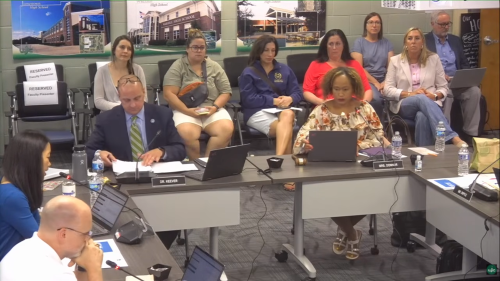
Officials presented the findings during the School Board’s June 2 work session. The review was conducted as part of Superintendent Daniel Keever’s Transition Plan.
Keever said conversations about student screen time locally and across Virginia prompted the division to take a closer look at how technology is being used in classrooms.
“Great teaching remains the most important factor in student learning,” Keever said. “No device, software program, or digital platform can ever replace the expertise, relationships and instructional skill of a highly effective teacher.”
Robin Ford, director of elementary curriculum and instruction, said the review focused not only on the amount of screen time students experience but also on how technology is being used and whether it supports instructional goals.
Tech in classrooms
The one-to-one device program, which provides students with individual devices for classroom learning, began at Toano Middle School in the 2014-15 school year and has since expanded. During the pandemic, all WJCC students received devices to support remote learning.
Today, elementary students use tablets that remain at school, while middle and high school students are issued laptops for use both at school and home.
Ford said technology is integrated into Virginia’s Standards of Learning and is used to support research, writing, collaboration, communication, coding, data analysis and project creation across multiple subjects.
What the data showed
As part of the review, school officials collected feedback from students and teachers, conducted classroom walkthroughs and analyzed browser-based usage data from more than 10,500 student devices.
Technology was used in 82% of the 101 classroom lessons observed, with most use occurring in short intervals of 6-15 minutes. Off-task or passive device use was observed in fewer than 10% of classrooms.
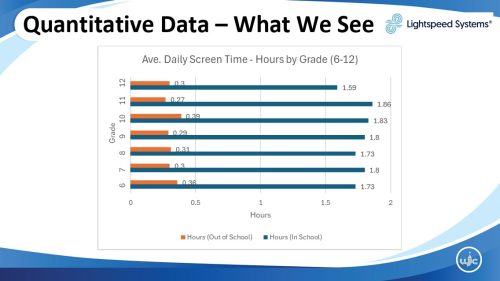
Browser-based activity data showed elementary students averaged less than 90 minutes per day on school devices, while middle and high school students averaged less than two hours daily.
Officials cautioned that the data does not include time spent using programs such as Microsoft Word, coding applications or graphic design software.
“Context matters,” Supervisor of Instructional Technology, Innovation and Information Literacy Kristin Barr said, emphasizing that the purpose and quality of technology use are more important than total screen time.
Student and teacher feedback
According to the research, teachers reported that programs such as Canvas help students quickly access instructional materials. However, some educators noted inconsistent expectations for technology use and intervention programs.
Students shared mixed opinions about classroom technology, according to Barr. While many appreciated Canvas for organization and document storage, some secondary students said technology use varies significantly from class to class.
They said students also indicated that creative and inquiry-based activities were more meaningful than digital worksheets.
School Board Chair Andrea Donnor said technology affects students differently depending on their individual needs.
“You’ve got to understand, like each kid is different and technology might detract for one child, but it might be supportive and make the curriculum accessible for another child,” she said.
Donnor cited her own experience as a parent of a child with dyslexia, noting that digital tools can help students access learning materials through text-to-speech functions, enlarged text and other accommodations.
Keever said the division plans to continue refining its approach to technology use.
Future steps include expanding digital citizenship instruction, providing additional teacher professional development, continuing classroom observations and forming an instructional technology focus group that includes staff, administrators and families.
The division also plans to clarify expectations for classroom device use, encourage a balance of digital and hands-on learning, and launch an awareness campaign promoting the Lightspeed Parent Portal, which allows families to monitor student device use outside school hours.
“This review was never about proving technology is good or bad,” Keever said. “It is about ensuring that technology is being used appropriately, intentionally and in a manner that best supports teaching and learning for our students.”

